Your digging level
Description
World fusion is a broad, exploratory approach that blends musical traditions from different cultures with contemporary forms such as jazz, rock, ambient, and electronic music. Rather than being tied to a single folk lineage, it privileges hybrid instrumentation, modal and rhythmic vocabularies from around the globe, and collaborative performance practices.
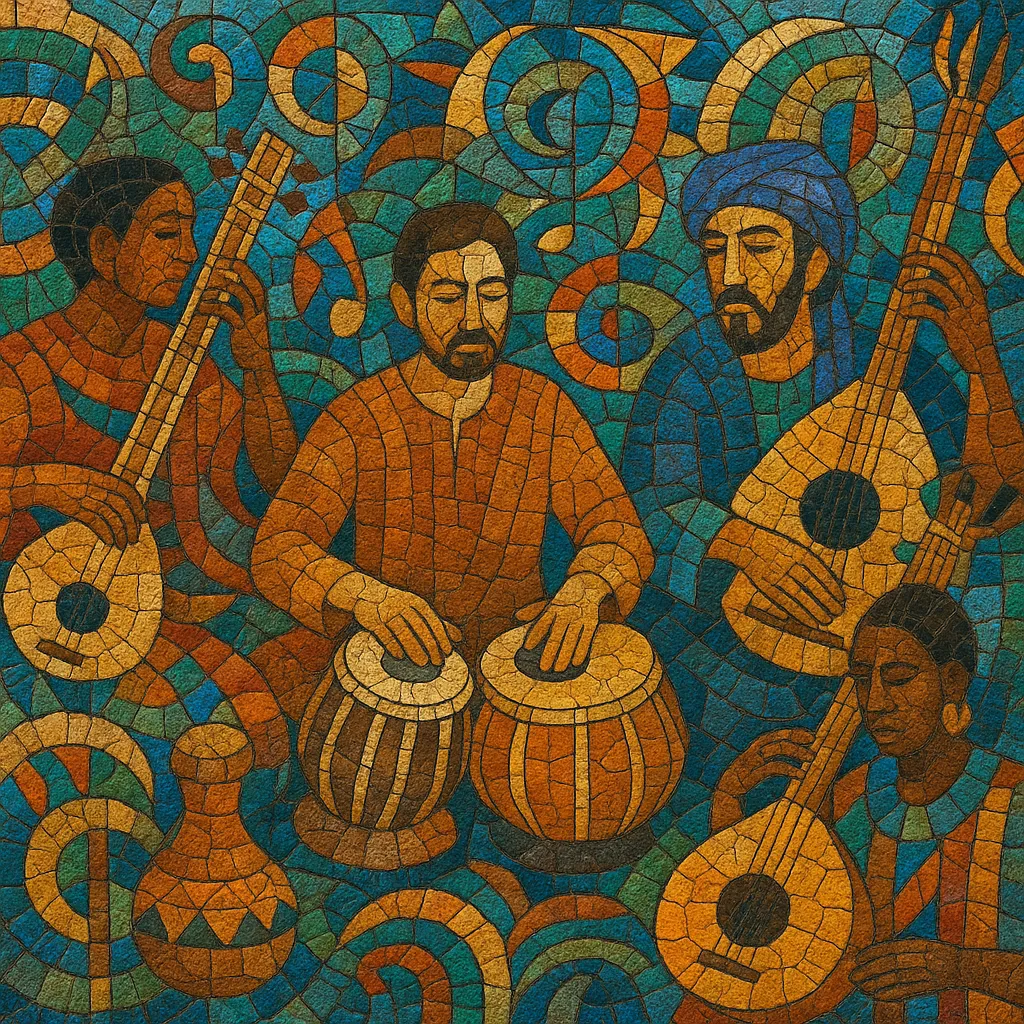
Compared with the more pop-oriented worldbeat, world fusion tends to be more improvisational, texture-driven, and studio- or ensemble-focused. It commonly juxtaposes instruments like oud, kora, sitar, tabla, duduk, and frame drums with electric guitar, synthesizers, and jazz rhythm sections, often emphasizing modal harmony, drones, polyrhythms, and odd meters.
History
World fusion coalesced in the 1970s as jazz improvisers and adventurous acoustic ensembles sought sustained collaboration with non-Western traditions. Pioneering groups such as Shakti (John McLaughlin with Zakir Hussain and L. Shankar) and Oregon (with members versed in jazz, classical, and Indian instruments) set templates for modal improvisation over drones, tala-inspired cycles, and hybrid timbres. ECM Records’ late-1970s projects (e.g., Codona) amplified this aesthetic, valorizing space, resonance, and cross-cultural dialogue.
The early 1980s brought institutional momentum: Peter Gabriel’s WOMAD festival (1982) and the UK’s 1987 “world music” retail initiative created visibility and infrastructure for transnational collaborations. Producers like Bill Laswell catalyzed unlikely pairings, while labels and studios embraced field recordings, live improvisation, and digital sampling. By the 1990s, projects such as Deep Forest and Afro Celt Sound System integrated sampling and electronic dance elements, fueling debates about authorship and ethics while expanding the audience.
From the 2000s onward, inexpensive digital tools and global networks made remote collaboration, sample exchange, and genre splicing commonplace. Artists and labels increasingly foreground consent, crediting, and revenue-sharing with tradition bearers. The idiom remains a laboratory for modal-jazz hybrids, electro-acoustic textures, and rhythm architectures that span West African polyrhythms, South Asian tala, Maghrebi and Levantine maqām, and Latin American grooves—often presented through cinematic production and live multimedia performance.
Blend traditional instruments (e.g., oud, kora, sitar, tabla, frame drum, duduk, shakuhachi) with modern ones (electric guitar, bass, keys/synths, drum kit) or electronic tools (samplers, granular/ambient processing). Layer sustained drones (tanpura, synth pads) beneath modal improvisation to create a spacious bed for cross-cultural dialogue.
Draw on polyrhythms and additive meters (e.g., 7/8, 9/8, 10/8) from Balkan, Indian, or Middle Eastern sources. Combine hand percussion (tabla, djembe, riq, cajón) with a subtle trap set or programmed beats. Let cycles (tāla/clave-like patterns) anchor improvisation while allowing micro-variations and call-and-response.
Favor modal systems (rāga, maqām, pentatonic and heptatonic folk modes) and drone-centred harmony over functional progressions. When using Western harmony, keep voicings open (quartal/quintal) and avoid dense cadential motion so modal colors remain primary. Encourage ornamentation (gamak, melisma, slides) in melodic phrasing.
Use head–solo–head or sectional forms that spotlight different traditions in turn. Feature conversational solos rather than virtuosic monologues; invite rhythmic/melodic cues to transition sections. Record live takes to capture interplay, then enhance with light studio edits and ambient sound design.
Place acoustic instruments upfront with natural room ambience; add gentle spatial effects (plates, convolution reverbs) to blend timbres. Employ tasteful sampling of licensed source material or self-made field recordings; document permissions and credits.
Co-create with culture bearers rather than sampling anonymously. Share songwriting credits, royalties, and contextual liner notes. Seek informed consent for field recordings, and represent traditions respectfully and accurately.