Your digging level

For this genre
0/8
🏆
Sign in, then listen to this genre to level up

Description

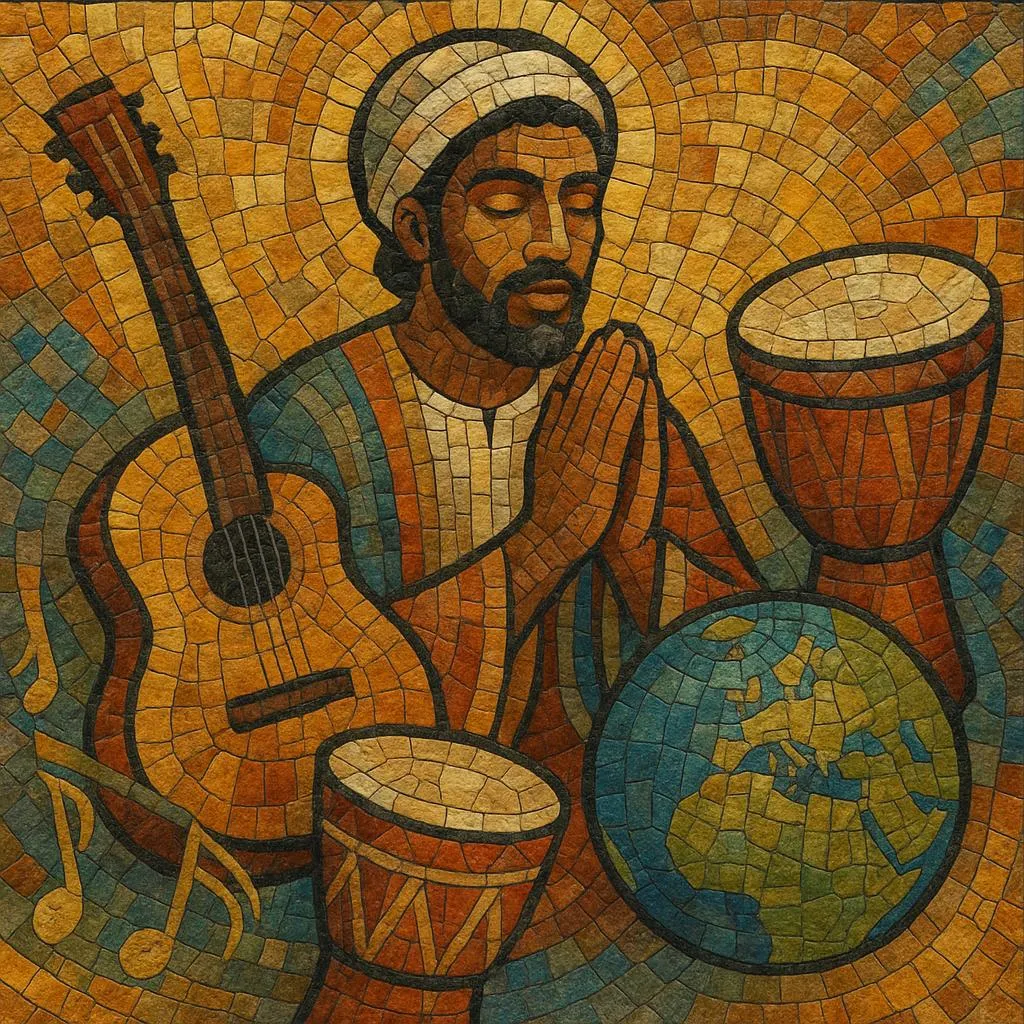
World worship is a globalized form of contemporary Christian worship that blends the musical language of modern praise with local languages, rhythms, and instruments from around the world.

Its sound ranges from soft, pad-led ballads to arena-sized pop-rock anthems, but what defines it is its transnational character: songs are written, translated, and adapted across cultures for congregational singing. Production values mirror mainstream pop, while melodic contours and grooves often reflect regional styles (Afrobeats, Latin rhythms, Celtic textures, or Asian folk timbres). Lyrically, it retains a vertical focus—addressing God directly—while integrating scriptural paraphrases and communal declarations of faith.


Sources: Spotify, Wikipedia, Discogs, RYM, MB, user feedback and other online sources

History

Roots (1970s–1990s)

World worship grows out of the modern praise-and-worship movement that emerged from the 1970s Jesus Movement in the United States and parallel developments in the UK. Through the 1980s–1990s, contemporary Christian congregations increasingly adopted pop-rock instrumentation, projecting lyrics and favoring simple, singable choruses over traditional hymn structures.

Globalization and Translation (2000s)

In the 2000s, international worship collectives, licensing networks, and publishing platforms (e.g., church conferences, songwriter hubs, and global copyright/licensing services) accelerated song circulation. Churches began translating and locally arranging internationally popular worship songs. As a result, stylistic markers of Western CCM (pads, four-on-the-floor builds, I–V–vi–IV harmonic loops) were fused with local rhythmic feels, instruments, and languages.

Streaming Era and Cross-Pollination (2010s–present)

Digital streaming, YouTube, and social media enabled rapid cross-border adoption, catalyzing regionally distinct worship scenes—Latin American, African, Asian, and European—each reinterpreting common worship repertoire while generating original catalogs. Production quality rose to mainstream pop standards; live worship albums and multi-campus collectives became central. Today, world worship denotes both an international repertoire sung across many cultures and a creative ecosystem that encourages local linguistic and stylistic identity within a global worship framework.

Defining Traits
•   Congregational focus with accessible melodies and repetitive, declarative lyrics. •   Pop-rock and ambient-pad aesthetics blended with indigenous grooves and instruments. •   Emphasis on translation/adaptation, often releasing multilingual versions. •   Live recordings that capture congregational participation and dynamic builds.

How to make a track in this genre

Core Aesthetics
•   Keep the congregational lens primary: write melodies that sit within a comfortable vocal range (typically A3–D5 for congregations), with clear, memorable hooks. •   Favor simple, cyclic harmony (e.g., I–V–vi–IV, IV–I–V–vi) to support participation and facilitate modulation or dynamic builds.
Instrumentation and Texture
•   Rhythm section: drum kit (brushes or sticks), electric bass with supportive, legato lines; electric and acoustic guitars for rhythmic drive and ambient swells. •   Keys/synths: piano for harmonic grounding; pads for sustained atmosphere; subtle arps for lift. Use side-chained pads or soft four-on-the-floor kick for modern feel when appropriate. •   Regional color: integrate indigenous instruments (e.g., djembe, cajón, ud, charango, nyckelharpa, erhu) and local grooves (Afrobeats swing, cumbia, bossa, Celtic reels) to reflect cultural context while keeping parts congregationally singable.
Rhythm and Form
•   Common meters: 4/4 with mid-tempo (70–84 BPM) for reflective songs and 100–128 BPM for upbeat anthems. Occasionally 6/8 or 12/8 for flowing, hymn-like pieces. •   Structure: verse – pre-chorus – chorus – verse – chorus – bridge (often a repeated, intensifying refrain) – final chorus/outro. Plan dynamic arcs from intimate to epic.
Lyrics and Theology
•   Vertical language addressing God; scriptural paraphrases; communal declarations (“We believe…”, “You are…”). Keep lines short and immediately comprehensible across translations. •   Consider multilingual or call-and-response sections to include the congregation’s languages.
Arrangement and Production Tips
•   Build arrangements in layers: start sparse (piano/pad + voice), add drums and guitars by the first chorus, reserve big tom hits and cymbal swells for the bridge/last chorus. •   Use ambient swells (volume-pedaled guitar, synth pads) between sections to maintain prayerful flow. •   Record live when possible to capture congregational energy; blend room mics subtly under the lead for authenticity. •   Mix with vocal clarity on top, warm low-mids for congregational body, and controlled highs to avoid harshness in reverberant worship spaces.

Top tracks

Locked
Share your favorite track to unlock other users’ top tracks

Upcoming concerts

in this genre
Influenced by
Has influenced

Download our mobile app

Get the Melodigging app and start digging for new genres on the go
© 2026 Melodigging
Melodding was created as a tribute to Every Noise at Once, which inspired us to help curious minds keep digging into music's ever-evolving genres.
Buy me a coffee for Melodigging