Your digging level

For this genre
0/8
🏆
Sign in, then listen to this genre to level up

Description

Latin worship is the Spanish‑ and Portuguese‑language branch of contemporary praise and worship that blends congregational songs with Latin American popular and folkloric rhythms (salsa, cumbia, merengue, reggaetón) and pop‑rock arrangements. Its lyrics center on adoration, prayer, and Scripture, designed for corporate singing with call‑and‑response coros and memorable refrains.

The modern movement coalesced in the late 1980s around Mexico‑based CanZion (founded by worship leader Marcos Witt), whose repertoire and training network helped standardize a fresh, contemporary sound for Hispanic congregations across the Americas. Today, Latin worship ranges from stadium‑sized live recordings to intimate acoustic devotionals, and it also includes Spanish versions of globally known worship catalogs (e.g., Bethel Music en Español, Gateway Worship Español).


Sources: Spotify, Wikipedia, Discogs, RYM, MB, user feedback and other online sources

History

Origins (1980s)
•   The contemporary Spanish‑language worship movement crystallized in Mexico in the mid‑ to late‑1980s when Marcos Witt founded CanZion Producciones (1987) and began releasing pop/soft‑rock worship albums in Spanish. CanZion soon added the Instituto CanZion to train worship leaders, seeding a continent‑wide network.
1990s–2000s: Expansion across Latin America
•   Alongside Witt, leaders such as Marco Barrientos (Mexico) and Danilo Montero (Costa Rica) issued live congregational albums and large worship events, helping define the repertoire of Hispanic evangelical churches. In parallel, Jesús Adrián Romero (Mexico) founded Vástago Producciones (1998), whose acoustic‑pop worship further broadened the stylistic palette.
2010s–present: Globalization and stylistic breadth
•   The 2010s saw international collectives release full Spanish catalogs (e.g., Bethel Music en Español, 2019), while pan‑Latin collaborations (Gateway Worship Español’s “Danzando”) topped radio and won Dove Awards, signaling mainstream reach of Latin worship aesthetics. Bands like Miel San Marcos, Generación 12/G12 Worship, and Barak filled arenas and cross‑pollinated with U.S. churches.
Rhythmic and cultural markers
•   From its inception, Latin worship integrated Latin pop with regional grooves (salsa montunos, cumbia tumbados, Caribbean merengue, and more recently reggaetón’s dembow) while retaining congregational forms. Academic fieldwork in U.S. Latino churches confirms a bi‑musical practice that blends global worship with indigenous Latin idioms.

How to make a track in this genre

Core feel
•   Aim for singable, congregational melodies with clear hooks and coros (call‑and‑response refrains). Keep lyric lines short, Scripture‑rooted, and centered on adoration, petition, and testimony.
Harmony & form
•   Common progressions (in major keys) include I–V–vi–IV and vi–IV–I–V. Use verse–pre‑chorus–chorus–bridge structures; add a spontaneous sección de adoración (tag/vamp) for extended congregational response.
Rhythm & groove (choose one or hybridize)
•   Salsa worship: 4/4 at ~92–110 BPM with piano montuno, tumbao bass, congas, bongó/timbales, and off‑beat brass stabs. •   Cumbia worship: 4/4 at ~90–105 BPM with cumbia bass pattern (anticipating beat 1), güira/shaker, and guitar/keys on the off‑beats. •   Pop‑rock worship: 4/4 at ~68–80 BPM (ballad) or 100–120 BPM (up‑tempo) with straight eighths, pad‑heavy keys, and layered guitars. •   Reggaetón worship: 4/4 at ~88–96 BPM using the dembow (kick on 1, snare/clap on “and” of 2 and 4), gentle synths, and crowd‑friendly chants; keep content worshipful and congregational.
Instrumentation & texture
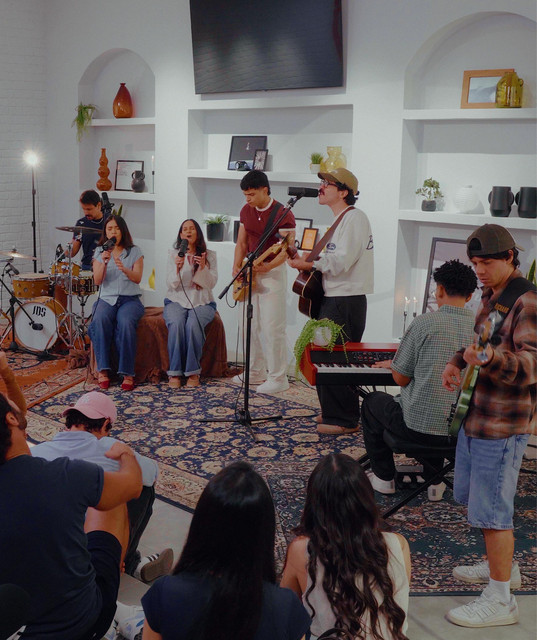
•   Core band: vocal leader + BGVs, acoustic/electric guitars, bass, drums, and keys/pads; add Latin percussion (congas, güira, timbales), brass section for salsa/merengue, or subtle loops for modern pop.
Lyrics & theology
•   Write in inclusive congregational voice (“te adoramos, Señor”; “Santo eres”). Anchor each section to a biblical image or promise; avoid overly figurative lines that obscure congregational clarity. Spanish scansion matters—accent syllables naturally to preserve singability.
Arrangement & production
•   Build dynamics from intimate verses to anthemic choruses (octave‑up melody, stacked harmonies). Use breakdowns to feature congregational singing, then reprise the chorus or vamp (e.g., a one‑line tag) for participation.
Team practice
•   Rehearse coros responsoriales and spontaneous ad‑libs; arrange percussion parts to complement (not clutter) the groove, leaving space for the congregation to sing.

Top tracks

Locked
Share your favorite track to unlock other users’ top tracks

Upcoming concerts

in this genre
Influenced by
Has influenced

Download our mobile app

Get the Melodigging app and start digging for new genres on the go
© 2026 Melodigging
Melodding was created as a tribute to Every Noise at Once, which inspired us to help curious minds keep digging into music's ever-evolving genres.
Buy me a coffee for Melodigging