Your digging level
Description
Hutsul folk music is the traditional folk music of the Hutsul people, a highland ethnographic group from the Carpathian Mountains.
It is characterized by strong links to pastoral life, ritual practice, dance, and seasonal customs. The style is especially associated with energetic violin-led dance music, highly distinctive flute and trembita playing, asymmetrical and driving rhythmic motion, and modal melodic language rooted in local Carpathian tradition.
The genre includes both instrumental and vocal repertories. Instrumental music is often used for dancing, weddings, communal festivities, and ceremonial occasions, while vocal music includes lyrical songs, ritual songs, and narrative forms reflecting mountain life, love, labor, religion, and local identity.
Its sound world is vivid, rustic, and highly regional, with ornamented melodies, drone support, improvisatory variation, and ensemble interplay that distinguishes it from neighboring Ukrainian, Romanian, Polish, and broader East European folk traditions while still sharing historical connections with them.
History
Hutsul folk music developed in the Carpathian highlands among the Hutsuls, an ethnocultural group inhabiting mountain areas now divided mainly between Ukraine and Romania. Its roots are old and oral, shaped by pastoral life, seasonal rituals, village ceremony, and regional dance practice.
Because it was transmitted largely by ear rather than through notation, the style evolved through local performance lineages. Musicians learned repertory from family members, village fiddlers, shepherds, ritual specialists, and wedding ensembles, preserving a highly localized musical identity.
The mountainous environment had a strong impact on the music. Instruments suitable for outdoor use, signal communication, and mobile performance became central to the tradition. This includes the trembita, a long alpine horn used for signaling and ceremonial purposes, as well as various flutes, fiddles, and compact accompanying instruments.
Hutsul music formed at the crossroads of East Slavic and Carpathian cultural exchange. While it shares features with neighboring Ukrainian, Romanian, and broader Balkan-Carpathian traditions, it retained distinctive melodic turns, dance rhythms, and ensemble textures associated specifically with Hutsul identity.
Historically, the music was inseparable from community life. It accompanied weddings, dances, Christmas and Easter cycles, harvest events, pastoral activity, funerary customs, and calendrical rituals. Instrumental dance tunes were especially important in village celebrations, where small ensembles provided music for social dancing.
Vocal genres served different functions, including ritual singing, lyrical songs, and songs tied to everyday labor or emotional expression. In this sense, Hutsul folk music was not a separate concert genre but part of lived social practice.
During the 19th and 20th centuries, ethnographers, folklorists, and composers began documenting Hutsul culture more systematically. Field recordings, song collections, and transcriptions helped preserve repertories that had previously circulated mainly orally.
At the same time, the image of Hutsul culture became important in broader Ukrainian national and artistic imagination. This led to both preservation and stylization: some performers maintained village-based traditional practice, while others adapted the repertory for staged folk ensembles and concert performance.
Today, Hutsul folk music survives in village tradition, staged folklore, festival performance, and archival revival. Some musicians aim for historically grounded regional authenticity, while others blend Hutsul elements with broader Ukrainian folk, world music, or academic folk arrangements.
Despite modernization and migration, the genre remains a major symbol of Carpathian identity. Its characteristic instrumental colors, dance energy, and ceremonial associations continue to make it one of the most recognizable regional folk traditions in the Ukrainian and wider Carpathian cultural sphere.
Build the music around a Carpathian village-folk sound rather than modern pop-folk production. The texture should feel acoustic, communal, and rooted in dance, ritual, or pastoral life.
Use a melody-first approach. Hutsul music often relies on memorable, ornamented tunes rather than dense harmonic development.
Typical instruments may include:
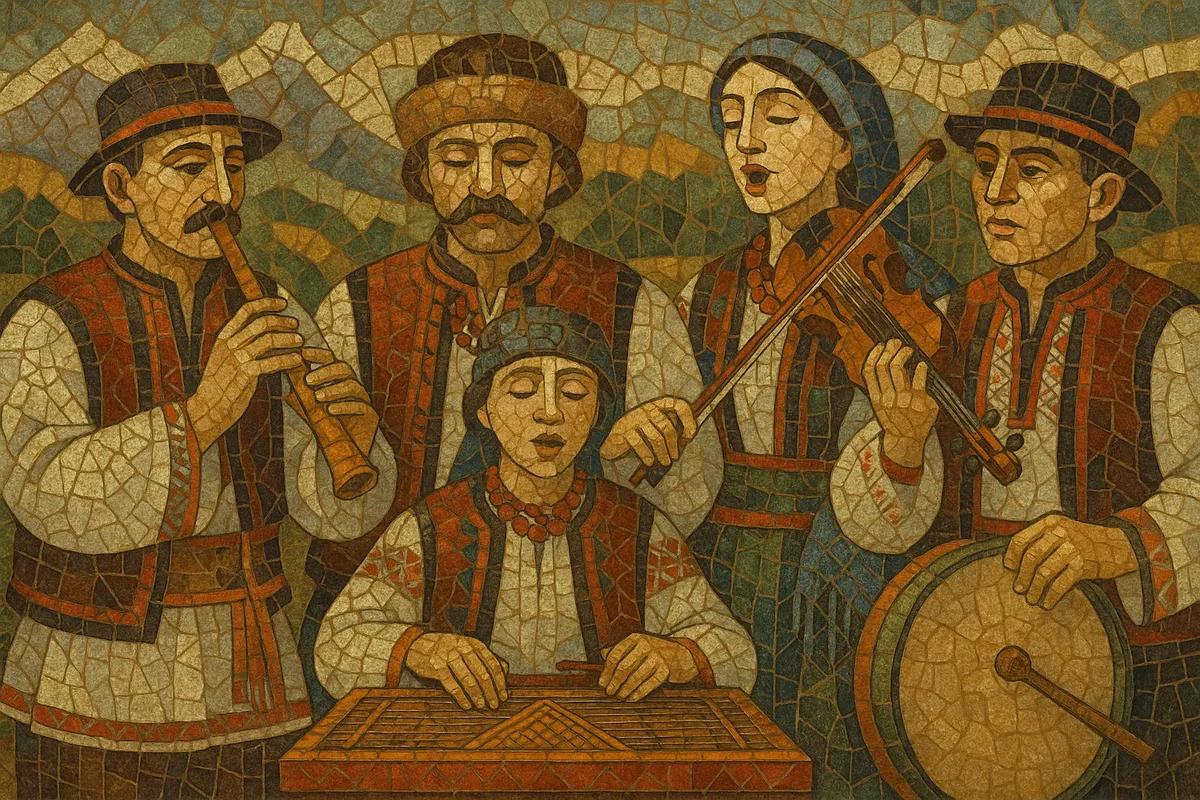
• Violin as the primary melodic lead. • Sopilka or other end-blown/open flutes for bright, agile melodic lines. • Trembita for ceremonial or atmospheric signaling effects. • Tsymbaly where appropriate for rhythmic-harmonic support. • Small folk ensemble accompaniment such as second fiddle, frame drum, hand percussion, or drone-based support.If writing for ensemble, keep the arrangement lean and interactive. Let instruments answer each other in short phrases rather than layering too many parts.
Write modal melodies with strong regional contour. Use narrow-range motifs expanded through repetition and ornamentation.
Favor:
• Stepwise movement mixed with sharp leaps. • Repeated melodic cells. • Grace notes, turns, slides, and other ornaments. • Call-and-response phrasing between instruments or voice and instrument.The tune should feel singable but also suitable for dancing. Even instrumental pieces should have a vocal quality.
Rhythm is central. Many Hutsul dance types have propulsive, accented movement. Keep the pulse lively and clearly articulated.
Practical approaches:
• Use fast duple or mixed-feel dance rhythms. • Accent rhythmic patterns through bowing, hammered accompaniment, or repeated bass figures. • Allow a slight elasticity in solo introductions, but keep dance sections tight and driving.The groove should feel earthy and physical rather than mechanically quantized.
Harmony is usually simple compared with art music traditions. Use drones, open fifths, tonic-dominant motion, and modal accompaniment.
Avoid overly chromatic jazz harmony unless you are deliberately making a fusion piece. The harmonic background should support the melody and rhythm, not overshadow them.
Common useful forms include:
• Short repeated dance strains with variation. • Introductory free rubato section followed by a dance groove. • Alternation between instrumental refrains and sung verses. • Gradual intensification through repetition, ornamentation, and ensemble buildup.Think in terms of functional community music: music for procession, ritual, or dance.
If writing vocals, choose themes such as:
• Mountain life and landscape. • Shepherding and pastoral labor. • Love and separation. • Village celebration. • Religious feasts and ritual customs. • Local identity, ancestors, and homeland.Keep the language direct, image-rich, and grounded in everyday life or ceremonial symbolism.
Perform with expressive flexibility and strong ornamentation. Tone can be raw, bright, and penetrating rather than polished in a classical sense.
For dance music, prioritize momentum, articulation, and ensemble feel. For ceremonial or lyrical material, allow more spacious phrasing and a sense of mountain echo or outdoor resonance.