Your digging level
Description
Deep Latin Jazz is a contemporary, groove-forward subset of Latin jazz that spotlights harmonically rich writing, long-form improvisation, and a “deep” pocket grounded in Afro-Caribbean and Brazilian rhythm.
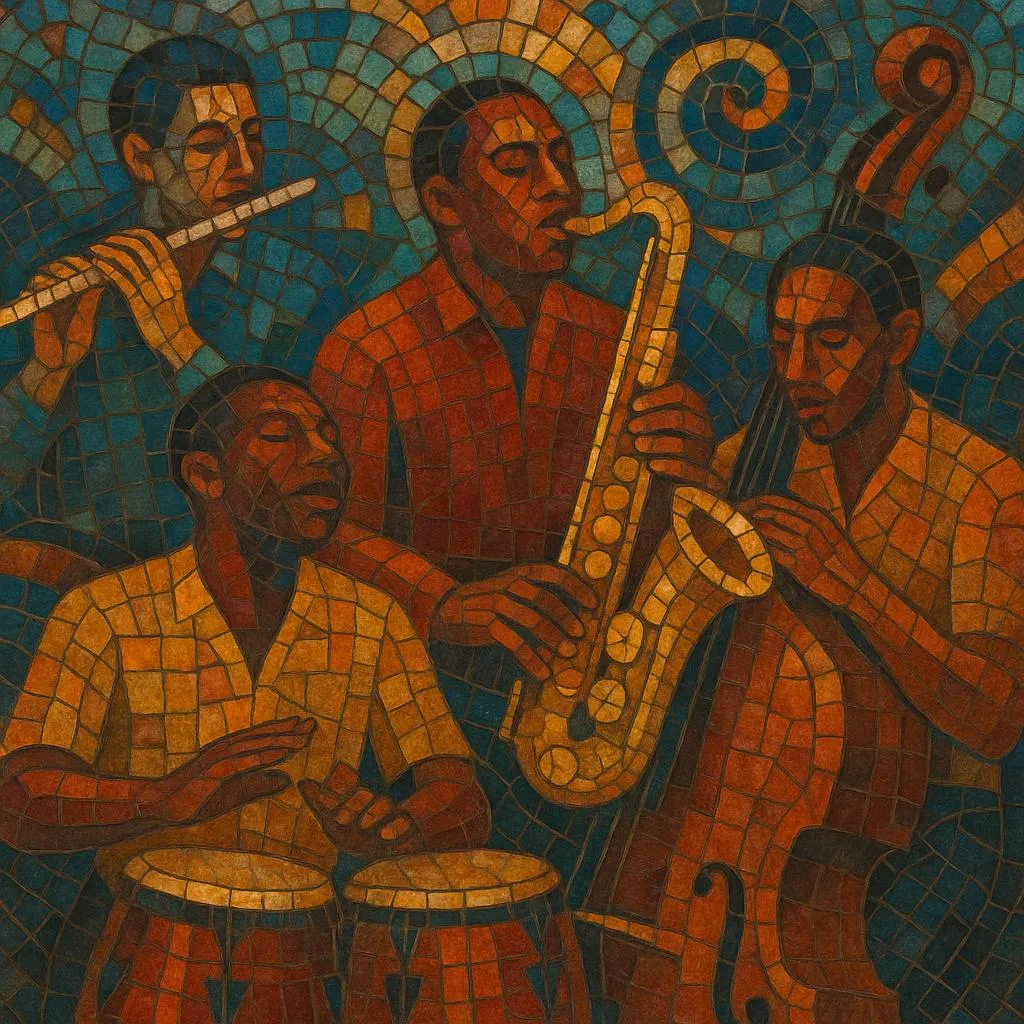
It extends the classic Latin jazz palette—clave-based grooves, montuno piano figures, tumbao bass, and layered hand percussion—into post-bop and modal harmonic territories, often with modern arranging, audiophile production, and sophisticated ensemble interaction. While the instrumentation remains rooted in congas, bongó, timbales, drum set, piano, bass, and horns (with flutes and saxophones prominent), it frequently incorporates Brazilian colors (samba, bossa, partido alto), rumba vocabularies (guaguancó, columbia), and spacious, contemporary jazz sonorities.
Compared with mainstream Latin jazz, Deep Latin Jazz tends to favor deeper vamps, textural development, extended solos, and moñas (tight horn riffs) that evolve over the course of the performance, yielding a sound that is both rhythmically propulsive and harmonically exploratory.

History
Latin jazz itself coalesced in 1940s New York through the collaborations of Afro-Cuban bandleaders and beboppers—figures like Machito and Mario Bauzá with Dizzy Gillespie—fusing clave-based Afro-Cuban rhythms with jazz harmony and improvisation. The mambo boom and the later bossa nova wave added idioms (mambo, cha-cha-chá, bossa) that became foundational to the broader Latin jazz language.
Post-bop, modal jazz, and fusion expanded the harmonic and textural vocabulary of jazz. Artists working in New York, the Caribbean, and Brazil began combining denser harmony, extended forms, and layered percussion with the core Latin jazz toolkit. Ensembles such as Jerry González & The Fort Apache Band and bandleaders like Eddie Palmieri developed a deeper, more exploratory approach—rooted in clave but open to modern voicings, modal vamps, and long narrative solos. By the 1990s, independent labels and cosmopolitan scenes (NYC, San Juan, Havana, São Paulo) helped codify a darker, warmer, and more groove-immersed strain recognized by listeners as “deep.”
In the 21st century, Deep Latin Jazz flourished via global diasporas and cross-pollination with contemporary jazz, nu-jazz, and even club-informed production aesthetics. Cuban, Puerto Rican, Panamanian, and Brazilian artists working in New York and beyond advanced writing for small- and mid-sized ensembles—tight horn moñas, sophisticated reharmonizations, and percussion choirs—while maintaining jazz’s improvisational core. The result is a mature style that balances rhythmic inevitability (clave) with harmonic depth (post-bop/modal), appealing to both dancers and attentive listeners.