Your digging level
Description
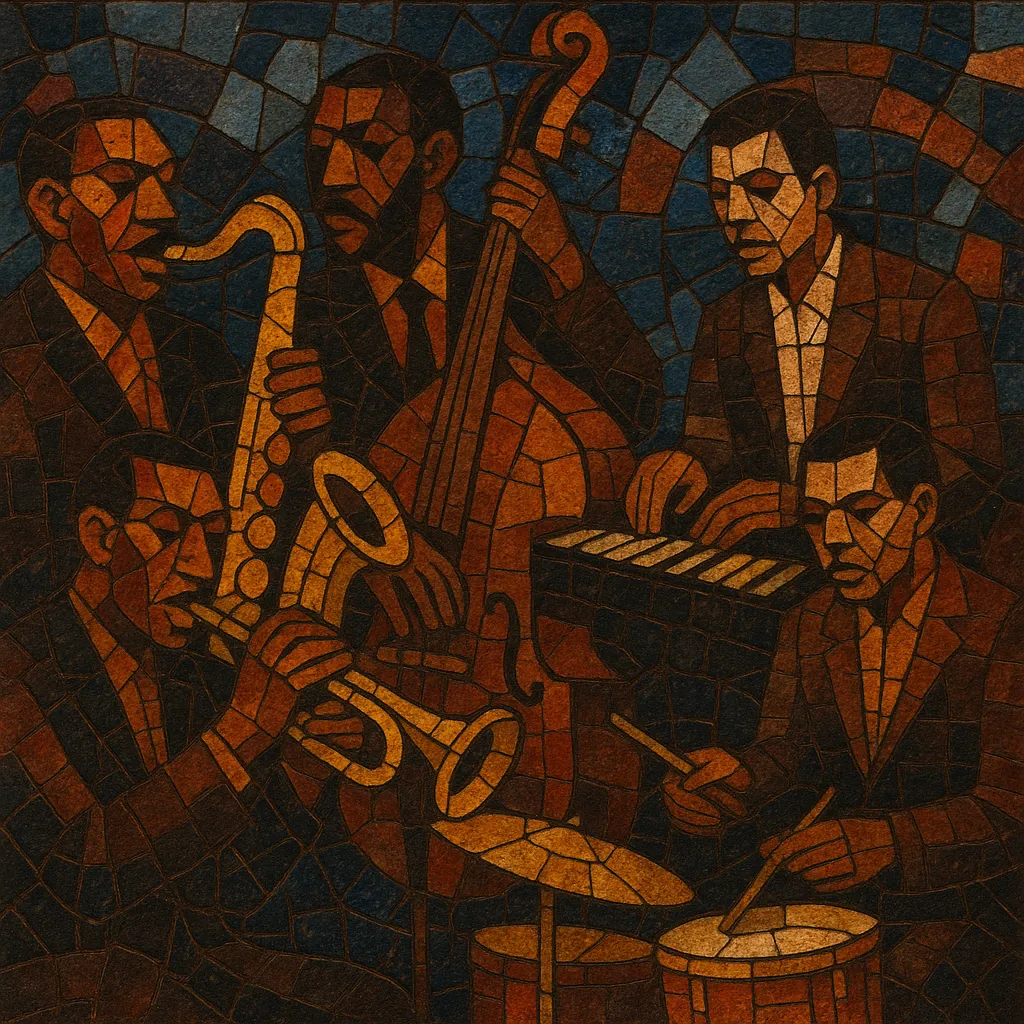
Hard bop is a mid‑1950s subgenre of jazz that extends bebop’s virtuosic improvisation while bringing back a more explicitly African‑American groove.
It incorporates pronounced influences from blues, rhythm & blues, and gospel—especially evident in riff‑based heads, church‑like harmonic movements on piano, and earthy saxophone phrasing. Compared with bebop, hard bop favors stronger backbeat accents, more grounded bass lines, and memorable, soulful melodies, all while retaining fast, harmonically rich improvisation when desired.
Typical ensembles are small groups (often quintets) with trumpet, tenor sax, piano, bass, and drums. The style’s hallmark is the blend of bop harmony and lines with blues/gospel feeling and a driving swing feel.
History
Journalists and record labels began using the term "hard bop" in the mid‑1950s to describe a new current within jazz that was an extension of bebop. Players such as Art Blakey, Horace Silver, Clifford Brown, and Max Roach forged a sound that retained bebop’s harmonic language and improvisational freedom, but reintroduced a groove‑oriented approach drawing deeply from rhythm & blues, gospel music, and the blues.
Blue Note Records became a central home for hard bop. Art Blakey & The Jazz Messengers (e.g., Moanin’, 1958) and the Horace Silver Quintet (e.g., Senor Blues, Song for My Father) defined the idiom’s churchy piano voicings, riff‑based themes, and muscular swing. Miles Davis’s mid‑1950s small‑group work (e.g., Walkin’; the “Prestige” sessions—Cookin’, Relaxin’, Workin’, Steamin’) also exemplified the style. Key horn voices included Hank Mobley, Lee Morgan, Freddie Hubbard, Sonny Rollins, Cannonball Adderley, Jackie McLean, and Benny Golson.
By the late 1950s, many hard bop musicians explored modal frameworks and looser forms, setting the stage for post‑bop in the 1960s. Simultaneously, the funkier, organ‑driven branch of hard bop crystallized into soul‑jazz. Records like Lee Morgan’s The Sidewinder (1963) popularized boogaloo‑tinged grooves within a hard bop context, influencing club‑friendly jazz and crossover markets.
Hard bop remained a core small‑group jazz language for subsequent generations. Its blend of blues/gospel feeling with bop sophistication fed into post‑bop and modal jazz, informed jazz fusion’s rhythmic sensibilities, and—decades later—became a sample bedrock for hip‑hop and jazz rap. Today, hard bop continues to be a foundational style in jazz education and performance.

![Art Blakey and The Jazz Messengers [Moanin']](https://i.scdn.co/image/ab67616d0000b273c653150f8ed1f6a12348ba79)