

Your digging level

For this genre
0/8
🏆
Sign in, then listen to this genre to level up

Description

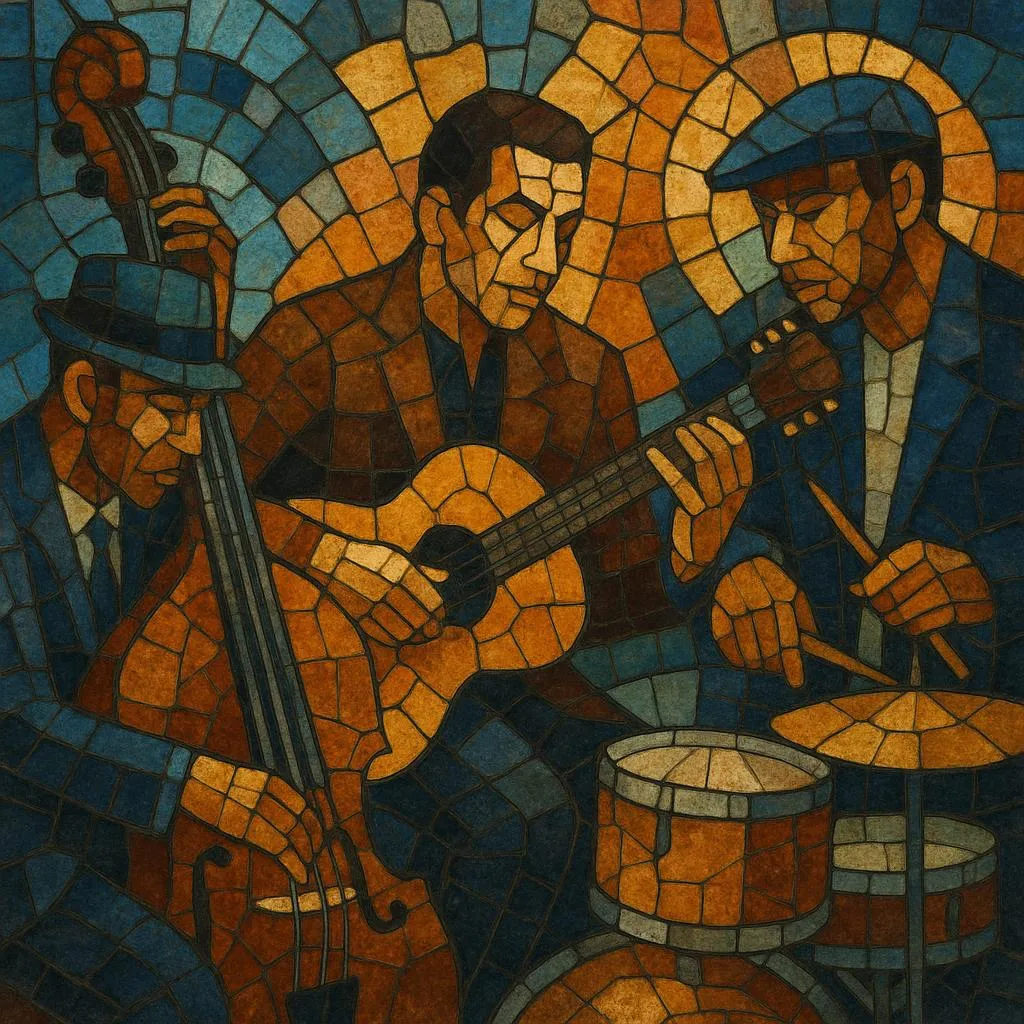
A jazz guitar trio is a small‑ensemble format centered on guitar with bass and drums (or, in organ‑trio variants, guitar with Hammond organ and drums). It foregrounds the guitar as both a melodic soloist and a chordal accompanist, relying on telepathic interaction and a strong rhythmic pulse rather than dense orchestration.

Stylistically, it blends bebop harmonic language and rhythmic swing with blues phrasing and ballad lyricism. Modern trios often widen the palette to modal harmony, metrically elastic time, and colors borrowed from rock, ambient, or free improvisation. Typical set pieces include standards, blues, rhythm‑changes contrafacts, bossa novas, and original tunes arranged to balance singable heads, conversational improvisation, and dynamic use of space.


Sources: Spotify, Wikipedia, Discogs, RYM, MB, user feedback and other online sources

History

Precedents (1930s–1940s)

The guitar’s rise as a frontline jazz instrument began with amplification in the late 1930s. Charlie Christian’s electric guitar with the Benny Goodman Sextet proved the guitar could project single‑note lines like a horn. Although not a trio specialist, his bebop‑leaning lines and time feel set the technical and aesthetic stage for guitar‑led small groups.

Foundational trios (1950s)

By the mid‑1950s, the guitar–bass–drums trio crystallized on records by Tal Farlow and Jimmy Raney, and in the West Coast “Poll Winners” sessions (Barney Kessel, Ray Brown, Shelly Manne, 1957–60). These groups codified the format’s balance: melodic guitar, walking bass, and interactive ride‑cymbal swing with sparse, responsive comping.

Organ‑trio influence (late 1950s–1960s)

Parallel to the straight guitar–bass–drums lineage, organ trios (guitar–Hammond B‑3–drums) brought gospel and blues heat to the idiom. Wes Montgomery’s early organ‑trio sides, and Grant Green and Kenny Burrell on Blue Note, infused the guitar‑trio language with deep groove, blues vocabulary, and soul‑jazz repertoire.

Modernization and ECM aesthetics (1970s–1980s)

Pat Metheny’s “Bright Size Life” (1976, with Jaco Pastorius and Bob Moses) reframed the trio as a contemporary, harmonically open, melodic vehicle. John Abercrombie’s Gateway (with Dave Holland and Jack DeJohnette) fused post‑bop with atmospheric textures and odd meters, shaping a spacious, interactive idiom associated with ECM recordings.

Contemporary expansions (1990s–present)

Bill Frisell’s trios blurred jazz, Americana, and ambient sound design; many guitarists (John Scofield, Peter Bernstein, Julian Lage, Gilad Hekselman, Lage Lund) advanced contrapuntal comping, metric play, and tone color. Today the format thrives across post‑bop, chamber‑jazz, nu‑jazz, and modern creative scenes, prized for portability and the clarity it gives to time feel, harmony, and ensemble conversation.

How to make a track in this genre

Core instrumentation and sound
•   Guitar: archtop or solid‑body with a clean, warm tone; mild compression/chorus/delay optional for modern colors. Aim for articulation and dynamic nuance more than distortion. •   Bass: double bass (or electric for specific aesthetics) provides time, roots, and counter‑melodies; in organ‑trio settings, the organ covers bass (often via pedals). •   Drums: ride‑cymbal time with light hi‑hat on 2 & 4; comp interactively with snare/toms and shape dynamics.
Harmony and voicings
•   Use shell voicings (3rd & 7th) to keep space for bass roots; add guide tones and tensions (9, 13, ♭9, ♯11) as the texture allows. •   Mix drop‑2, close, and quartal voicings; weave chord‑melody fragments between single‑note lines. •   Common progressions: 12‑bar blues, rhythm changes, functional turnarounds (ii–V–I, backdoor ii–V), modal vamps, and reharmonized standards (tritone subs, diminished approach chords, pedal points).
Rhythm and form
•   Feel: medium swing, up‑tempo bop, ballads with rubato intros, straight‑8 bossa/samba, 3/4 or 5/4 waltzes; modern trios explore metric modulations and odd meters. •   Forms: head–solos–head, with optional intros/codas, tags, vamps, and trading 4s/8s with drums. •   Time: prioritize deep, steady ride‑cymbal pulse and a relaxed yet forward bass walk; guitar phrasing should breathe and converse with the rhythm section.
Arrangement and interaction
•   Arrange heads for contrast: unison with bass, harmonized lines, or counter‑melody under the melody. •   During solos, alternate textures: sparse shell‑voicing comping, pedal‑tone drones, chord hits, or complete drop‑outs to spotlight bass/drums. •   Employ dynamic arcs (quiet statement → building chorus → open drum feature → soft reprise) to keep trio energy evolving.
Tone color and modern approaches
•   For contemporary aesthetics, use subtle delay/verb swells, volume‑pedal crescendos, or light overdrive for climaxes. Ambient interludes can reset the ear between tunes. •   Hybrid picking and chord‑melody devices let the guitar move between accompaniment and melody seamlessly.
Practice and repertoire
•   Build a book: blues in multiple keys, rhythm changes, a core of standards/ballads, a few Latin feels, and at least 2–3 original pieces that exploit trio space. •   Rehearse call‑and‑response cues, codas, and spontaneous form extensions so the band can stretch confidently on stage.

Top tracks

Locked
Share your favorite track to unlock other users’ top tracks

Upcoming concerts

in this genre
Influenced by
Has influenced

Download our mobile app

Get the Melodigging app and start digging for new genres on the go
© 2026 Melodigging
Melodding was created as a tribute to Every Noise at Once, which inspired us to help curious minds keep digging into music's ever-evolving genres.
Buy me a coffee for Melodigging
