Your digging level
Description
Traditional music is an umbrella term used in the mid–20th century by folklorists and ethnomusicologists to denote community-rooted, orally transmitted repertoires tied to social ritual, work, celebration, and storytelling.
Unlike commercial pop or art-music traditions, traditional music is typically learned by ear, varies regionally, and evolves slowly through communal participation. It often features modal melodies, cyclic rhythms, heterophony or unison singing, and indigenous instruments whose timbres are integral to local identity. Lyrics tend to preserve language, history, and collective memory.
While the musical practices themselves can be ancient, the phrase “traditional music” emerged to replace earlier, narrower or colonial framings like “folk” or “ethnic” music, foregrounding continuity, locality, and living practice rather than exoticism.
History
Traditional music predates written notation in many cultures and was sustained through oral tradition, apprenticeship, and communal participation. Songs marked rites of passage, agricultural and seasonal cycles, labor, and spiritual practice, embedding music in everyday life.
Although the practices are ancient, “traditional music” as a scholarly and cataloging label became more common in the 1950s, as ethnomusicology matured and institutions sought terminology that avoided exoticism and better recognized local ownership and continuity. Archives and broadcasters (e.g., the BBC Folk Music programs) helped normalize the tag in catalogs.
Portable recorders enabled collectors to document village ensembles, chant traditions, and ballad repertoires worldwide. Parallel folk revivals in the British Isles and North America highlighted local dance tunes and ballads, inspiring festivals and community ensembles that preserved repertoire under the “traditional” banner.
As global music markets expanded, traditional ensembles and singers toured internationally. Labels and festivals framed these musicians alongside “worldbeat” and “world fusion,” often balancing authenticity with staged presentation.
Online archives, community-led documentation, and heritage initiatives have increased local control over representation and pedagogy. Young artists continue to reinterpret dance tunes, work songs, and ritual genres with period instruments, while others respectfully fuse traditional vocabularies with contemporary forms.
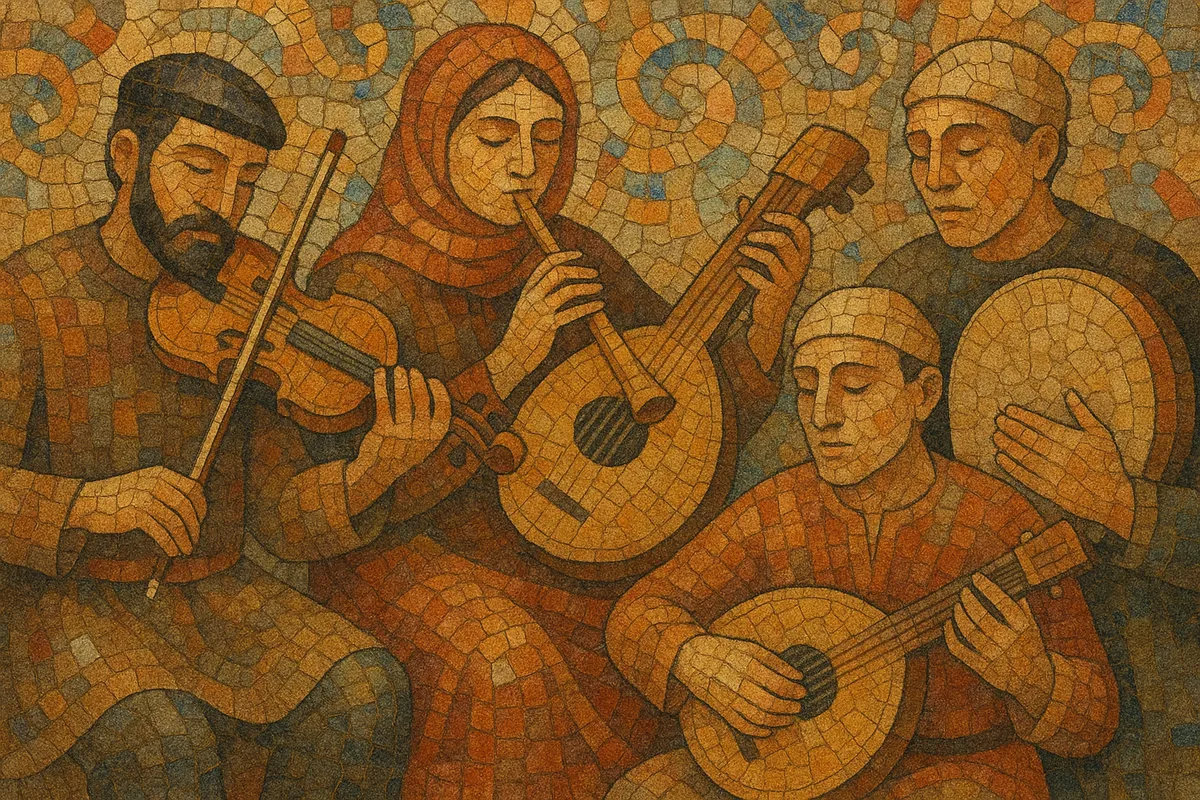
Select instruments native to the tradition you are drawing from (e.g., fiddle, tin whistle, kora, mbira, baglama, shamisen, frame drum). Timbre is identity: favor natural resonance, minimal processing, and performance techniques (bow pressure, plucks, embouchure) typical of the locale.
Use cyclic forms (8, 12, or 16-beat patterns), dance-derived grooves, and additive meters where relevant (e.g., 7/8, 9/8, 11/8 in many Balkan traditions). Keep arrangements strophic or call-and-response. Drone or ostinato accompaniments can ground modal melodies.
Favor pentatonic or modal systems (Dorian, Mixolydian, maqam, raga, anhemitonic pentatonic) rather than functional harmony. Melodies should be singable, with narrow to moderate range, and shaped by ornamentation (grace notes, slides, mordents) specific to the tradition.
Heterophony (multiple voices ornamenting the same melody) or melody-plus-drone textures are common. If using chords, keep them sparse and modal; avoid heavy functional progressions unless the tradition supports them.
Write in the local language or dialect. Topics often include work, courtship, travel, history, faith, and community events. Rhyme and meter should follow the prosody of the language and any dance function the song serves.
Prioritize communal feel over metronomic precision—slight tempo drift and microtiming are musical. Learn by ear, use call-and-response where appropriate, and leave space for improvised ornaments within established stylistic boundaries.
Capture room ambience, group singing, and natural instrumental blend. Document provenance (region, tune type, dance function) and credit tradition-bearers. When fusing with modern styles, keep the traditional core (mode, rhythm, instrument technique) clearly foregrounded.