Your digging level
Description
Música indígena mexicana refers to the living musical practices of Mexico’s Indigenous peoples (Nahuas, Purépecha, Wixárika, Maya, Yaqui/Yoeme, Seri/Comcaac, Mixe, Mixtec, Zapotec, and many others). It encompasses ceremonial repertoires, communal dances, narrative songs, and work or healing chants transmitted primarily through oral tradition.
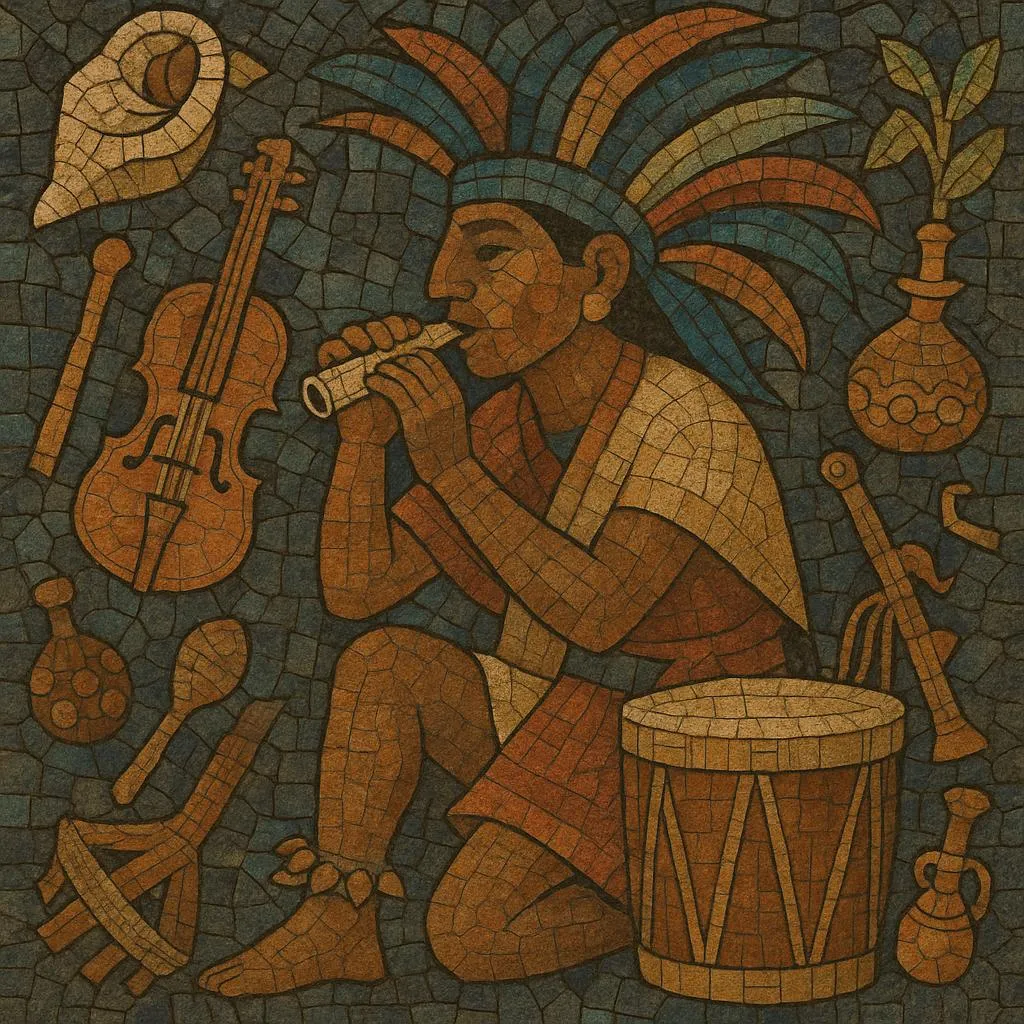
Core timbres come from pre‑Hispanic aerophones (clay ocarinas and flutes, cane flutes, conch shells), idiophones (ayoyotes/ankle rattles, seed and gourd rattles, stone plates), and membranophones (huehuetl and teponaztli drums). In many regions these instruments coexist with post‑Contact strings (guitarra, violín, jarana, arpa) and marimbas, yielding a mosaic of local styles. Rhythms are tightly coupled to dance steps and ritual calendars (harvest, rain, healing, saints’ feasts), and melodies often favor narrow ambitus, call‑and‑response, heterophony, and language‑specific prosody.
Today the field spans strictly traditional ensembles and innovative projects that set Indigenous languages and cosmologies to rock, folk, or electronic frameworks, sustaining cultural revitalization and linguistic continuity.
History
Before European contact, music permeated ritual, governance, and daily life across Mesoamerica. Ensembles centered on huehuetl and teponaztli drums, shell trumpets, whistles, and flutes supported dance, procession, and prayer, with songs encoded in local languages and cosmologies.
After the 16th century, Indigenous communities incorporated stringed instruments, European hymnody, and processional practices while preserving ceremonial repertoires. The result was a dense layer of regional hybridities—Indigenous poetic forms carried by both ancient and newly adopted instruments.
Ethnomusicological work and community archiving expanded, and ensembles dedicated to pre‑Hispanic instruments helped safeguard repertoires and instrument‑making. Radio, festivals, and cultural institutions widened circulation, while Indigenous leaders emphasized music’s role in language and land defense.
A new wave of artists began performing in Indigenous languages and fusing traditional timbres with rock, folk, and other popular idioms—bringing ceremonial poetics to broader stages and using music as a vehicle for identity, linguistic revitalization, and intercultural dialogue.