Your digging level
Description
Música prehispánica (Pre‑Hispanic music) refers to the ceremonial, social, and courtly musical practices of Indigenous civilizations of Mesoamerica (e.g., Mexica/Aztec, Maya, Mixtec, Zapotec) and, by extension in some usages, the pre‑Columbian Andes, prior to Spanish colonization.
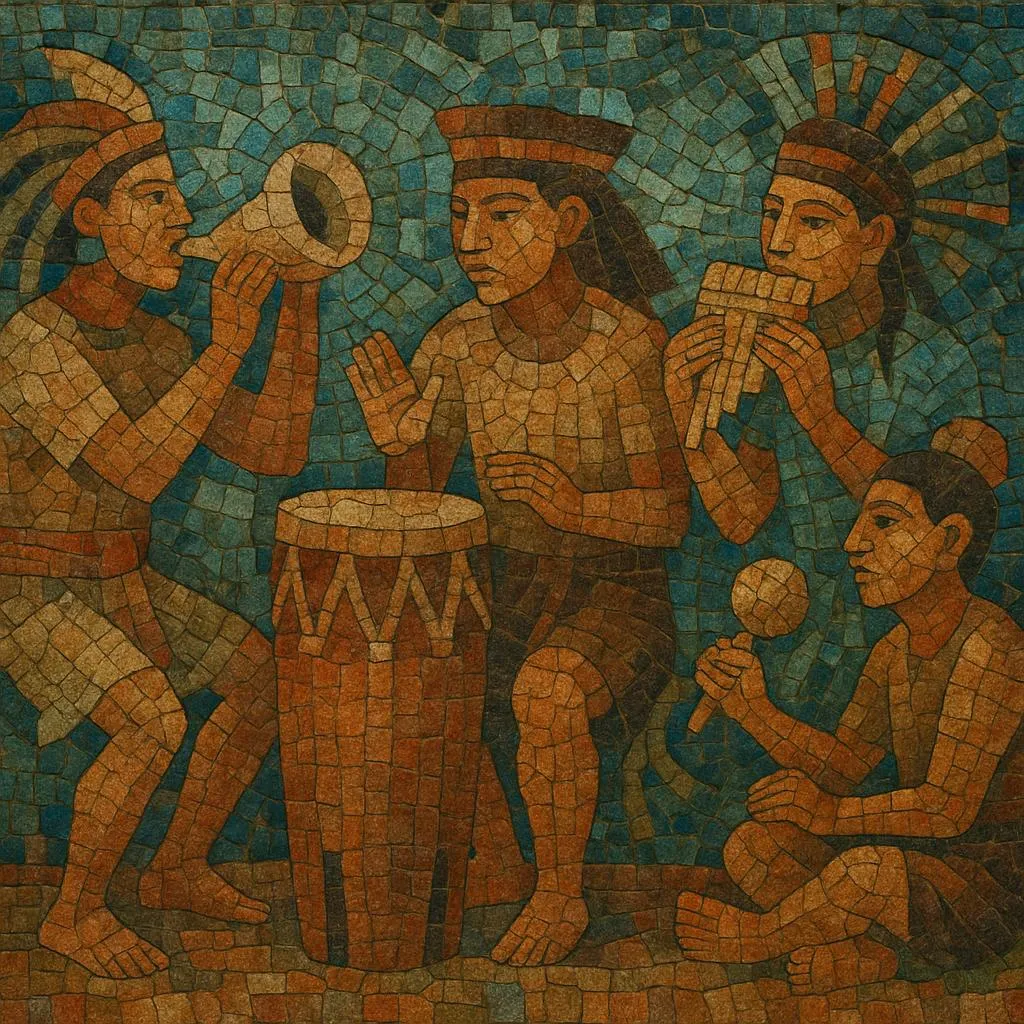
It is characterized by rich percussion ensembles (particularly the huehuetl vertical drum and teponaztli slit drum), aerophones (whistles, ocarinas, tlapitzalli flutes, panpipes, and conch trumpets), and rattles and other idiophones. Voices often use chant, hocketing, and call‑and‑response. Rhythmic ostinati, processional patterns, and dance‑linked meters are central, while pitch systems are variable (often non‑equal tempered, with pentatonic, hexatonic, or heptatonic collections). Music was inseparable from ritual, dance, and cosmology, accompanying offerings, calendrical feasts, healing rites, warfare, and rulership.
Because no staff notation survives, modern understanding comes from archaeological instruments, codices and iconography, colonial descriptions, living traditions, and experimental reconstruction by contemporary practitioners.
History
Pre‑Hispanic music developed over many centuries across Mesoamerica and the Andes, serving ritual, courtly, martial, and communal purposes. Drums (huehuetl, teponaztli) articulated dance cycles and processions; flutes, whistles, ocarinas, and conch trumpets (atecocolli) signaled, invoked deities, and colored ceremonial space. Music, poetry, and dance formed a single aesthetic (often termed “song‑dance”), embedded in cosmology and calendrical observances.
Archaeology and codices depict intricate instrument families: slit drums with tuned tongues, ceramic ocarinas and whistles with zoomorphic forms, cane flutes (tlapitzalli), shell trumpets, rattles (ayoyotes), and panpipes (notably in the Andes). Ensembles combined layered percussion ostinati with antiphonal vocals and alternating or interlocking flute lines.
Spanish conquest and evangelization curtailed many ceremonial practices, yet musical knowledge persisted in syncretic fiestas, processional drumming, conch‑shell signaling, and local dance‑drama. Instrument‑making techniques and rhythmic formulas survived within community memory and adapted to Christian festivals.
From the early 20th century, archaeology, organology, and ethnomusicology (alongside nationalist art music) renewed interest. Reconstructors and instrument makers experimented with surviving artifacts, while composers referenced Indigenous timbres and rhythmic archetypes.
Since the 1970s, Mexican and Latin American musicians have crafted performance practices based on period instruments, iconography, and living ritual models. Artists such as Jorge Reyes, Antonio Zepeda, and Luis Pérez Ixoneztli popularized concert and recording projects that foreground teponaztli/huehuetl ensembles, conch trumpets, and Indigenous flutes—sometimes blending with ambient and electronic textures. Community groups continue ceremonial drumming and dance, keeping repertoires alive alongside stage reconstructions.