Your digging level
Description
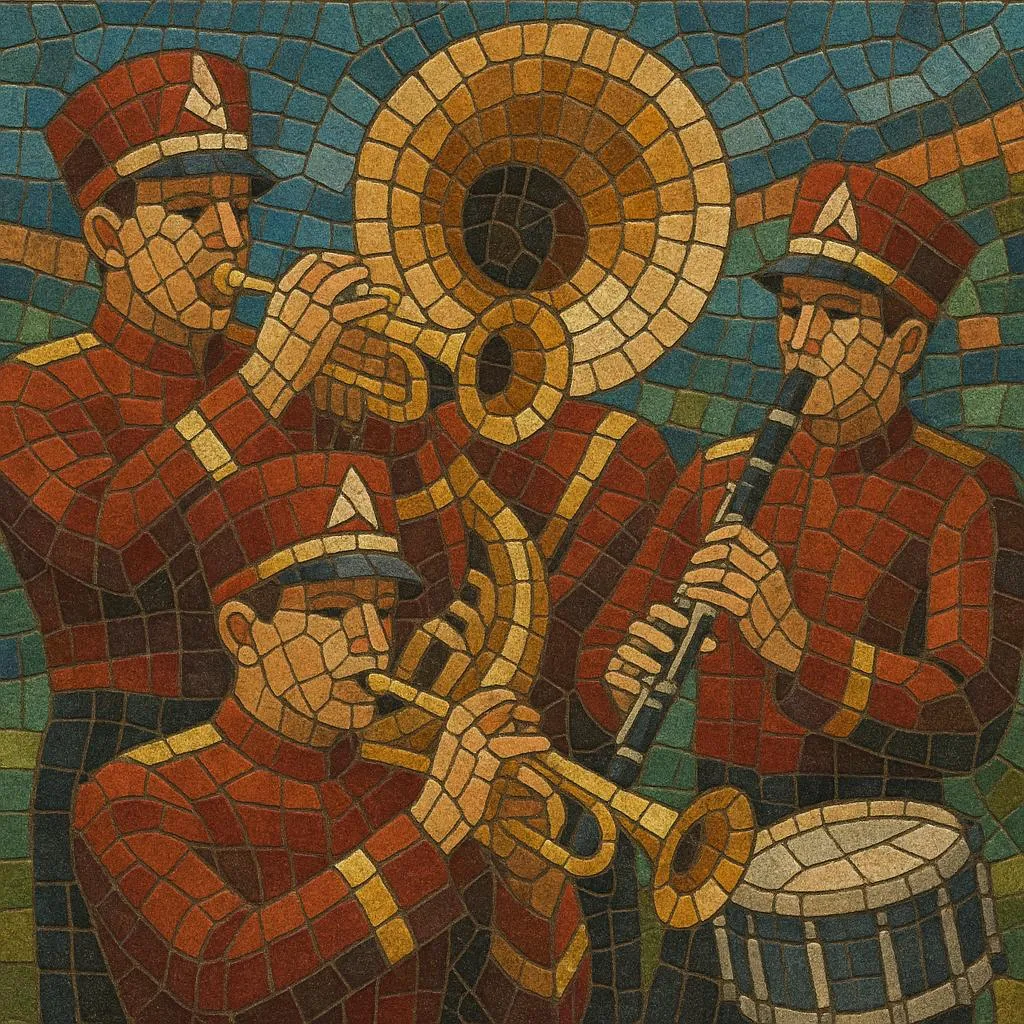
College marching band is a genre of outdoor musical performance characterized by large ensembles of brass, woodwind, and percussion instruments, primarily associated with university athletic events, particularly American football. The genre is defined by its dual focus on musicality and visual spectacle, with bands performing intricate drill formations, geometric patterns, or dance routines while playing. Musically, it emphasizes volume and projection to fill large stadiums, utilizing driving rhythms, block chord structures, and a repertoire that spans traditional fight songs, school alma maters, classical arrangements, and high-energy adaptations of popular music.
History
The history of the college marching band is deeply intertwined with the American military tradition and the rise of collegiate athletics.
•Military Roots (Late 19th Century): The earliest college bands, such as those at the University of Notre Dame (1845) and Purdue University (1886), often began as drill corps for ROTC programs. These ensembles utilized military instrumentation and marching styles to instill discipline and accompany drills.
•The Football Connection (Early 20th Century): As college football grew in popularity, bands began performing at games to boost morale. The University of Illinois Marching Illini is credited with performing the first modern halftime show in 1907, shifting the focus from military rigidity to entertainment. This era saw the birth of the 'fight song' and the 'alma mater' as staple genres.
•The 'Show Band' Era: In the mid-20th century, bands in the Big Ten conference pioneered the 'show band' style, introducing pictorial formations (like Script Ohio) and faster tempos. Meanwhile, Historically Black Colleges and Universities (HBCUs) developed a distinct, high-energy style rooted in African American musical traditions, emphasizing dance, high-stepping, and funk/R&B repertoire, pioneered by Florida A&M's 'Marching 100'.
•Corps Style and Modern Era (1970s-Present): Influenced by Drum Corps International (DCI), many college bands adopted a 'corps style' characterized by glide steps, curvilinear drill, and symphonic musical arrangements. Today, the genre is a diverse mix of these traditions, incorporating electronics, viral pop culture references, and elaborate props into massive stadium productions.
Composing for a college marching band requires specific attention to outdoor acoustics and ensemble size.
•Instrumentation and Voicing: Treat the band as a massive quartet. Assign the melody to high brass (trumpets) and woodwinds (flutes, clarinets, alto saxes) for projection. Use mellophones and trombones for counter-melodies or harmonic support. The bass line is carried by sousaphones and baritone saxophones. Because sound dissipates outdoors, avoid thin textures; double parts across sections to create a 'wall of sound'.
•Rhythm and Percussion: The 'battery' (snare, tenor, and bass drums) provides the rhythmic drive. Write active, syncopated cadences that lock in the tempo, which is often brisk (120-160 BPM) to maintain energy. Use the 'pit' (stationary percussion like marimbas) for melodic color if available.
•Harmony: Use block chords and closed voicings to ensure a full sound. Extended harmonies (9ths, 11ths) can be effective but must be balanced carefully so they don't sound muddy in a stadium echo.
•Structure: Keep arrangements concise (1:30 to 3:00 minutes). Start with a high-impact 'fanfare' introduction, move to the main theme, include a percussion break or contrasting lyrical section, and end with a powerful 'shout chorus' finale.