Your digging level
Description
Ghanaian traditional music is a diverse family of indigenous styles practiced by the many ethnic groups of Ghana, including Akan, Ewe, Ga–Dangme, Dagomba, Dagaaba, Frafra and others.
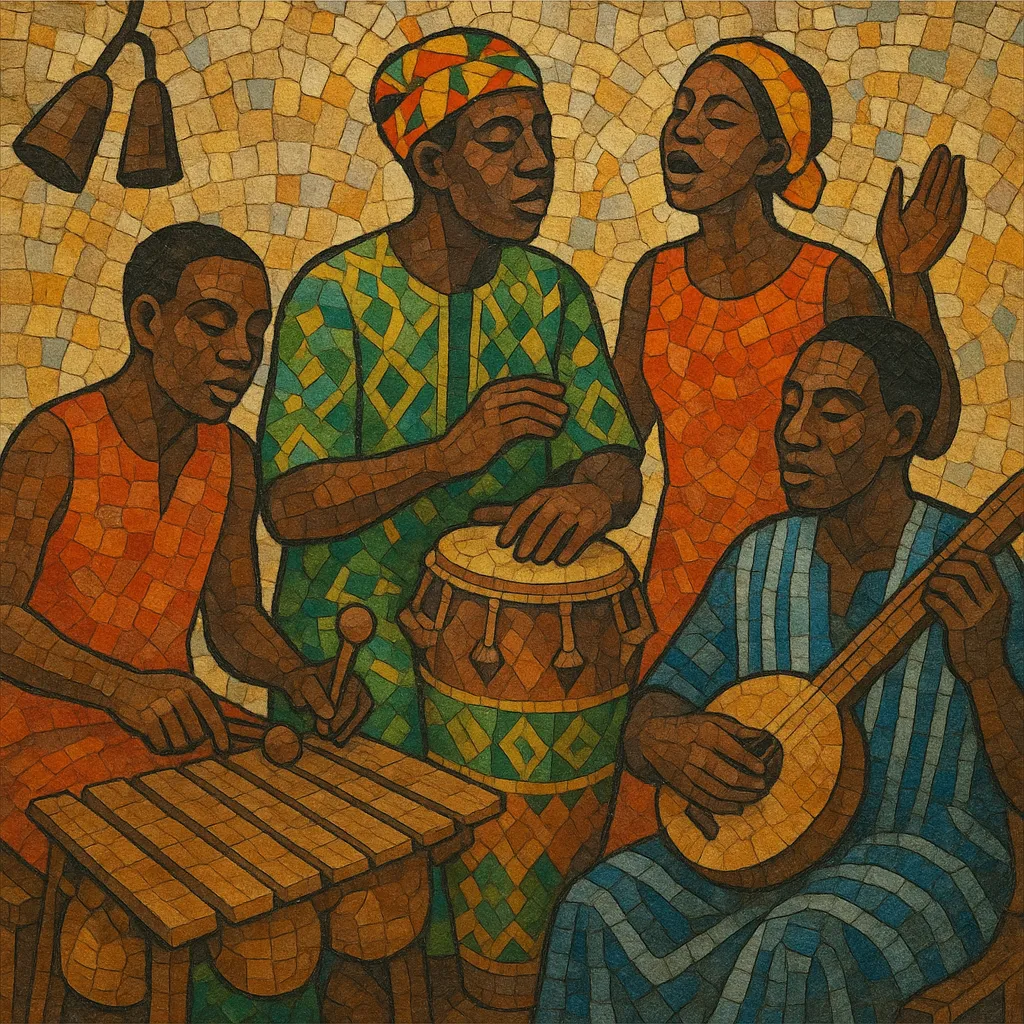
It is best known for polyrhythmic percussion ensembles built around a metal timeline bell (such as the gankogui) and rattles (axatse), interlocking drum parts, and call-and-response singing that coordinates music with dance and social ceremony. Core instruments include lead/response drums (atsimevu, sogo, kidi, kagan), talking drums (dondo/atumpan), large court-drumming sets (fontomfrom, kete), wooden xylophones (gyil), two-string lute (kologo), seperewa harp-lute, flutes, and handclaps. Repertoires align with functions—festivals, chieftaincy rites, funerals, initiations, and recreational dances like Kpanlogo, Adowa, Agbadza, Bamaya—where music, dance, and poetry are inseparable.
Structurally, short repeated cycles in 12/8 or 4/4 host cross-rhythms (e.g., 3:2) and cue-based variation from a master drummer who "speaks" phrases, signals dancers, and shapes the form. Songs are often in local languages, using proverbial text and praise poetry that encode history, ethics, and communal identity.
History
Ghanaian traditional music long predates colonial contact. Distinct court-drumming traditions (Akan fontomfrom and kete), warrior and work songs, praise poetry, funerary repertories, and initiation dances evolved as integral parts of governance, spirituality, and social life. Ensembles crystallized around a timeline bell and interlocking drum patterns, with a master drummer coordinating dancers and singers.
Under colonial rule, court and community ensembles persisted while mission schools introduced choral idioms. Indigenous structures continued to thrive in festivals and rites. The emergence of guitar-based palm-wine music drew on local rhythms and vocal styles while adopting imported instruments, foreshadowing later urban fusions.
After independence (1957), national ensembles like the Ghana Dance Ensemble systematized and staged regional traditions (Adowa, Agbadza, Bamaya, Kpanlogo). Scholars such as J. H. Kwabena Nketia documented rhythmic organization, drum language, and song forms, shaping global understanding of West African music. Master drummers began teaching abroad, spreading repertories to universities and community ensembles worldwide.
Ghanaian artists established teaching centers and touring groups, preserving lineage-based knowledge while adapting performances to concert stages. Traditional forms continue to anchor life-cycle events and festivals at home, and they inform popular styles (highlife, hiplife, azonto, afrobeats) through bell patterns, call-and-response hooks, and dance-driven grooves.
Today, Ghanaian traditional music remains both a ceremonial practice and a dynamic creative resource. New compositions, drum choirs, and lute/xylophone song traditions coexist with classic court repertoires, sustaining community identity and inspiring global musicians.
Choose a regional template and ensemble:
•Ewe (Agbadza/Kpanlogo): gankogui (bell), axatse (rattle), kagan, kidi, sogo, atsimevu (lead drum), voices, handclaps.
•Akan (Adowa/Kete/Fontomfrom): atumpan/talking drums, fontomfrom/kete drum set, dawuro (bell), donno (hourglass drum), voices.
•Northern/Dagara–Lobi: gyil (pentatonic xylophone) with calabash resonators, gourd rattles, frame drums; or kologo (two‑string lute) and vocal lead.