Your digging level
Description
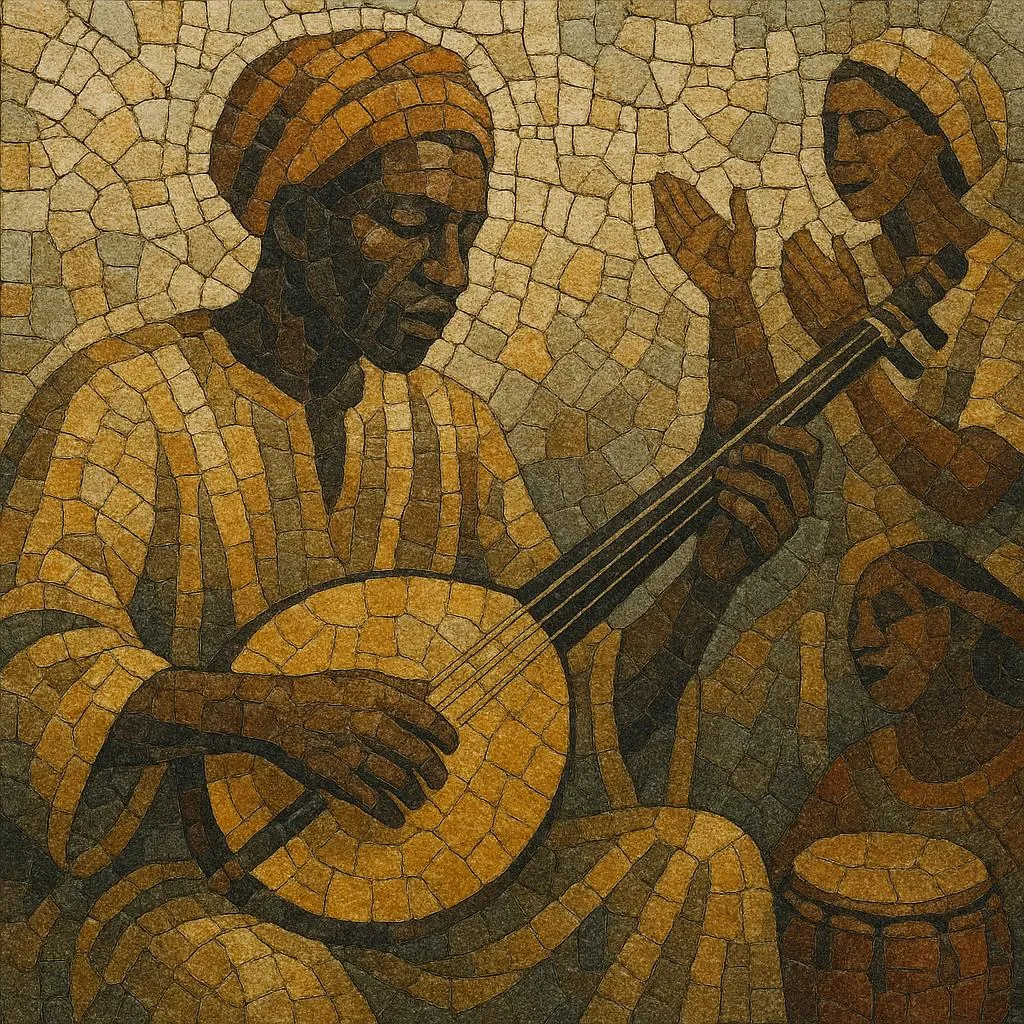
Ngoni is a family of West African skin-headed lutes central to Mande musical life, especially in present-day Mali and neighboring countries. Played by griots (jeliw) and by hunter-musicians (donso), it features a dry, percussive timbre, rapid ostinatos, and pentatonic modal melodies.
There are several lineages: the jeli ngoni (often 4 strings) used in praise-singing; the donso ngoni (typically 5–6 strings) associated with hunters’ music and ritual; and the more recent kamale ngoni (youth/“boy’s” ngoni, 8–14 strings) that helped shape the modern Wassoulou sound. Performance commonly blends interlocking plucked patterns with call-and-response vocals and calabash percussion, creating a propulsive, dancing groove that can move from meditative to celebratory.
History
The ngoni’s roots trace to the Mali Empire (from the 1200s), where professional bards (jeliw/griots) maintained genealogies, praise songs, and social histories. The jeli ngoni became a principal griot instrument alongside voice and balafon, while the donso ngoni was maintained by hunters’ associations for ritual and moral instruction. Repertoires circulated widely through Mande networks across present-day Mali, Guinea, Senegal, Côte d’Ivoire, and Burkina Faso.
French colonial rule, urbanization, and early radio fostered new ensembles combining ngoni with balafon, hand percussion, and later guitars. Archival recordings and national festivals after independence helped codify griot repertoires and donso pieces. During this period, ngoni practice remained modal and largely pentatonic, emphasizing cyclic ostinati and improvisation over harmonic change.
A pivotal innovation was the kamale ngoni (1950s–60s), a lighter, higher-pitched adaptation of the hunters’ lute with more strings and flexible tunings. It underpinned the rise of the modern Wassoulou sound and broadened ngoni usage beyond ritual and court contexts into youth dance music and urban stages.
Ngoni masters brought the instrument to world stages, experimenting with amplification, extended techniques, and ensemble formats (multiple ngoni sizes in one group). Cross-cultural collaborations highlighted the kinship between West African lutes and the North American banjo, as well as convergences with blues and desert blues. Today, ngoni traditions thrive both in hereditary lines and in contemporary, genre-blending projects.