Your digging level
Description
Mandingo music, also known as Manding or Mandé music, is the classical musical tradition of the Mandé peoples of West Africa, particularly the Mandinka, Maninka, and Bamana. It is deeply rooted in the history of the Mali Empire and is preserved by a hereditary caste of musician-historians known as Jali or Griots. The music is characterized by complex polyrhythms, heptatonic scales, and the intricate interplay between the kora (harp-lute), balafon (xylophone), and ngoni (lute). It serves as a vehicle for oral history, praise singing, and social commentary, blending ancient traditions with modern influences.
History
The roots of Mandingo music lie in the founding of the Mali Empire in the 13th century by Sunjata Keita. The tradition was established to preserve the history and genealogy of the empire through oral transmission, a role assigned to the Jali (Griots).
For centuries, the Jali served as advisors to kings and custodians of culture. They developed a sophisticated musical language centered around praise songs and historical epics, passed down through specific families like the Kouyatés, Diabatés, and Sissokos.
Following the independence of West African nations in the 1960s, state-sponsored orchestras like the Rail Band and Bembeya Jazz National began to modernize the sound. They incorporated electric guitars and brass sections while maintaining traditional melodies and rhythms.
In the late 20th century, artists like Mory Kanté and Salif Keita brought Mandingo music to the global stage, fusing it with pop, jazz, and electronic elements. This era saw the kora and ngoni becoming recognized instruments worldwide.
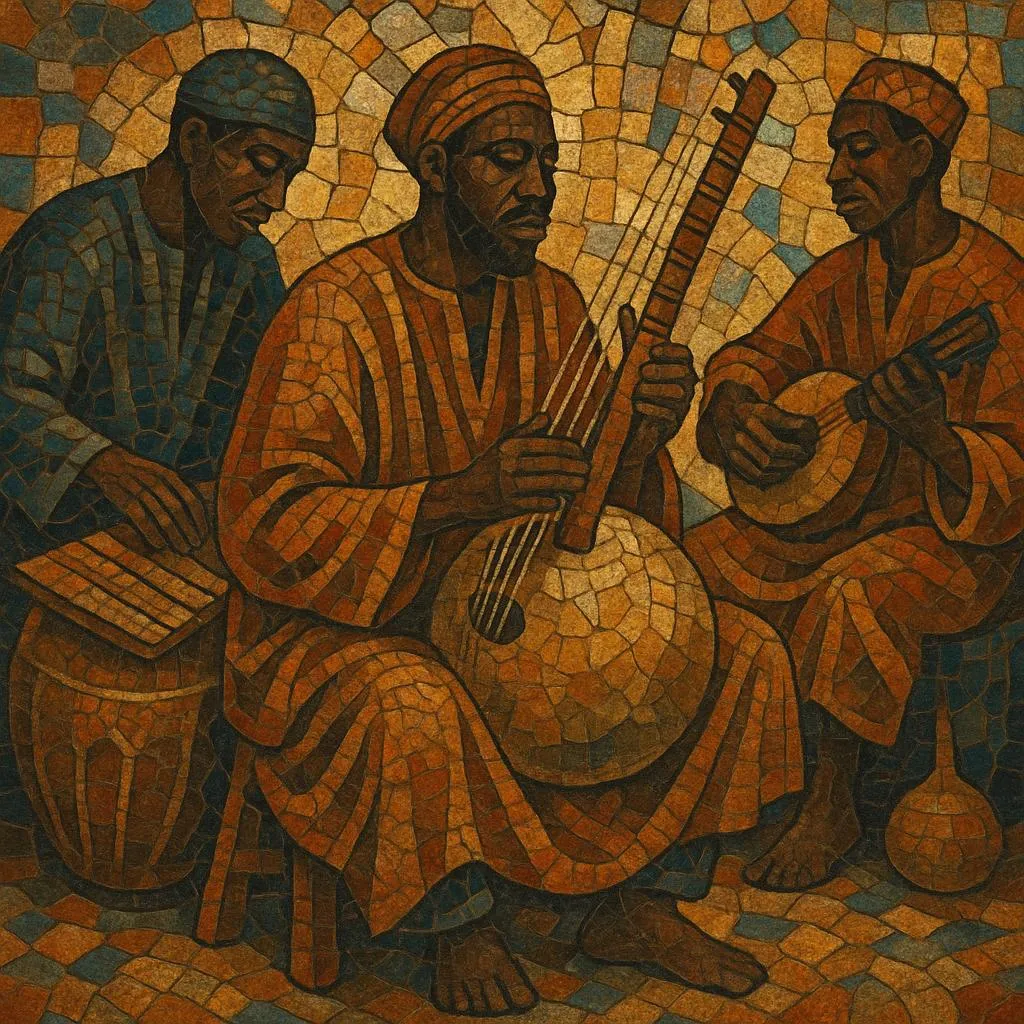
The core of Mandingo music relies on the Kora (21-string harp-lute), Balafon (wooden xylophone), and Ngoni (traditional lute). Percussion is often provided by the Djembe or Calabash. Modern interpretations may add electric bass and guitar.
Compositions are built on a foundation called Kumbengo, which is a repetitive, ostinato pattern played on the kora or guitar that establishes the groove. Over this, the soloist plays Birimintingo, which are rapid, improvised melodic runs and flourishes.
The music typically utilizes heptatonic scales (seven-note scales) that often approximate Western Lydian or Mixolydian modes. Harmonies are often quartal or quintal, moving in parallel motion.
Vocals are powerful and declamatory. The lyrical content is paramount, often consisting of praise for patrons, historical narratives, or proverbs. The structure frequently follows a call-and-response pattern between a lead singer and a chorus.