Your digging level

For this genre
0/8
🏆
Sign in, then listen to this genre to level up

Description

West African jazz is a family of big‑band and small‑combo styles that blend American jazz harmony and improvisation with the dance rhythms, melodies, and timbres of West Africa.

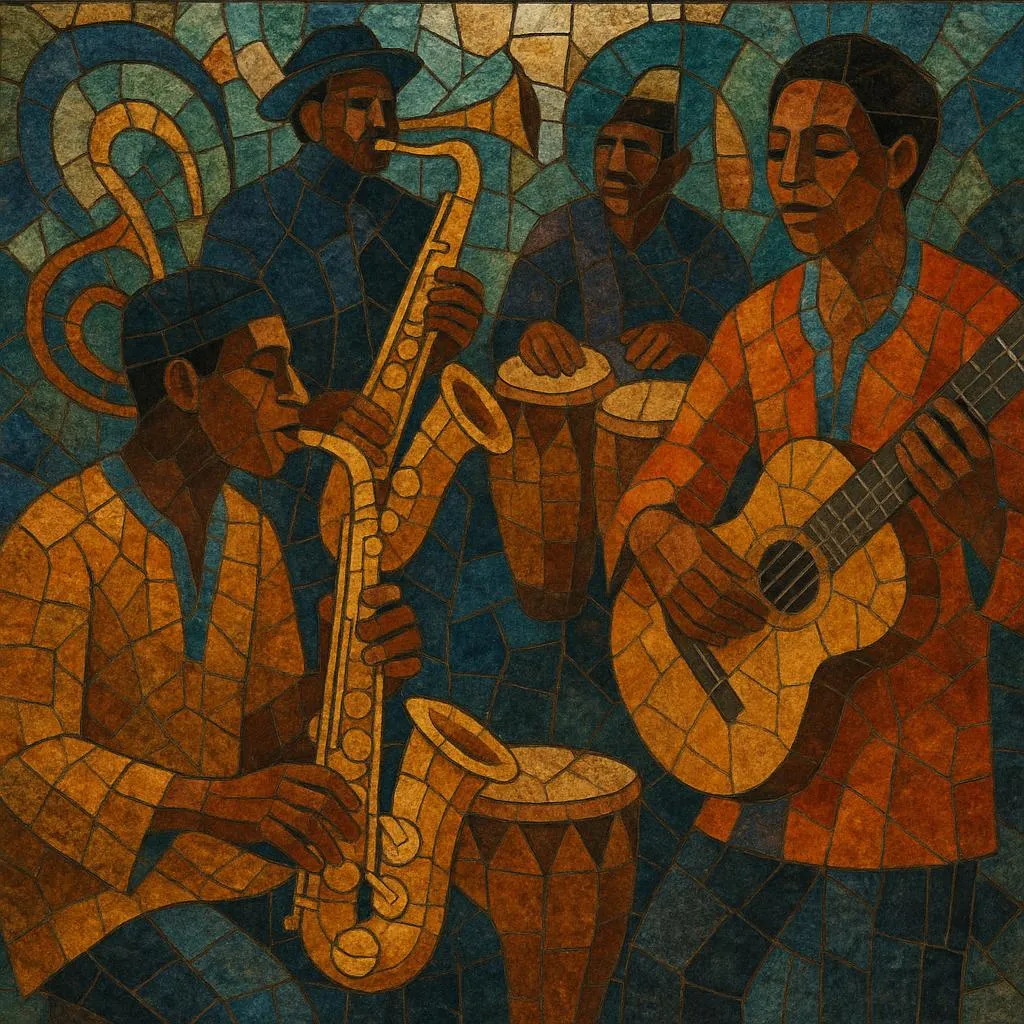
It grew out of highlife dance bands and Afro‑Cuban repertoires that swept the region via radio, vinyl, and port cities, and it absorbed griot (jeli) melodic thinking, Mandé and Wolof drum timelines, and call‑and‑response vocals. Typical ensembles pair a jazz rhythm section (drum set, bass, guitars, keyboards) and horn lines (saxophones, trumpets, trombones) with African percussion (congas, sabar, bongo, shekere), kora or balafon, and vocal languages from across the region.

The groove often sits in 12/8 or a swinging 4/4, with clave‑derived timelines, tumbao‑style bass motion, interlocking guitar arpeggios, and horn riffs arranged in parallel thirds/sixths. Harmonically, ii–V–I cadences and extended chords meet pentatonic, mixolydian, and heptatonic modes from local traditions. The result is music that is at once dance‑forward and richly improvisational.


Sources: Spotify, Wikipedia, Discogs, RYM, MB, user feedback and other online sources

History

Early Roots (1940s–1950s)

Dance bands in British and French West Africa began adapting swing and early bebop into local ballroom repertoires. In Ghana, highlife orchestras—already rich with horns, guitars, and Afro‑Caribbean rhythms—absorbed jazz harmonies and solos, establishing the template for a region‑wide sound.

Independence Era and State Orchestras (1960s)

As newly independent nations invested in culture, national and regional orchestras in Guinea, Mali, Senegal, and elsewhere fused jazz arranging with indigenous repertoires. Afro‑Cuban material (son, rumba, pachanga) filtered in via seaports and radio, catalyzing a distinctly West African, jazz‑inflected big‑band style with polyrhythmic percussion and call‑and‑response vocals.

Urban Club Circuits and Fusion (1970s)

Major hubs—Accra, Conakry, Dakar, Bamako, Banjul, Cotonou—saw club bands pair jazzy horn sections and modal solos with griot melodies, sabar and djembe timelines, and highlife/jùjú guitars. Touring circuits and pan‑African festivals spread the idiom, while recordings on state labels and European imprints carried it abroad. Jazz‑fusion colors (electric keys, wah guitars) entered the palette.

Diaspora, Experimentation, and Continuity (1980s–2000s)

Migration to Paris, London, and New York placed West African jazz alongside global jazz and world‑fusion scenes. Arrangers tightened horn writing, rhythm sections adopted funkier feels, and collaborations with kora and balafon soloists deepened the music’s modal character. Archival reissues and festivals in the 2000s–2010s renewed international attention and inspired new bands.

Today

Contemporary ensembles retain the dance‑band backbone—tight horn riffs, jazz improvisation, and African percussion—while interfacing with afrobeats, modern highlife, and global jazz. The style remains a vital bridge between local tradition and improvising practices.

How to make a track in this genre

Ensemble and Instrumentation
•   Rhythm section: drum set emphasizing a swinging 12/8 or lilting 4/4, electric bass with tumbao‑like ostinatos, rhythm and lead guitars with interlocking arpeggios and muted strums, electric piano/organ for comping. •   Horns: 2–4 parts (trumpet(s), alto/tenor sax, trombone) playing tight riffs, call‑and‑response figures, and harmonized lines in thirds/sixths. •   African color: congas/bongos, sabar or djembe, shekere/caxixi; optional kora or balafon for modal intros or featured solos.
Groove and Rhythm
•   Favor 12/8 bell patterns and clave‑derived timelines (2‑3/3‑2 feel). Let congas outline the heartbeat; drum set rides triplet swing while bass locks a cyclical line on beats 1 and 3 (12/8), anticipating chord changes. •   Layer guitar parts: one steady ostinato, one syncopated comp; leave space for horns and vocals.
Harmony and Melody
•   Combine jazz ii–V–I motion and extended chords (6/9, 13, sus) with pentatonic and mixolydian melodies common to Mandé/Wolof repertoires. •   Use call‑and‑response: lead voice (or sax) states a phrase; horns or chorus reply with a harmonized tag. •   Modal vamps work well for solos—Dorian or mixolydian over a one‑ or two‑chord cycle in 12/8.
Form and Arrangement
•   Intro vamp (percussion + guitar ostinato) → head (horn riff + verse) → solo section (sax/trumpet/guitar/kora) → breakdown (percussion/vocal call) → shout chorus (full horns) → tag ending. •   Write horn shouts that mirror local dance motifs; use dynamic swells and stop‑time hits to frame solos.
Vocal and Language
•   Lyrics can be in Akan, Wolof, Bambara, Mandinka, Ewe, or English/French; themes often celebrate social life, wisdom, love, or commentary. •   Keep melodies singable and dance‑forward; let the chorus repeat over the groove to energize the floor.
Production Tips
•   Prioritize live room feel, stereo horn image, and crisp percussion transients. Slight tape‑style saturation flatters brass and balafon; keep bass round but articulate.

Top tracks

Locked
Share your favorite track to unlock other users’ top tracks

Upcoming concerts

in this genre
Influenced by
Has influenced

Download our mobile app

Get the Melodigging app and start digging for new genres on the go
© 2026 Melodigging
Melodding was created as a tribute to Every Noise at Once, which inspired us to help curious minds keep digging into music's ever-evolving genres.
Buy me a coffee for Melodigging