Your digging level
Description
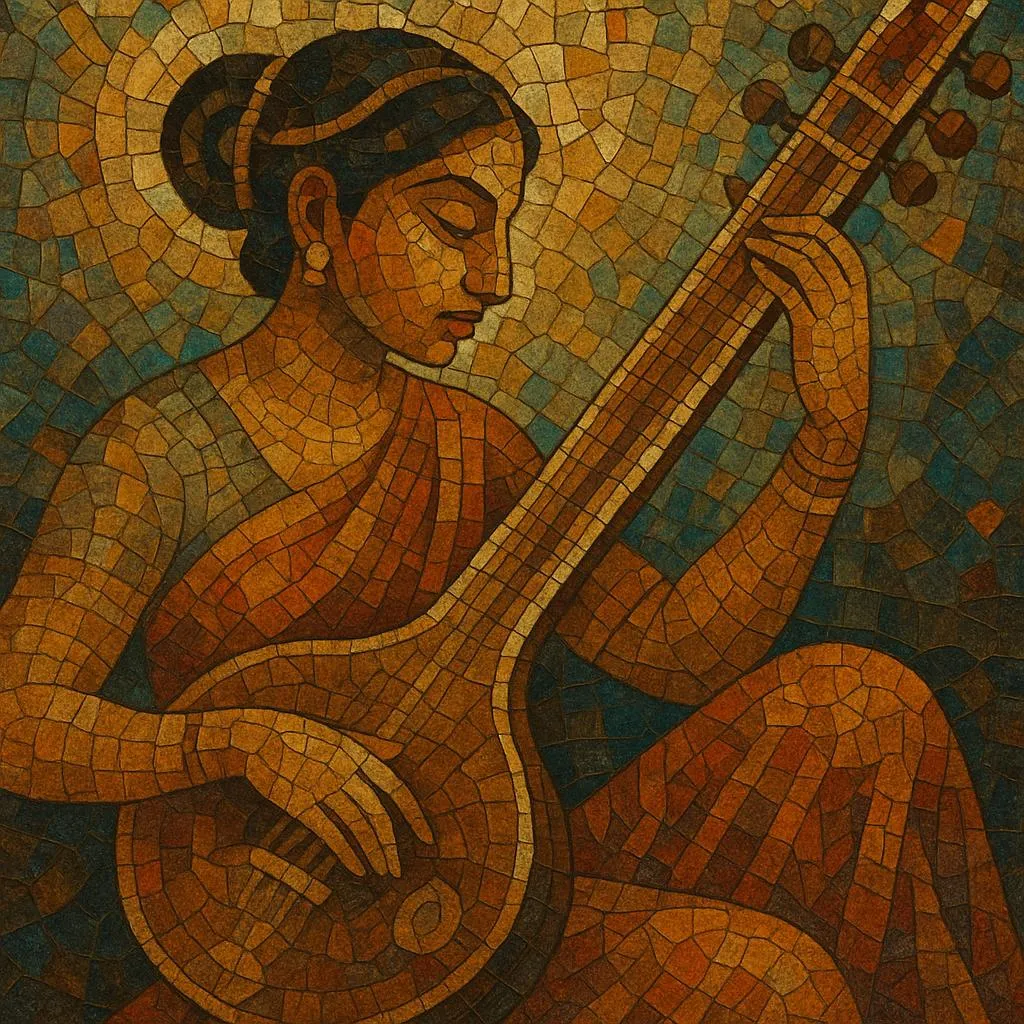
Veena (also spelled vina) is a family of long‑necked Indian lutes whose concert practice today is centered on the Saraswati veena in South Indian Carnatic music and the rudra veena and vichitra/chitraveena in North Indian (Hindustani) traditions.
In performance, the veena sings raga through continuous microtonal ornament (gamakas) and sustained, vocal‑like phrasing. Carnatic veena music features improvisatory sections such as alapana and tanam, as well as composed forms (varnam, kriti, tillana) rendered within tala (cyclic rhythms). Hindustani rudra veena performance emphasizes a deep, meditative alap–jor–jhala architecture and dhrupad aesthetics.
Timbrally, the instrument’s large resonator(s), metal strings, and wide brass frets (or a fretless plate in vichitra/chitraveena) enable expressive slides, pulls, and oscillations that articulate raga grammar with great nuance. The veena’s idiom is both devotional and virtuosic, bridging ancient theory and living classical performance.
History
References to vina/veena appear in early Sanskrit literature and are codified in Bharata’s Natyashastra (circa 200 BCE–200 CE), which describes its construction, tuning, and role in classical aesthetics (rasa). Over subsequent centuries, regional forms diversified—bowed, plucked, fretted, and fretless—cementing the veena as a principal vehicle for raga.
Between the 17th and 19th centuries, the Saraswati veena (with a large wooden resonator, 24 fixed brass frets, and four main plus drone/sympathetic strings) became the archetype in the Thanjavur court milieu. Its idiom matured alongside Carnatic pedagogy and the great composer‑performer traditions of the Trinity (Tyagaraja, Muthuswami Dikshitar, Syama Sastri). Schools such as the Karaikudi bani established right‑ and left‑hand techniques that define modern veena phrasing and gamaka execution.
In Hindustani music, the rudra veena (with two large gourds and a long hollow neck) flourished within dhrupad. Gharanas associated with the Dagar and Khandar lineages maintained a contemplative, microtonally rich style. The 20th century saw renewed attention through maestros who preserved its austere alap–jor–jhala format.
Recording, radio, and sabha culture in South India elevated concert veena soloists. The fretless goṭṭuvādya/chitraveena expanded the palette of slides and meend, while modern luthiery stabilized construction and intonation. In recent decades, veena artists have collaborated across jazz, world fusion, and film music, bringing raga phrasing and tambura‑anchored sonority into wider global circulation while sustaining rigorous classical pedagogy.