Your digging level for this genre

0/8
🏆
Sign in, then listen to this genre to level up

Description

Indian fusion blends the raga- and tala-based frameworks of Indian classical and folk traditions with the harmony, instrumentation, and production practices of genres such as jazz, rock, electronic music, and hip hop.

Hallmarks include raga-derived melodies ornamented with gamakas (microtonal inflections), cyclical tala grooves articulated on tabla or mridangam, a sustained drone (often tanpura), and extended improvisation. These sit alongside Western chord progressions, backbeat or syncopated drum-kit patterns, electric bass ostinatos, keyboards/synths, guitar effects, and contemporary studio techniques.

The style emerged from cross-cultural collaborations in the late 1960s and 1970s and matured through both India-based and diaspora scenes, later expanding into club culture and film music. Its flexibility allows acoustic concert formats, amplified jazz-rock lineups, and fully electronic live/DJ sets.

History

Early Crossovers (1960s–1970s)

Indo–Western collaboration accelerated in the late 1960s through Ravi Shankar’s exchanges with Western classical and popular musicians and the global curiosity about Indian music. The first explicitly named fusion projects appeared soon after: the London-based Joe Harriott & John Mayer Indo-Jazz Fusions, and, in India, Shakti (John McLaughlin with L. Shankar, Zakir Hussain, et al.), which fused jazz improvisation, Indian ragas, and konnakol/tabla virtuosity. These groups codified a template: raga-based themes, tala cycles, extensive improvisation, and Western harmonic motion.

Consolidation and Expansion (1980s–1990s)

Throughout the 1980s, Indian virtuosi such as L. Subramaniam and Trilok Gurtu worked with jazz, rock, and world-music circles. Parallel to concert-hall fusion, film composers increasingly hybridized Indian melody with Western harmony and instrumentation. In the late 1990s, the UK’s Asian Underground (e.g., Talvin Singh, Nitin Sawhney) injected drum & bass, trip hop, and ambient aesthetics into raga-tala vocabularies, helping popularize club-oriented Indian fusion.

2000s–2010s: Mainstream and Globalization

A. R. Rahman and a new generation bridged conservatory-grade Indian musicianship with pop hooks and cinematic orchestration, influencing both Indian film music and global pop. Artists such as Karsh Kale, Midival Punditz, and Indian Ocean mixed classical/folk idioms with electronica, rock, and hip hop, while independent folk-fusion acts (e.g., The Raghu Dixit Project) brought Kannada/Hindi lyrics and regional rhythms to indie stages and festivals.

Today

Indian fusion thrives across formats—from acoustic jugalbandi and jazz-club quartets to festival stages and electronic live/DJ sets. It functions as a flexible framework for multicultural collaboration, film scoring, and contemporary pop, continuing to evolve via modular synths, DAW-driven production, and global collaborative networks.

How to make a track in this genre

Scales and Melodic Language
•   Choose a raga (e.g., Kafi, Kalyani/Kalyan, Bhairavi) and treat it as your primary melodic mode. Outline characteristic phrases and use gamakas (ornaments) to maintain raga identity. •   Sustain a drone (tanpura, synth pad, or bowed strings) on the tonic (Sa) and fifth (Pa) to anchor modal color.
Rhythm and Groove
•   Base grooves on tala cycles (e.g., Teental 16, Rupak 7, Adi 8) played on tabla or mridangam. Layer drum-kit patterns (backbeat or syncopated funk) to create hybrid feels. •   Use common devices like tihai (threefold cadential pattern) and laykari (rhythmic modulation) to shape phrases and transitions.
Harmony and Chords
•   Start melodically (drone + modal bass) and introduce chords sparingly to preserve raga color. Favor modal harmony (sus/add9, quartal voicings) or jazz extensions (9, 11, 13) that avoid clashing with the raga’s restricted notes. •   Pedal the tonic while moving inner voices; consider borrowed chords for dramatic filmic lifts without undermining raga identity.
Instrumentation
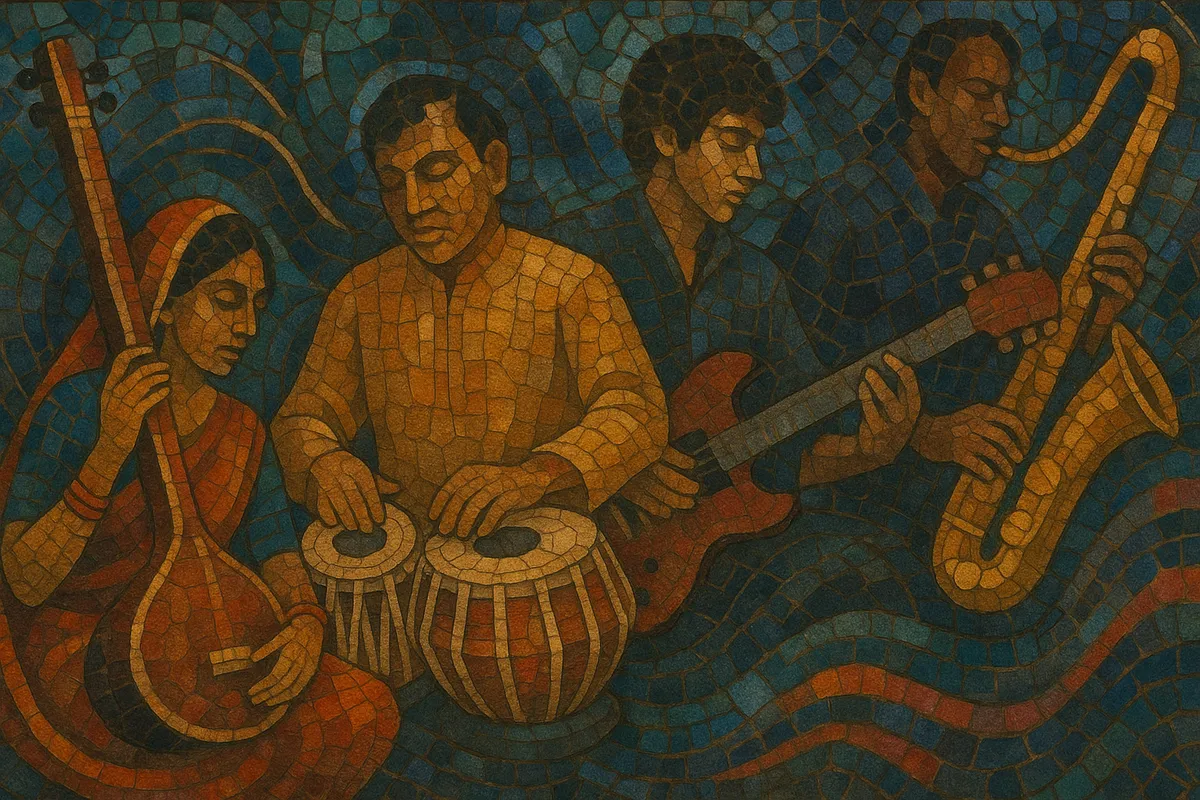
•   Indian: sitar, sarod, bansuri, violin, veena, santur/santoor, tabla, mridangam, ghatam, kanjira, tanpura. •   Western/modern: electric guitar (clean/delays), bass guitar, keyboards/synths, drum kit, DAW-based samples and sound design. •   Arrange call-and-response between melody instruments (e.g., bansuri vs. guitar) and feature solo sections for improvisation.
Form and Arrangement
•   Typical shapes: alap-like intro (free-time exploration) → band groove with theme → solos over tala/changes → tihai or unison figure to close. •   Interleave ambient interludes, breakdowns, or electronic drops for dynamic contrast.
Lyrics and Aesthetics
•   Write in Hindi, Tamil, Bengali, Urdu, English, or mix (code-switching works well). Themes often bridge devotion/spirituality with contemporary life and identity.
Production Tips
•   Blend close-mic detail on hand drums with room ambience; parallel compress the drum kit to sit under tabla clarity. •   Layer tanpura/synth drones subtly; tame resonances from sitar/sarod with gentle dynamic EQ, preserving upper-harmonic sparkle. •   Sampling folk/classical motifs is effective—credit sources and maintain cultural context.
Practice and Collaboration
•   Rehearse konnakol/bol recitation to internalize rhythmic cycles. •   Workshop with both Indian classical and jazz/rock/electronic musicians; agree on raga, tala, form, and solo order before recording or performance.

Top tracks

Locked
Share your favorite track to unlock other users’ top tracks
Influenced by
Has influenced
Challenges
Digger Battle
Let's see who can find the best track in this genre
Š 2025 Melodigging
Melodding was created as a tribute to Every Noise at Once, which inspired us to help curious minds keep digging into music's ever-evolving genres.
Buy me a coffee for Melodigging