Your digging level for this genre

0/8
🏆
Sign in, then listen to this genre to level up

Description

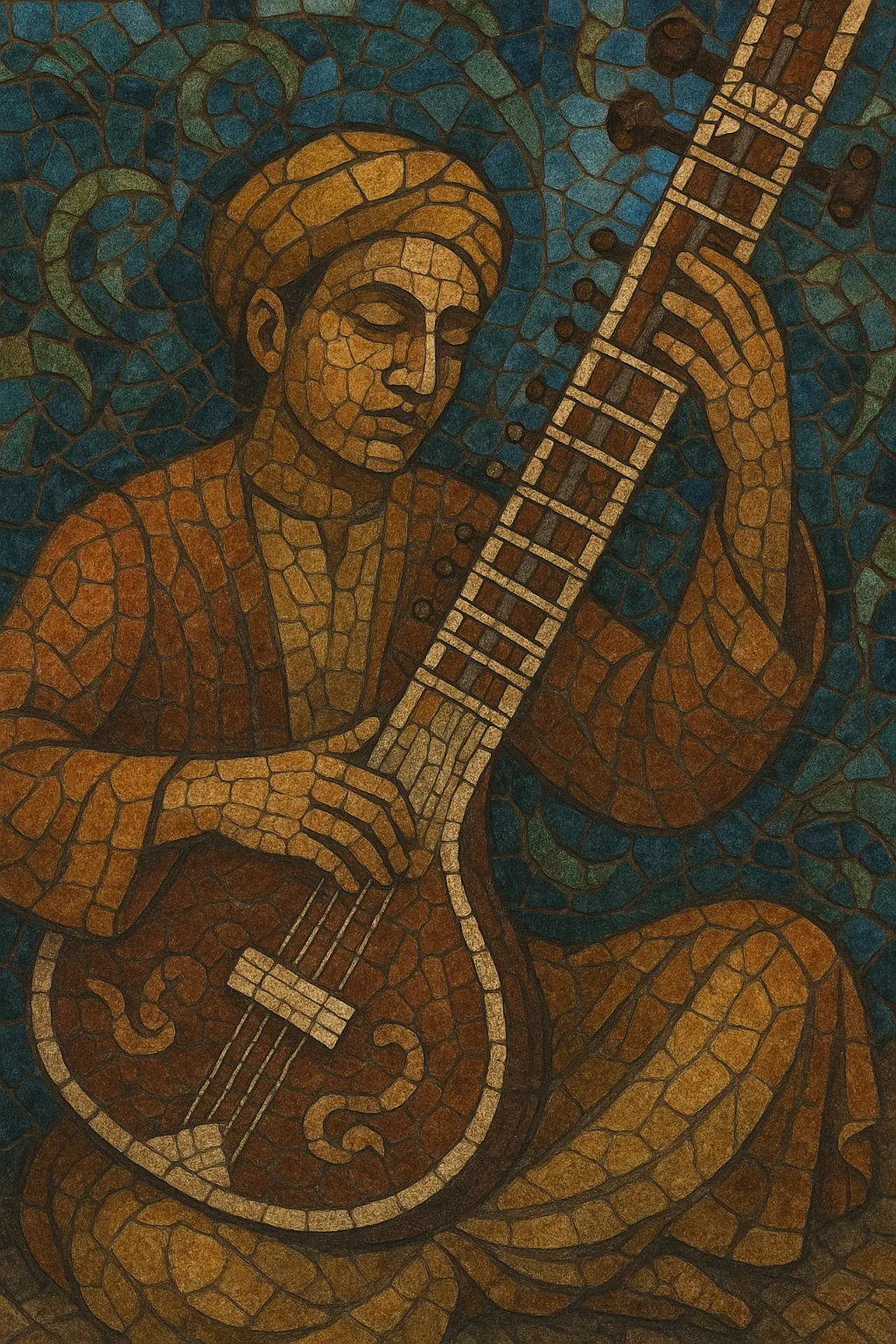
Sitar is a North Indian (Hindustani) plucked-lute tradition centered on the sitar, an instrument with fretted melody strings, rhythmic drone strings (chikari), and sympathetic strings (tarab) that resonate in response to the raga’s scale. Its sound is characterized by ringing resonance, fluid pitch bends (meend), rapid ornamental figures, and a rich, overtone-laden timbre shaped by a gourd resonator.

As a genre-practice, sitar performance unfolds within the Hindustani raga–tala framework. A typical recital progresses from a slow, unmetered alap to rhythmic jor and virtuosic jhala, and culminates in fixed compositions (gat) with tabla accompaniment. Two major stylistic lineages—Ravi Shankar’s kharaj-pancham (bass-rich, architectonic) approach and Vilayat Khan’s gayaki ang (vocal-imitative) style—define contrasting aesthetics within the tradition.

History

Origins (18th century)

The sitar crystallized in North India during the Mughal period, emerging from interactions between indigenous lute traditions (notably the veena family) and Persian musical culture (including the setar). By the 1700s, the instrument had acquired frets, sympathetic strings, and a gourd resonator, enabling the sustained, shimmering sonority essential to Hindustani ragas.

19th–early 20th century consolidation

Across princely courts and urban centers, gharanas (pedagogical lineages) codified technique, repertoire, and raga interpretation. Instrument makers refined construction, adding more tarab strings and standardizing fret layouts to accommodate nuanced intonation and long meend. Sitarists developed distinct aesthetics—some prioritizing instrumental bravura, others emulating the intricacies of khyal vocalism.

Mid-20th century: Modern masters

The 20th century produced towering figures—Ravi Shankar, Vilayat Khan, Nikhil Banerjee—who established canonical approaches. Shankar’s architecture emphasized expansive alap–jor–jhala arcs and dramatic rhythmic design, while Vilayat Khan’s gayaki ang translated micro-ornamentation and melodic contour of the voice to the fretboard. Recording and broadcasting disseminated sitar globally, and luthiery stabilized two principal set-ups: kharaj-pancham (with deep bass strings) and gandhar-pancham (lighter, more vocal-leaning).

Globalization and crossovers (1960s–1990s)

Sitar entered popular consciousness in the West through collaborations (e.g., Ravi Shankar and George Harrison) and inspired raga rock and psychedelic pop. Indo jazz experiments and worldbeat contexts incorporated sitar timbres, while concert traditions remained anchored in raga purity and improvisational depth.

21st century: Tradition and innovation

Contemporary sitarists balance lineage fidelity with innovation—new ragas, rhythmic hybrids, and chamber formats. Enhanced recording, amplification, and global pedagogy broaden the instrument’s reach, while the core grammar of raga, tala, meend, and tihais remains central.

How to make a track in this genre

Instruments and setup
•   Use a full-size sitar with 6–7 main strings (including chikari) and 11–13 sympathetic strings (tarab). Choose either kharaj-pancham (deeper bass strings; Ravi Shankar style) or gandhar-pancham (lighter, vocal-leaning; Vilayat Khan style). •   Tune the melody string to Sa (tonic), with chikari set to Sa and Pa (or Sa variants depending on raga). Tune tarab individually to the raga’s scale to maximize resonance.
Raga and tala selection
•   Pick a raga with clear aroha–avaroha (ascent/descent), vadi–samvadi (primary/secondary tones), and characteristic pakad (motif). Maintain raga grammar strictly, especially intonation of microtonal inflections. •   For the gat section, select a tala (e.g., Teentaal 16, Ektaal 12, Jhaptaal 10). Internalize sam (downbeat), khali (empty beat), and vibhag (sections).
Formal design
•   Alap: Unmetered, slow exposition of the raga from lower register upward, employing long meend and subtle gamak. Avoid rhythmic pulse; prioritize breath-like phrasing. •   Jor: Introduce a steady pulse with right-hand strokes (da–ra patterns), developing sequences and expanding register. •   Jhala: Accentuate rapid chikari strokes, creating sparkling rhythmic textures and climactic energy. •   Gat: Present a fixed composition with tabla. Begin in vilambit (slow), then move to drut (fast). Craft tihais (threefold cadences) to land emphatically on sam.
Technique and ornamentation
•   Left hand: Execute wide meend (1–5 semitones or more), kan (grace notes), andolan (slow oscillation), and murki/krintan (quick turns). Keep intonation precise against fret positions by controlling finger pressure and pull length. •   Right hand: Develop crisp mizrab articulation for da–ra alternations, bol permutations, and sustained chikari shimmer. Balance resonance and clarity so tarab rings without blurring melodic intent.
Composition and improvisation workflow
•   Motif building: Derive phrases from the raga’s pakad, then sequence and vary them across registers. •   Rhythmic design: Place mukhda (pickup) to resolve on sam; design tihais with mathematically balanced subdivisions. •   Dynamics and pacing: Shape a long-form arc—meditative alap, propulsive jor, brilliant jhala, and structured gat(s)—preserving raga identity throughout.
Accompaniment and sound
•   Use tanpura (or a high-quality electronic drone) tuned to Sa–Pa–Sa–Sa to anchor intonation. •   Coordinate with tabla: Agree on tempo evolution, tihai cues, and tihai lengths; leave space for tabla relas in faster sections.
Notation and practice
•   Use sargam (Sa Re Ga Ma Pa Dha Ni) for sketching ideas, but prioritize aural learning. •   Slow practice for clean meend and stable pitch; record sessions to evaluate sustain, clarity, and raga fidelity.

Top tracks

Locked
Share your favorite track to unlock other users’ top tracks
Influenced by
Has influenced
Challenges
Digger Battle
Let's see who can find the best track in this genre
© 2025 Melodigging
Melodding was created as a tribute to Every Noise at Once, which inspired us to help curious minds keep digging into music's ever-evolving genres.
Buy me a coffee for Melodigging