Your digging level

For this genre
0/8
🏆
Sign in, then listen to this genre to level up

Description

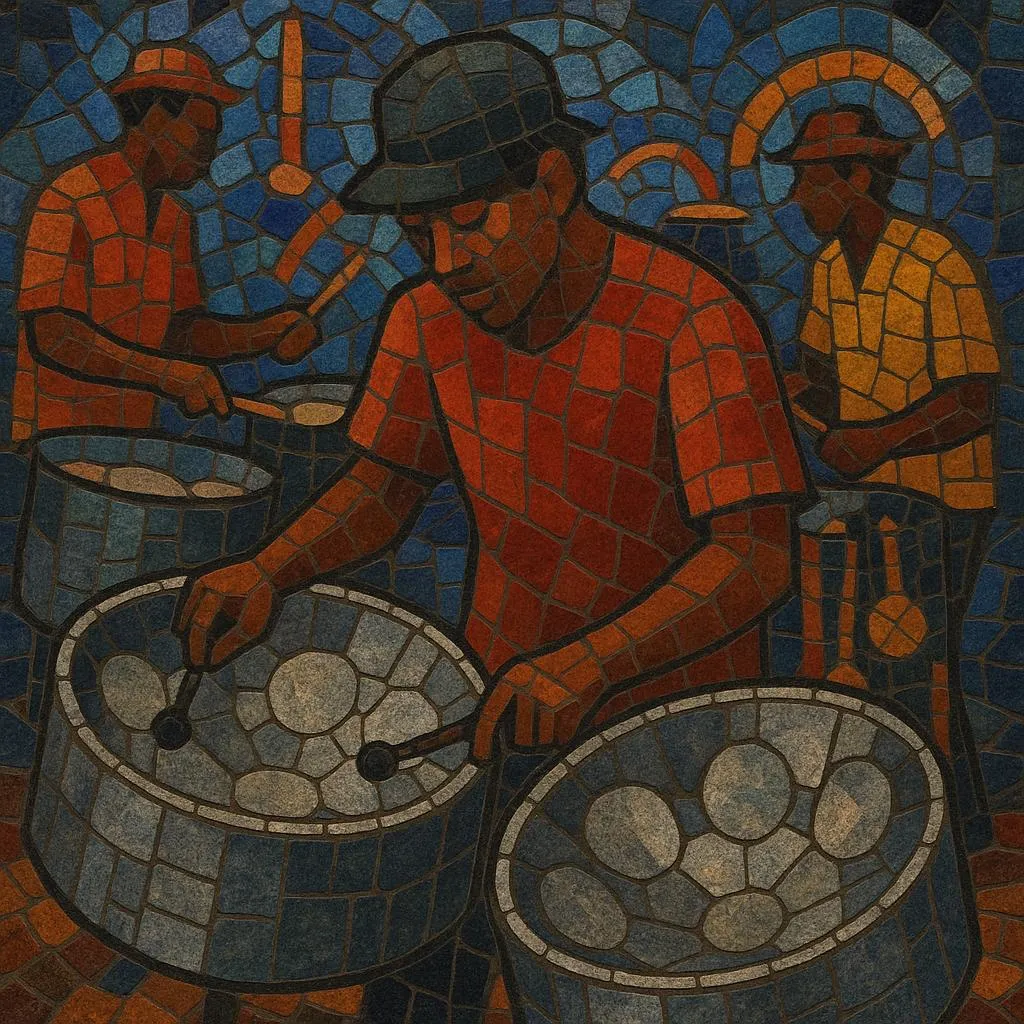
Steelpan (or steel band) is a Trinidad and Tobago–born musical tradition centered on the steelpan family of pitched percussion instruments forged from industrial metal drums.

An ensemble typically includes lead (tenor) pans for melody, inner-voice pans such as double seconds and guitar pans, cello pans for counterlines and pads, and six-to-nine bass pans for low-end lines. A dedicated “engine room” (drum set, brake drums/"iron", congas, cowbell, güira/scraper, shakers) drives the rhythm. Repertoire ranges from calypso and soca to jazz, classical arrangements, film themes, popular song, and original panorama pieces.

The music is bright, percussive and harmonically rich, using voicings and orchestrations conceived for the unique note layouts and overtone spectra of the pans. It is both a street-marching and concert-hall art form, celebrated annually at Carnival and exported worldwide through community bands, conservatories, and touring ensembles.


Sources: Spotify, Wikipedia, Discogs, RYM, MB, user feedback and other online sources

History

Origins (1930s–1940s)

Steelpan’s roots lie in the working-class neighborhoods of Port of Spain, Trinidad, where African-descended communities adapted percussive traditions to available materials. After bans on traditional skin drums in the early 20th century, musicians turned to tamboo bamboo (struck bamboo tubes) and then to metal containers and biscuit tins. By the late 1930s and into the 1940s, innovators began sinking, tempering, and tuning metal surfaces to produce discrete pitches, creating the first melodic pans.

The oil drum revolution and early innovators

World War II logistics left 55-gallon oil drums on the island; tuners discovered these were ideal blanks for shaping stable, resonant instruments. Pioneers such as Winston “Spree” Simon (early melodic tenor), Ellie Mannette (shaping, sinking, chroming, and standardized tuning methods), Anthony Williams (the “spider-web” note layout and the four-pan cello family), and Bertie Marshall (acoustical refinements and amplification) transformed a street practice into a coherent instrument family.

Steelbands, Carnival, and Panorama (1950s–1980s)

Steelbands organized around local “yards” became the sonic heartbeat of Trinidad’s Carnival, parading and competing with large, highly disciplined ensembles. From the 1960s, the national Panorama competition formalized large-scale arranging, orchestration, and virtuosity. Arrangers like Clive Bradley, Jit Samaroo, Ray Holman, and Len “Boogsie” Sharpe expanded harmonic language, formal development, and counterpoint, while maintaining the groove foundations of calypso and, later, soca.

Global spread and new contexts (1990s–present)

By the late 20th century, steelpan had spread to the wider Caribbean, North America, Europe, Africa, and Asia, entering schools, universities, and concert stages. Pan ensembles now tackle jazz, classical masterworks, and contemporary commissions; “pan jazz” and chamber configurations flourished, and solo virtuosi emerged. Advances in metallurgy, tempering, and tuning stabilized concert pitch and projection, while pedagogies and notation systems (lead sheets, bespoke pan parts, and full scores) helped codify the art.

Sound and technique

Steelpans are convex, tuned idiophones: each note area is carefully hammered, grooved, and tempered to excite a strong fundamental with controlled overtones. Players use rubber-tipped sticks, employing single strokes, rolls for sustain, and idiomatic stickings shaped by each pan’s note map. The engine room provides the relentless, kinetic pulse that links steelband music to Carnival streets as much as to the concert hall.

How to make a track in this genre

Ensemble and roles
•   Lead/tenor pan carries the melody; write idiomatic lines that favor scalar motion and arpeggiation across its circular “spider-web” note layout. •   Inner voices (double seconds, guitars) comp with off‑beat strums, broken chords, and rhythmic counterlines. Use alternating stickings to articulate syncopations cleanly. •   Cello pans provide mid‑range pads, counter‑melodies, and rhythmic ostinati; write wide, legible voicings that exploit their three-octave coverage across multiple shells. •   Bass pans (6–9 bass) anchor harmony with punchy, often anticipatory figures (pickups into the downbeat) to lock with the engine room. •   Engine room (drum set, iron/brake drum, congas, cowbells, shakers) supplies the groove. Notate core patterns but allow section leaders to personalize parts.
Rhythm and groove language
•   For calypso: 95–120 BPM with a buoyant “and-of-2” lift; interlock iron patterns, hi-hat offbeats, and kick drum on 1 & 3 (or soca-style 4-on-the-floor for modern drive). •   For soca: 115–150 BPM; emphasize steady four-on-the-floor, strong backbeat, and bright percussion figures (cowbell, scratcher) to energize the dance pulse. •   Use call‑and‑response between melody and engine room breaks; write tactical stop‑times to frame sectional “breakaways.”
Harmony, melody, and form
•   Common harmonic language: I–IV–V frameworks enriched by secondary dominants, ii–V–I turnarounds, modal mixture (bVII), and tritone substitutions for jazz‑flavored color. •   Orchestrate melody in the lead pan, reinforce with octave doublings (seconds/cellos) at climaxes; use contrary‑motion counterlines to maintain clarity. •   Employ drop‑2/3 voicings adapted to pan layouts; avoid dense clusters that blur on metallic sustain unless for special effect. •   Structure Panorama‑style works with: Intro → Statement (song/theme) → Variations/Development (modulations, metric shifts, breakaways) → Engine‑room break → Recap/Tags → Coda.
Notation, techniques, and rehearsal
•   Provide bespoke parts labeled by pan type; indicate stickings and rolls (tremolo marks) for sustained tones. •   Balance is crucial: orchestrate so guitars/cellos don’t mask lead; keep bass lines rhythmically tight with iron patterns. •   Rehearse sectionals first; then integrate with the engine room to refine interlocks, dynamics, and tempo transitions.
Sound design and recording
•   Tune pans to concert pitch with consistent stretch; mic close with overheads for ensemble, and spot-mic lead/bass judiciously. Control harsh highs with gentle EQ dips around 4–6 kHz; preserve transient sparkle.
Compositional tips
•   Write grooves the players feel first; then layer harmony and counterpoint. •   Exploit the instrument’s timbral shimmer with antiphonal scoring (left/right seconds, cello choirs). •   Save your boldest reharmonizations and modulations for the final third to maximize crowd impact.

Top tracks

Locked
Share your favorite track to unlock other users’ top tracks

Upcoming concerts

in this genre
Influenced by
Has influenced

Download our mobile app

Get the Melodigging app and start digging for new genres on the go
© 2026 Melodigging
Melodding was created as a tribute to Every Noise at Once, which inspired us to help curious minds keep digging into music's ever-evolving genres.
Buy me a coffee for Melodigging