Your digging level

For this genre
0/8
🏆
Sign in, then listen to this genre to level up

Description

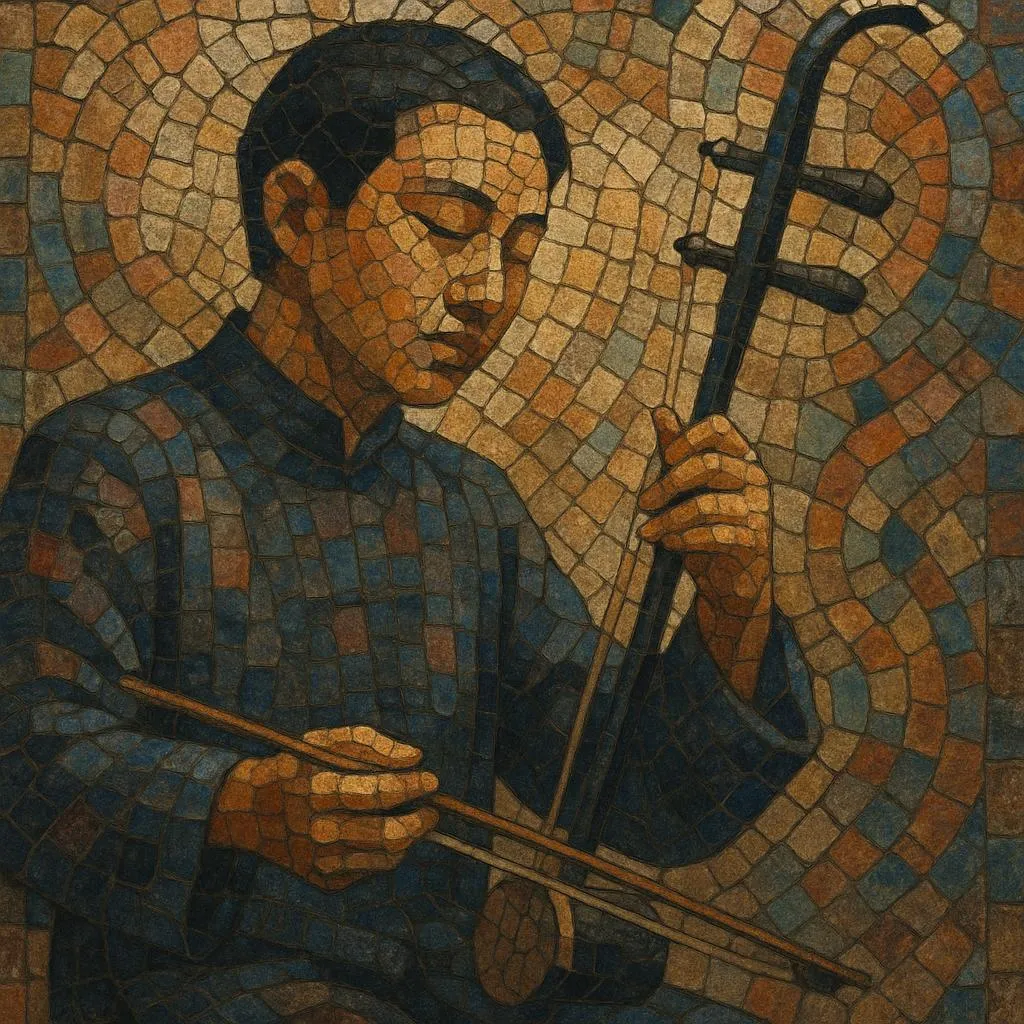
Erhu is a Chinese two‑string bowed lute (a member of the huqin family) whose singing, voice‑like timbre can move seamlessly between lyrical cantabile lines and brilliant, percussive articulations. It is held vertically on the left thigh, with the bow hair running between its two strings, which are usually tuned a fifth apart (D4–A4).

As a genre label, “erhu” refers to the solo and ensemble repertoire centered on the instrument—music that ranges from folk‑derived melodies and opera idioms to conservatory‑style concert works and contemporary fusion. Its melodic language draws heavily on pentatonic and modal materials from various Chinese regional traditions, while modern compositions expand technique, form, and orchestration for Chinese orchestra and mixed ensembles.

The instrument’s expressive palette—portamento, nuanced vibrato, ornamental slides, wide dynamic range—gives erhu music a distinctive capacity for lyrical narrative, tender intimacy, and dramatic storytelling.


Sources: Spotify, Wikipedia, Discogs, RYM, MB, user feedback and other online sources

History

Origins and Early Development

The erhu descends from the broader huqin family that entered the Chinese court and folk spheres by the Tang–Song periods. For centuries it functioned primarily in folk ensembles and opera accompaniment, absorbing regional idioms and vocal aesthetics.

Modernization in the Early 20th Century

The emergence of erhu as a concert solo genre crystallized in the 1920s–1930s. Composer‑pedagogue Liu Tianhua codified technique, expanded left‑ and right‑hand vocabulary, and created a notated solo repertoire that fit modern concert platforms. Parallel to conservatory reforms in Shanghai and Beijing, street and temple musicians (notably the blind itinerant master A Bing) showed the instrument’s profound expressive potential, shaping the public imagination and influencing later concert works.

People’s Republic Era and Orchestral Expansion

From the 1950s onward, state ensembles and conservatories standardized tuning, pedagogy, and notation (jianpu and staff). Arrangers integrated erhu into the newly forged modern Chinese orchestra, where it became the principal bowed voice. Composers explored symphonic forms, concertos, and programmatic tone poems, elevating the instrument from folk settings to national stages.

Globalization and Crossover

From the late 20th century, virtuosic soloists toured internationally and recorded widely, introducing erhu to world‑music stages, film scores, and cross‑genre collaborations (jazz, new age, ambient, pop, and post‑rock). Today, the genre includes historically rooted solos, large‑scale concert works, and boundary‑pushing hybrids, all anchored by the erhu’s unmistakable, voice‑like expressivity.

How to make a track in this genre

Setup and Sound
•   Tune to D4–A4 (a fifth). Exploit the instrument’s natural register: soulful mids, brilliant upper positions, and a warm, resonant low string. •   Write lines that "breathe" like a singer; the erhu excels at cantabile phrasing with rubato and nuanced dynamics.
Scales, Modes, and Harmony
•   Favor pentatonic sets (gong, shang, jue, zhi, yu) and related modal inflections. Color tones (b3, b7, or raised 4th) can evoke specific regional flavors. •   Harmony is often implied melodically; when accompanying with piano, yangqin, pipa, guitar, or strings, use open fifths, drones, and parallel fourths/fifths to preserve timbral clarity.
Rhythm and Form
•   Combine free‑tempo introductions (sanban) with metered sections (youban). ABA, rondo, theme‑and‑variations, or episodic narrative forms are idiomatic. •   Rhythms may reference dance meters or opera patterns; allow flexible tempo for cadential ornaments and climactic slides.
Technique Vocabulary (Write It In!)
•   Left hand: portamento and ornamental slides (hua yin), varied vibrato speeds/widths, trills, mordents, harmonics, occasional double‑stops. •   Right hand: long legato bows, expressive swells, accented strokes, tremolo for intensity, light detaché/spiccato effects in brisk passages. •   Cadential gestures: appoggiaturas, grace‑note turns, and wide expressive glissandi are characteristic.
Orchestration and Texture
•   For Chinese orchestra, pair the erhu with yangqin or ruan for rhythmic bed and with dizi or sheng for coloristic dialogues. •   In hybrid settings, let erhu carry the lyrical lead above sustained pads (strings/synths) or minimalist ostinati; avoid over‑dense midrange to protect its vocal presence.
Notation and Production
•   Use jianpu (numbered) or staff notation with detailed phrasing, bowing, fingerings, and slide directions. •   In studio mixing, gentle presence EQ (2–5 kHz), controlled sibilant highs, and a natural room reverb preserve the instrument’s breathy, human quality.

Top tracks

Locked
Share your favorite track to unlock other users’ top tracks

Related labels

Upcoming concerts

in this genre
Influenced by
Has influenced

Download our mobile app

Get the Melodigging app and start digging for new genres on the go
© 2026 Melodigging
Melodding was created as a tribute to Every Noise at Once, which inspired us to help curious minds keep digging into music's ever-evolving genres.
Buy me a coffee for Melodigging