Your digging level
Description
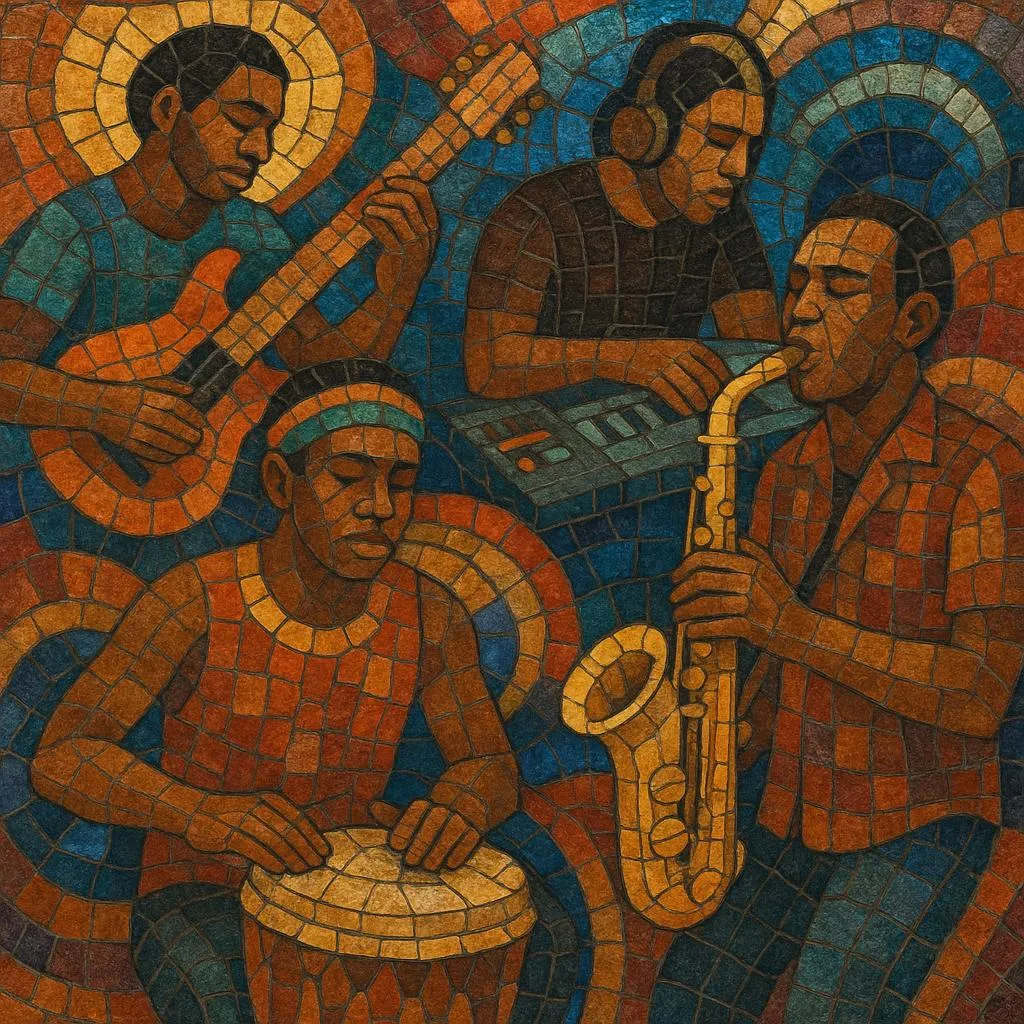
Afrobeat fusion is a modern hybrid that blends the classic Nigerian/Ghanaian Afrobeat template—polyrhythmic drums, interlocking guitars, deep bass vamps, and punchy horn sections—with contemporary styles such as house, hip‑hop, dub, nu‑jazz, disco, and broader electronic production.
Where traditional Afrobeat foregrounds long, hypnotic grooves and socially charged, call‑and‑response vocals, Afrobeat fusion often shortens forms for the club, layers in synthesizers and drum machines, employs studio effects (filters, delays, tape echo, side‑chain pumping), and borrows arrangement ideas from DJ culture. The result keeps the music’s West African rhythmic DNA intact while widening its timbral palette and harmonic vocabulary for global dance floors and modern listeners.
History
Afrobeat was forged in late‑1960s/1970s Nigeria by Fela Kuti and collaborators, melding highlife and Yoruba percussion with American funk and jazz horn writing. Its long‑form vamps, polyrhythms, and political edge became canonical. Parallel developments in disco, dub, and electronic studio craft created future tools that would later be folded into Afrobeat’s language.
A global Afrobeat revival began in the 1990s, especially in New York and London, as large ensembles and crate‑digging DJs rediscovered vintage West African recordings. Bands adopted the core Afrobeat rhythm section and horn aesthetics, but framed them with contemporary funk, nu‑jazz, and club sensibilities—laying the groundwork for explicitly cross‑genre, producer‑driven Afrobeat fusion.
Veteran Afrobeat musicians collaborated with electronic producers and jazz, rock, and techno artists. Studio‑first approaches grew: four‑on‑the‑floor kicks sat beneath traditional percussion, dub techniques were applied to horns and guitars, and synthesizers doubled or replaced keyboard parts. Labels, reissue culture, and festival circuits amplified the sound and audience, pushing the music into broader club and live settings.
Afrobeat fusion diversified across continents. UK‑based jazz collectives, North and South American funk/Latin scenes, and African urban producers converged on a shared toolkit: Afrobeat groove logic plus modern production and pop forms. Streaming platforms and global DJ networks spread cross‑pollinations with house, broken beat, hip‑hop, and electronic jazz. Today, Afrobeat fusion thrives both on stage with large horn‑driven ensembles and in producer studios crafting DJ‑friendly, edit‑ready versions that retain the heartbeat of West African rhythm.

![THIS AFROBEATS IS ACTUALLY FIRE 🔥. [GUITAR AFRO BEAT TUTORIAL ON FL STUDIO ]](https://i.ytimg.com/vi/-BG3uK1FYSg/hqdefault.jpg)