Your digging level

For this genre
0/8
🏆
Sign in, then listen to this genre to level up

Description

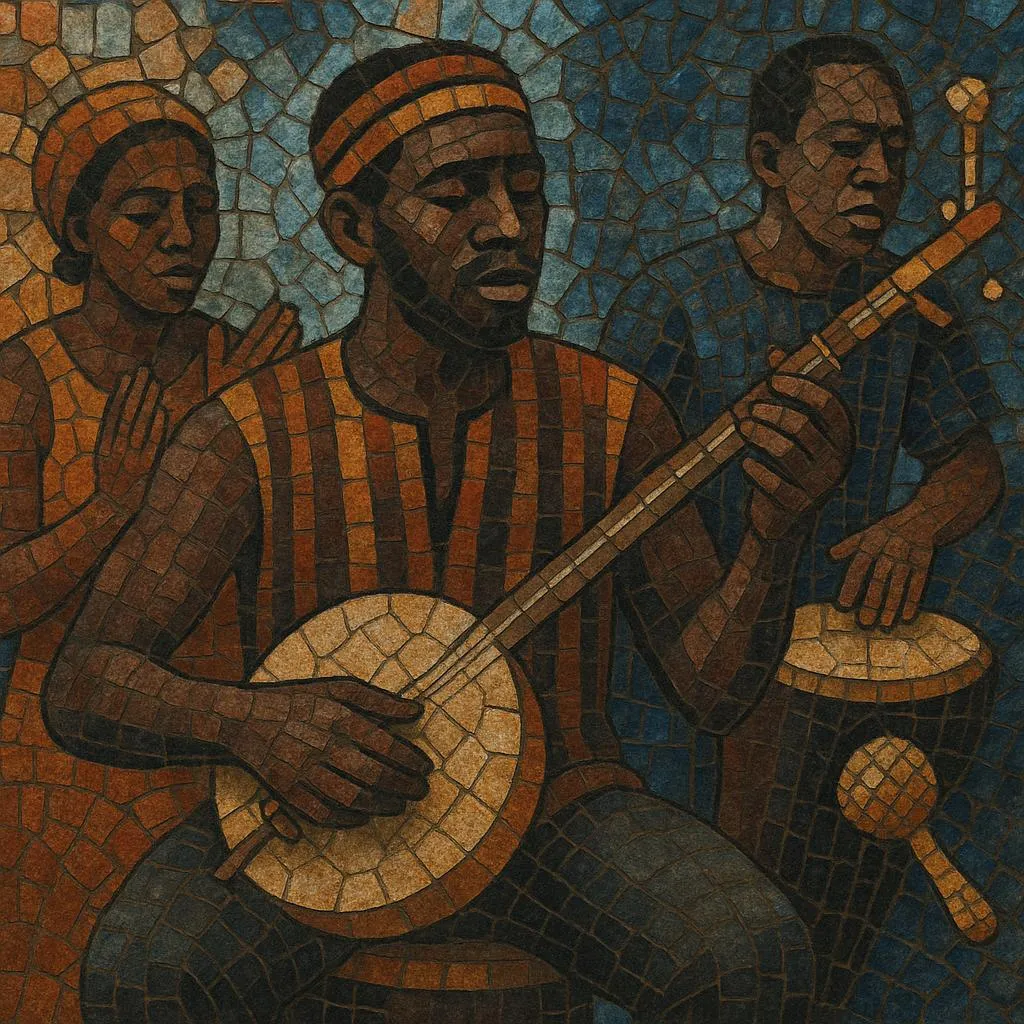
Frafra is a traditional music of the Frafra (Gurune) people from the Upper East Region of northern Ghana (and contiguous areas of Burkina Faso).

Its most emblematic sound centers on the kologo, a two‑string skin‑headed lute whose bright, buzzing timbre is driven by steady ostinatos, call‑and‑response singing, handclaps, calabash/gourd percussion, and shakers. Melodies are largely pentatonic, vocals are raw and declamatory, and lyrics—typically sung in Gurune/Frafra—carry social commentary, praise, moral counsel, and celebration.

Since the late 20th century, Frafra traditions have also crossed into amplified contexts: kologo lines interlock with drum kits, bass, and synths, producing a lean, urgent groove heard on modern stages while retaining the music’s earthy pulse and participatory feel.


Sources: Spotify, Wikipedia, Discogs, RYM, MB, user feedback and other online sources

History

Origins and functions

Frafra music is rooted in the communal life of the Frafra (Gurune) people of northern Ghana. For centuries, small ensembles around a two‑string lute (kologo), calabash percussion, rattles, and voices animated rites of passage, funerals, market‑day dances, and praise‑singing. Songs transmit oral history, admonition, and praise, with leaders and chorus in tight call‑and‑response.

Colonial era to post‑independence

With 20th‑century radio, records, and Ghana’s highlife boom, Frafra performers encountered new instruments and stage contexts. While the core kologo idiom remained village‑based, amplification and urban gigs brought local praise musicians into contact with highlife bands and later sound systems, seeding a hybrid practice without displacing the acoustic lineage.

Late 20th century revival and international attention

From the 1990s into the 2000s, charismatic kologo players began touring beyond the region. Artists such as Atongo Zimba and King Ayisoba presented the stark, percussive kologo sound to national and international audiences, often with minimal accompaniment that foregrounded vocal grit and driving ostinatos. Compilation projects and European labels helped circulate the style globally.

2010s–present: Fusion and global circuits

A new cohort—Guy One, Stevo Atambire, Ayuune Sule, and the band Alostmen—expanded the palette with bass, drum kit, and occasional electronics while honoring the instrument’s rhythmic heart. Parallel Frafra‑language gospel and praise ensembles (e.g., Alogte Oho & His Sounds of Joy) adapted local melodic shapes to choral and brass textures. Today, Frafra music stands both as an enduring village tradition and as a modern, exportable roots sound that influences Ghana’s alternative and fusion scenes.


How to make a track in this genre

Core instrumentation and tuning
•   Center the kologo (two strings over a skin head on a calabash or wooden body). Traditional tunings often place the two strings a fifth or an octave apart, enabling a droning open string while the other outlines the riff. •   Add calabash or gourd percussion, shakers, handclaps, and, in modern settings, bass guitar and a sparse drum kit (kick, snare, hi‑hat) to reinforce the groove without crowding the lute.
Rhythm and groove
•   Aim for cyclical ostinatos in 2/4 or a lilting 12/8 feel; think short repeating cells with micro‑variations. •   Emphasize off‑beat handclaps and calabash accents; keep the pulse unwavering to invite call‑and‑response participation and dance.
Melody and harmony
•   Use pentatonic melodies (major or minor pentatonic) with narrow ranges that sit well over a drone. •   Avoid Western chord changes; imply harmony through the kologo drone plus melodic contour and rhythmic tension/release.
Text and delivery
•   Write in Gurune/Frafra (or a local language), addressing praise, proverbs, social advice, and topical themes. •   Lead vocals are direct and declamatory; intersperse with a responsive chorus. Ornament phrases with speech‑like inflections more than with melisma.
Arrangement and production (modern stage)
•   Keep mixes dry and intimate so the kologo’s buzz and the voice’s grain cut through. •   Layer subtle bass notes doubling the kologo root; use sparse, tight drums (no heavy cymbal wash). Light synth drones can mirror the kologo’s open string.
Practice tips
•   Build songs from a compelling one‑ or two‑bar kologo riff; develop lyrics and responses over that loop. •   Rehearse entrances/exits for chorus responses and percussion breaks to heighten the music’s communal, participatory arc.

Top tracks

Locked
Share your favorite track to unlock other users’ top tracks

Upcoming concerts

in this genre
Influenced by
Has influenced

Download our mobile app

Get the Melodigging app and start digging for new genres on the go
© 2026 Melodigging
Melodding was created as a tribute to Every Noise at Once, which inspired us to help curious minds keep digging into music's ever-evolving genres.
Buy me a coffee for Melodigging