

Your digging level

For this genre
0/8
🏆
Sign in, then listen to this genre to level up

Description

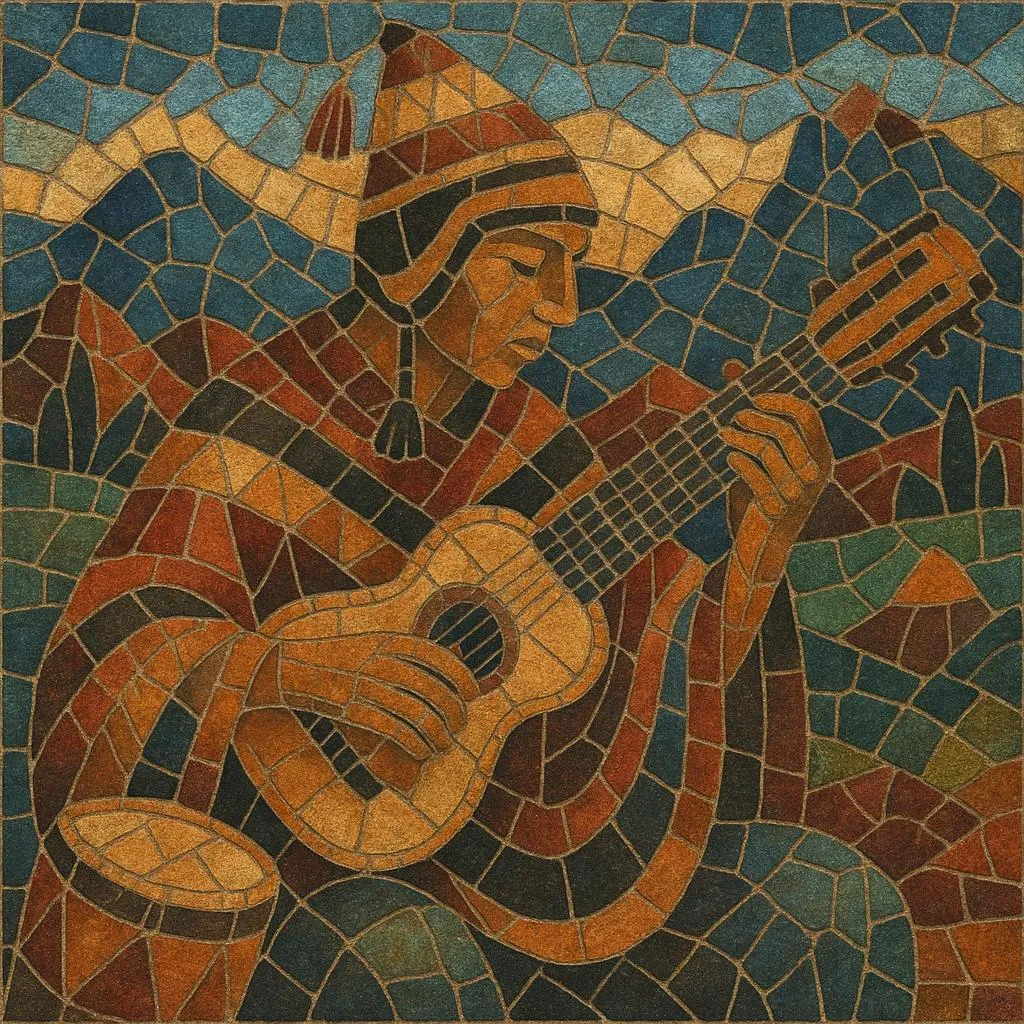
Charango refers to the Andean tradition of music centered on the charango, a small, bright‑sounding 10‑string lute that emerged in the central Andean highlands during the colonial era.

Typically built today with a carved wooden bowl (historically sometimes with armadillo shell), the instrument uses reentrant tuning (commonly sol–do–mi–la–mi / G–C–E–A–E across five courses), producing a chiming, bell‑like timbre ideal for rapid strums, cross‑rhythms, and tremolo melody lines.

Charango music accompanies and carries the melodies of regional dances and songs such as huayno, carnavalito, cueca boliviana, tinku, kaluyo, and saya, and often appears with panpipes (siku), end‑blown flutes (quena), and bombo/wankara drums. Beyond folk ensembles, the charango has become a solo concert instrument and a modern studio color in film, pop, and world fusion.


Sources: Spotify, Wikipedia, Discogs, RYM, MB, user feedback and other online sources

History

Origins (18th–19th centuries)

The charango took shape in the central Andes during the colonial period, adapting Iberian baroque/early guitar and vihuela practices to local craftsmanship and aesthetics. Indigenous and mestizo musicians embraced the compact lute for portability in highland festivities and rituals. Reentrant tuning and dense strumming idioms developed to project melody and rhythm in outdoor settings.

Regionalization and Ensemble Roles (late 19th–mid‑20th centuries)

By the late 1800s and early 1900s, distinct Andean regions (especially Bolivia and southern Peru, extending into northwest Argentina and northern Chile) cultivated local repertoires—huayno, cueca boliviana, carnavalito, tinku, kaluyo—where the charango alternated between fast arpeggiated melody, harmonic “campanella” textures, and percussive rasgueados. Larger/smaller relatives (ronroco, charangón) expanded its range, and luthiers refined wooden bowlback builds.

Professionalization and Nueva Canción (1950s–1970s)

Radio, records, and folk ensembles professionalized charango performance. Virtuosi and pedagogues systematized technique and tunings. During the 1960s–70s Nueva Canción movement, the instrument became a sonic emblem of Andean identity and social protest. Chilean and Bolivian ensembles showcased its capability as both accompanist and lead instrument on international stages.

Global Reach and Concertization (1980s–present)

From the 1980s onward, the charango entered world‑fusion, popular music, and cinema. Composers wrote concert works; players adapted classical techniques (tremolo, campanella scales, mixed articulations) to solo recital contexts. National and regional festivals (notably in Bolivia) fostered pedagogy and luthiery, while modern builders created electro‑charangos and extended‑range models. Today, the instrument is equally at home in traditional ensembles, contemporary folk/rock hybrids, and film and ambient scores.

How to make a track in this genre

Instruments and Tuning
•   Use a standard 10‑string charango (5 courses) with common reentrant tuning G–C–E–A–E (sol–do–mi–la–mi). Alternative setups (e.g., ronroco for lower register) can double parts. •   Ensemble colors: pair charango with quena/siku (melody/antiphony), guitar/charangón (harmony), and bombo or wankara (groove).
Rhythms and Groove
•   Huayno: typically notated in 2/4 or 4/4 with a characteristic short–long lilt; emphasize offbeats with brisk rasgueados. •   Carnavalito and cueca boliviana: exploit 6/8–3/4 hemiolas (two groups of three vs. three groups of two); interlock arpeggios with accented downstrokes. •   Saya/tinku: driving 2/4 or 4/4 with syncopated ‘pushes’; layer strums and golpes (soundboard taps) for percussive lift.
Harmony and Melody
•   Favor diatonic major/minor with frequent pentatonic motion; Dorian and Mixolydian color tones are common in Andean melodies. •   Use parallel 3rds/6ths with upper‑course drones; simple I–V–IV or I–IV–V frameworks support folk dance forms. •   Write singable, flute‑like melodies; realize them on charango with tremolo, campanella scales (letting open strings ring), slides, mordents, and quick grace notes.
Texture and Technique
•   Combine rasgueado patterns (abanico, abanico‑reverse, triplet rolls) with broken‑chord arpeggios. •   Alternate melody and accompaniment within one part: punctuate phrases with tremolo, then fill with syncopated strums. •   Add golpes (thumb/knuckle taps) and muted strums to mark cadences and dance steps.
Form and Arrangement
•   Typical layouts: brief instrumental intro (often rubato), two or three sung or flute‑led strains, modulating interludes, and a coda that accelerates to a festive close. •   In studio settings, double key lines an octave apart (charango + ronroco) and pan for stereo shimmer; light reverb enhances the bell‑like decay.

Top tracks

Locked
Share your favorite track to unlock other users’ top tracks

Upcoming concerts

in this genre
Influenced by
Has influenced

Download our mobile app

Get the Melodigging app and start digging for new genres on the go
© 2026 Melodigging
Melodding was created as a tribute to Every Noise at Once, which inspired us to help curious minds keep digging into music's ever-evolving genres.
Buy me a coffee for Melodigging
