Your digging level

For this genre
0/8
🏆
Sign in, then listen to this genre to level up

Description

Música andina (Andean music) is a pan‑regional folk tradition of the South American Andes that blends pre‑Columbian Indigenous sound worlds with colonial string instruments and urban folk revivals.

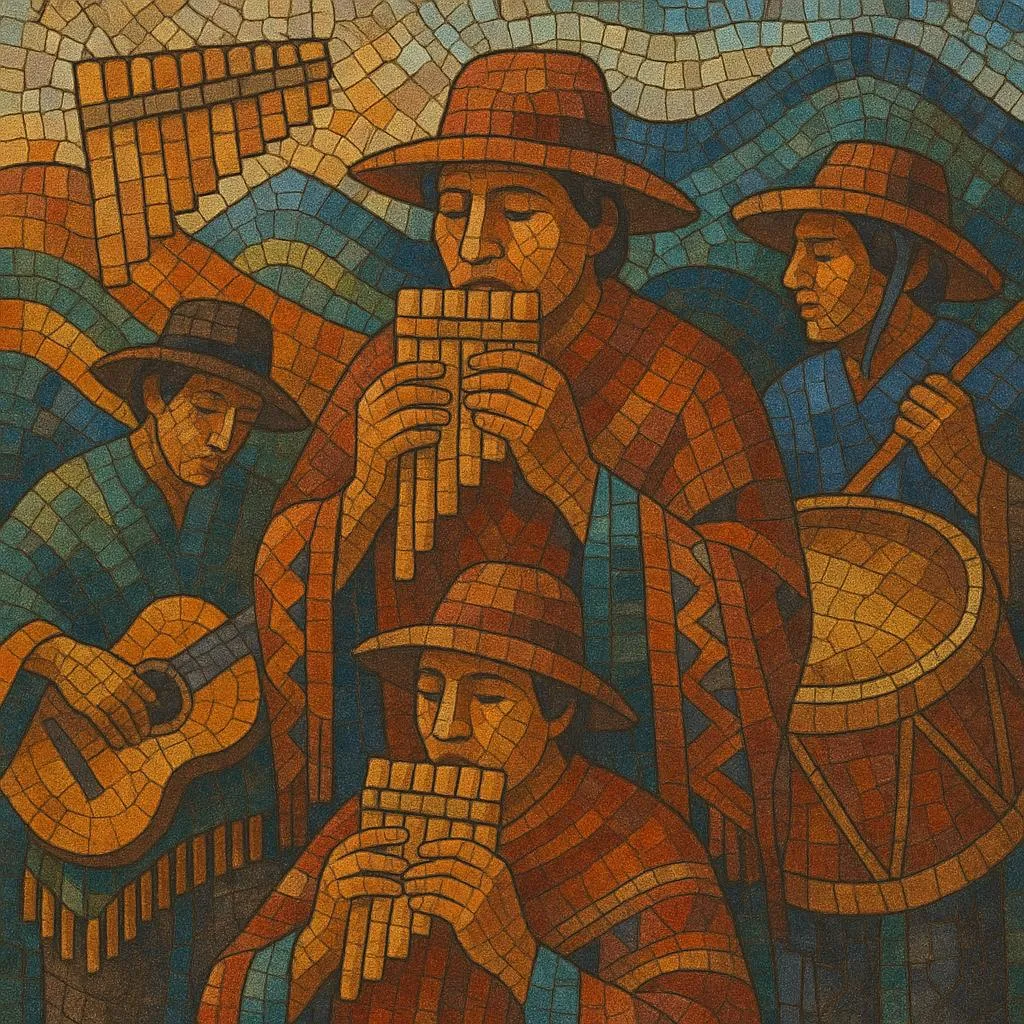
Typical ensembles feature panpipes (siku/zampoña), notched flutes (quena), small 10‑string lutes (charango), guitars, and large drums (bombo). Melodies often use pentatonic and modal scales (Aeolian/Dorian), parallel fourths and fifths, and antiphonal “hocketing” between matched panpipe parts. Repertoires draw on local dance‑song forms such as huayno, sanjuanito, carnavalito, saya, and tinku, each with distinctive grooves and tempos.

From mid‑20th‑century urban centers the style crystallized into a recognizable pan‑Andean sound that traveled globally, while remaining rooted in Quechua and Aymara languages, community festivities, and ritual calendars.


Sources: Spotify, Wikipedia, Discogs, RYM, MB, user feedback and other online sources

History

Indigenous and colonial roots

Andean music grows from pre‑Columbian highland traditions in what is now Peru, Bolivia, Ecuador, northern Chile and Argentina, and parts of Colombia. Panpipes, notched flutes, and communal wind bands served ceremonial, calendrical, and agricultural functions. After the 16th century, Iberian guitars and vihuelas inspired new hybrids: the charango (a small lute with re‑entrant tuning), polyphonic song practices, and poetic song types like the yaraví.

Urbanization and the folk revival (mid‑20th century)

In the 1950s–60s, migration to Andean capitals (La Paz, Lima, Quito, Santiago) and the rise of radio and records helped codify a pan‑Andean sound. Local dance‑song forms—huayno (Peru/Bolivia), sanjuanito (Ecuador), carnavalito (NW Argentina), Afro‑Bolivian saya, and ritual tinku—entered staged folklore and professional ensembles, standardizing instrument line‑ups: siku/quena, charango, guitar, bombo, and vocals in Spanish, Quechua, and Aymara.

Political song and international spread (1960s–1980s)

Parallel to the era’s social movements, Andean timbres became emblematic within Latin American protest currents, amplifying the music’s visibility. Touring ensembles, cultural festivals, and diasporic busker scenes took the panpipe‑charango sound to Europe and North America, where it became a hallmark of "world music."

Diversification and fusion (1990s–present)

Since the 1990s, música andina has flourished both in heritage contexts and in fusions—rock andino, Andean new age, folktronica, and progressive styles. Artisan instrument makers refined concert‑grade sikus and quenas; charango technique expanded with conservatory training. Today the genre lives simultaneously in community fiestas, contemporary stages, and cross‑genre studios while remaining a powerful symbol of Andean identity and continuity.

How to make a track in this genre

Core instrumentation
•   Winds: siku/zampoña (paired Ira/Arka panpipes for interlocking lines), quena (G/A notched flute), occasionally kena kena or pinkillu. •   Strings: charango (re‑entrant 5 double courses), guitar; optionally ronroco or bandola andina. •   Percussion: bombo (large double‑headed drum), wankara; hand percussion (chajchas).
Melody, scales, and texture
•   Favor pentatonic (minor pentatonic) and modal (Aeolian/Dorian) scales; ornament with appoggiaturas and grace notes on quena. •   Use heterophony and parallel fourths/fifths; for sikuri style, write in two complementary parts (Ira and Arka) that “hocket” to complete the melody.
Rhythmic building blocks
•   Huayno: brisk 2/4 with a lilt; characteristic long‑short patterns and strong downbeats. •   Sanjuanito: lively duple (2/4), steady eighth‑note patterns, often minor modality. •   Carnavalito: buoyant 6/8 (or 3‑3/2‑2 feel), with syncopated bombo accents. •   Saya/Tinku: square 4/4 with call‑and‑response vocals and emphatic off‑beats.
Harmony and form
•   Keep harmony sparse: drones, open fifths, and occasional I–VII or i–VII motion; avoid dense jazz chords. •   Common song forms are strophic or AABA; instrumental interludes showcase quena or sikus doubling the voice an octave higher.
Vocals, language, and arrangement
•   Alternate solo and chorus in call‑and‑response; sing in Spanish, Quechua, or Aymara. •   Layer textures: begin with charango and quena, add sikus in the chorus, reinforce cadences with bombo rolls.
Production tips (modern settings)
•   Close‑mic flutes to capture breath and edge; blend with a room mic for natural space. •   In folktronica fusions, loop a huayno or sanjuanito groove, keep acoustic timbres forward, and avoid over‑compression to preserve transient bite of sikus and charango.

Top tracks

Locked
Share your favorite track to unlock other users’ top tracks

Upcoming concerts

in this genre
Influenced by
Has influenced

Download our mobile app

Get the Melodigging app and start digging for new genres on the go
© 2026 Melodigging
Melodding was created as a tribute to Every Noise at Once, which inspired us to help curious minds keep digging into music's ever-evolving genres.
Buy me a coffee for Melodigging