Your digging level
Description
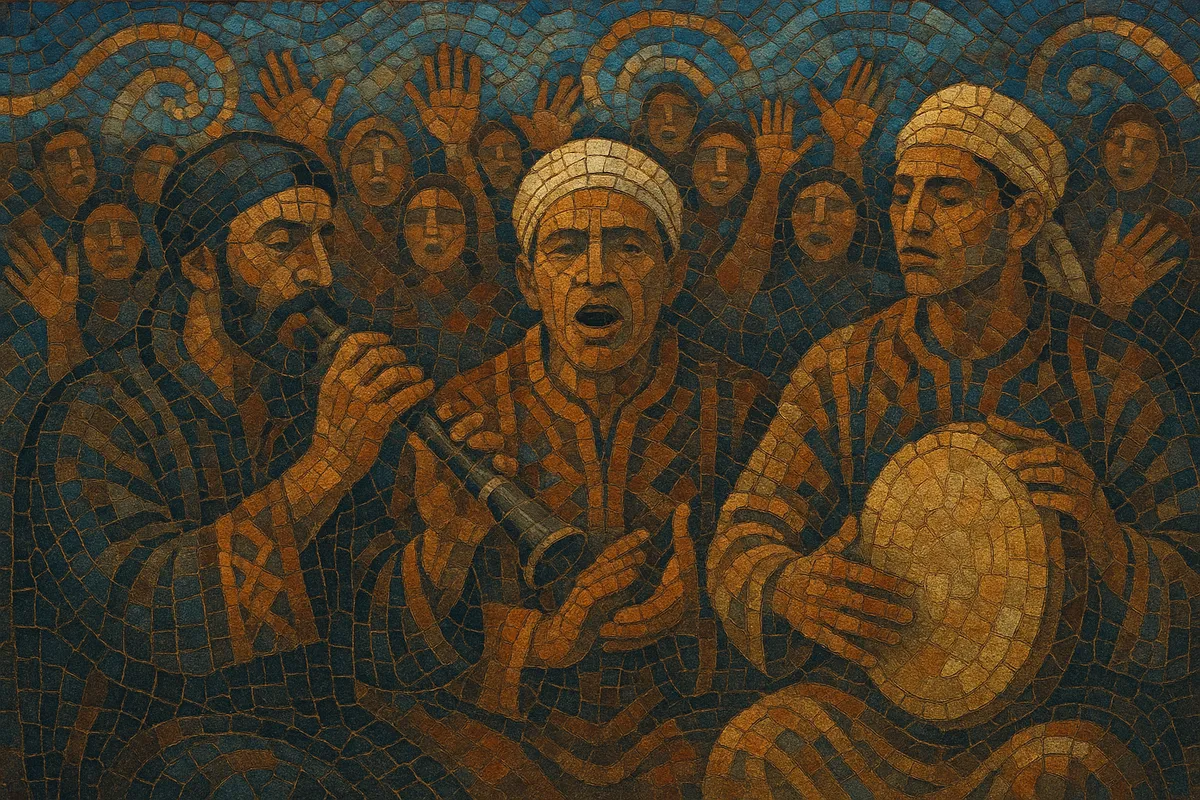
Rif is a traditional Amazigh (Berber) musical style from the Rif Mountains of northern Morocco, where the Tarifit (Riffian) language is spoken. It is characterized by trance-leaning, repetitive rhythms played on frame drums (bendir) and barrel drums (tbel), piercing double-reed oboes (rhaita/ghaita), and communal, call-and-response vocals.
Melodies are modal and riff-driven, often hovering around a few tones with ornamental turns, creating a hypnotic, processional feel. Performances are typically social—weddings, seasonal feasts, and village gatherings—where singing, line-dancing, and ululations are integral to the experience. Poetic couplets known as izran (improvised or semi-improvised verses) are central, touching on love, memory, resistance, and local life.
While firmly rooted in indigenous Amazigh practice, Rif music absorbed neighboring Andalusian-Maghrebi aesthetics and Sufi-trance energies, and in the 20th century some of its ritual and ceremonial variants (notably in the Jbala/Rif area) drew international attention through recordings and collaborations.
History
Rif music arises from the Amazigh communities of the Rif Mountains in northern Morocco. Its core practices predate audio documentation and are bound to social ritual—harvests, weddings, and communal feasts—where collective percussion, oboe (rhaita), and responsorial song support line dances and poetic exchange (izran). The music’s modal phrasing and cyclical rhythmic cells reflect a deep North African continuum shared with broader Maghrebi and Andalusian legacies.
In the early to mid-1900s, colonial-era field recording and later Moroccan radio began to document local repertoires. As Rif communities migrated toward cities and abroad, ensemble formats adapted to new audiences, incorporating violin, oud, and amplified percussion while retaining bendir/tbel grooves and call-and-response. Ritual and festivity contexts persisted, but staged performance and cassette culture broadened reach.
From the mid-20th century, ensembles from the broader Jbala/Rif region—especially the Master Musicians of Joujouka/Jajouka—brought trance-inflected reed-and-drum music to international attention via recordings, festivals, and cross-cultural collaborations. This exposure connected Rif lineage sounds with Western psychedelia, jazz, and worldbeat scenes without severing their ritual and communal functions at home.
Today, Rif music thrives in weddings, village celebrations, and diaspora gatherings, and coexists with Moroccan pop and global fusion. Core features—bendir/tbel ostinati, rhaita fanfares, izran verses, and antiphony—endure, while amplification, studio layering, and adjacent regional dance currents inform modern presentations. Despite modernization, its communal, trance-leaning, and poetic heart remains central.