Your digging level
Description
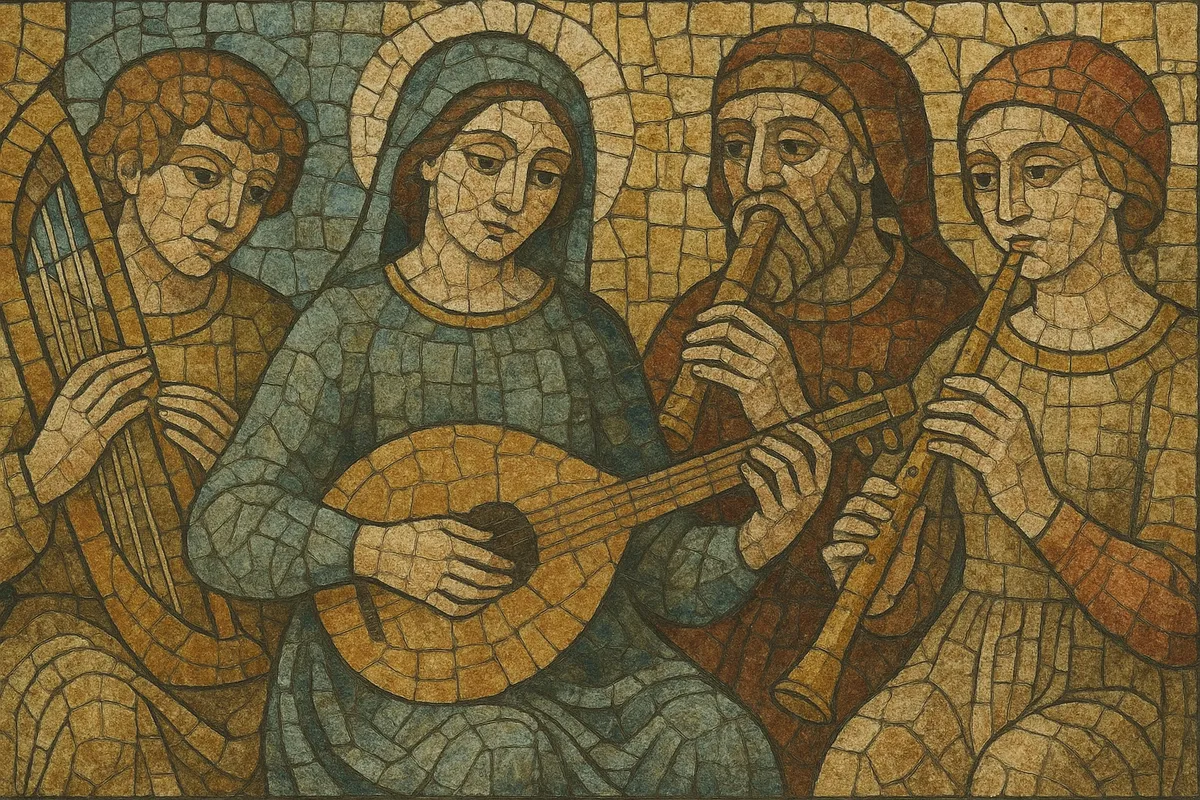
Early music is a modern performance movement devoted to the repertoire of the Medieval, Renaissance, and early Baroque eras (roughly before c. 1750), approached with historically informed performance (HIP) practices.
It emphasizes period instruments (or faithful replicas), historical tunings and temperaments, original notations and sources, and performance conventions documented in treatises of the time. The sound world ranges from monophonic chant and modal organum, to intricate Renaissance polyphony, to the emergence of basso continuo and dramatic affect in the early Baroque.
Rather than being a single historical style, early music is a contemporary practice of reviving diverse pre‑Classical musics with scholarly rigor and artistic vitality.
History
Although its repertoire stems from the Middle Ages through the early Baroque, “early music” as a modern performance movement coalesced in the mid‑20th century. Pioneers such as Arnold Dolmetsch in England laid foundations in the early 1900s by reviving instruments (recorders, viols, lutes) and advocating historical methods.
The interwar and post‑war decades saw the creation of specialized centers (e.g., Schola Cantorum Basiliensis, founded 1933) and growth in musicology, paleography, and organology. Editions of medieval and Renaissance sources, study of temperaments, and research into ornamentation and rhetoric reshaped how performers approached pre‑Classical music.
From the 1950s, ensembles and leaders like Gustav Leonhardt, Nikolaus Harnoncourt (Concentus Musicus Wien), and David Munrow popularized historically informed performance. The countertenor revival (Alfred Deller) and early opera stagings on period instruments broadened audiences. In the 1970s–80s, groups and directors such as Christopher Hogwood, John Eliot Gardiner, William Christie, Jordi Savall, Ton Koopman, and Emma Kirkby brought international prominence through recordings and tours.
By the 1990s, HIP principles had influenced mainstream classical performance, extending beyond Baroque into Classical and Romantic repertories. Early music today spans solo song, chamber, choral, and opera, balancing scholarly fidelity with creative interpretation, and continues to inform genres that draw on medieval and Renaissance idioms.
Select forms representative of the eras: chant, conductus, motet, madrigal, chanson, lute song, consort music, early opera scenes, and dance suites (pavan/galliard/allemande/courante). Match them to historically appropriate forces—voices (including countertenor), viol or recorder consort, lute/vihuela/theorbo, cornett and sackbut, harpsichord/organ, and early strings.
Use church modes rather than functional tonal harmony for medieval/renaissance pieces. Write primarily modal counterpoint with careful control of consonance/dissonance, suspensions, and cadences (e.g., Landini cadence). For early Baroque, employ basso continuo (figured bass) supporting one or more soprano lines, with clear cadential patterns and rhetorical contrasts.
In medieval works, think in rhythmic modes or isosyllabic chant flow rather than modern bar measures. Renaissance music often moves with a steady tactus, with proportional changes. For early Baroque, explore dance meters and affekt‑driven pacing. Notation can be modernized for practicality, but consult original sources for ligatures, coloration, and proportions.
Adopt historical temperaments (e.g., Pythagorean or just for medieval/renaissance; quarter‑comma meantone and well temperaments later). Use period pitch standards (often around A=415/466 in Baroque; variable earlier) as appropriate to the repertory.
Add ornaments tastefully: improvised diminutions and passaggi in late Renaissance/early Baroque lines; cadential trills and appoggiaturas; extempore preluding on lute/keyboard; improvised continuo realization guided by figures and style.
Prioritize text declamation, word‑painting, and rhetorical delivery. In sacred music (Latin), maintain clarity and reverence; in secular madrigals, emphasize imagery and emotional affekt.
Balance one‑to‑a‑part transparency against choral sonority according to historical evidence. Consider venue acoustics (chapels, stone churches) when shaping articulation, tempo, and dynamics. Use gut strings, historical bows, and period articulation for authenticity.