Your digging level

For this genre
0/8
🏆
Sign in, then listen to this genre to level up

Description

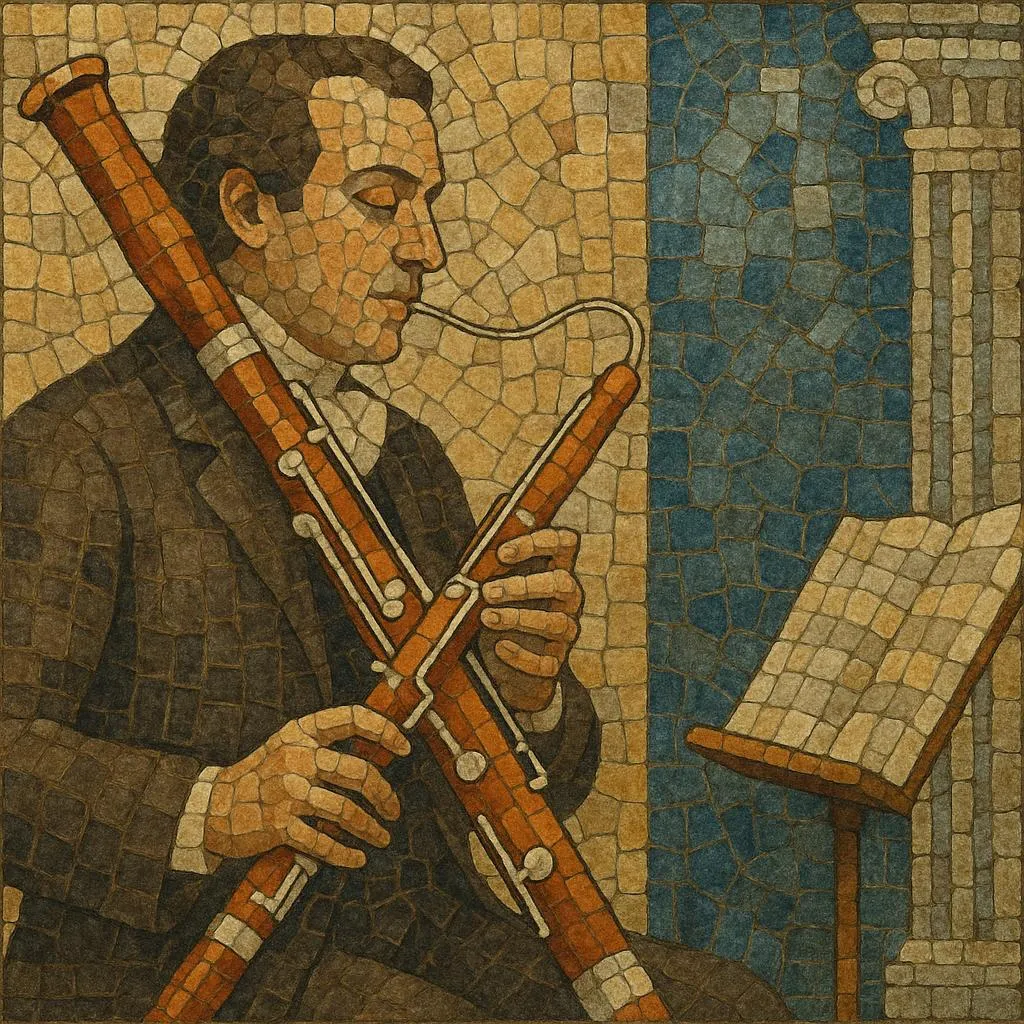
Classical bassoon refers to the body of Western art‑music written for, or prominently featuring, the bassoon—from the late Baroque through the Classical and Romantic eras into the present. It encompasses solo concertos and sonatas, chamber music (often with piano or strings), and characteristic orchestral writing that showcases the instrument’s wide expressive range.

A double‑reed, non‑transposing bass voice of the woodwind family, the bassoon spans approximately A1 to E5, moving from a dark, plummy low register to a vocal, singing tenor and a pungent, characterful upper range. Its agility, comic timing, and cantabile line made it a favorite for both witty scherzi and deeply lyrical slow movements. Classical bassoon practice also codified idiomatic articulation (legato cantilena, ultra‑clean staccato), voice‑leading across breaks, and the expressive use of dynamics that remain foundational to woodwind writing.


Sources: Spotify, Wikipedia, Discogs, RYM, MB, user feedback and other online sources

History

Origins (late 17th–early 18th century)

The modern bassoon evolved from the Renaissance dulcian. Key refinements in 17th‑century France and Italy (including multi‑joint construction and added keys) produced an agile, chromatic instrument suited to Baroque continuo lines and solo display. By the early 1700s, Italian schools (notably Venice) fostered a dense concerto repertoire, with composers exploiting the bassoon’s basso and tenor singing roles.

Classical era (mid–late 18th century)

In the Classical period, makers standardized bore and keywork further, supporting the instrument’s role in the emerging symphony and opera orchestra. Composers wrote elegant, balanced phrases for the bassoon, alternating witty rapid passages with expressive cantabile. Chamber sonatas with keyboard flourished, and the instrument’s signature orchestral solos (often in slow movements) became a stylistic hallmark.

Romantic expansion (19th century)

Romantic writing deepened the bassoon’s lyrical identity and widened its dynamic compass and chromaticism. Conservatory traditions in Paris, Vienna, and later Germany produced virtuoso performers and pedagogues, while makers like Heckel (Germany) advanced the key system that underpins modern technique. The bassoon’s character—by turns melancholic, pastoral, and humorous—became a dramatic color in symphonic poems and opera.

20th–21st centuries

Modernists and neoclassicists expanded the bassoon’s technical envelope (extended range, rapid articulation, harmonics), while contemporary composers embraced new timbres (multiphonics, flutter‑tongue, micro‑gestures). Today’s “classical bassoon” repertoire ranges from historically informed Baroque concerti to newly commissioned solo and chamber works, with a robust recording and competition scene sustaining the instrument’s evolving voice.

How to make a track in this genre

Instrument and range
•   Non‑transposing, written chiefly in bass clef (tenor clef for extended high passages). Practical range ~A1–E5. •   Registers: low (sonorous, weighty), middle/tenor (lyrical, vocal), upper (biting, bright). Write lines that move through registers with clear harmonic support.
Idiomatic technique and articulation
•   Favor stepwise motion and arpeggiation; rapid tongued passages and clean staccato are idiomatic, especially in Classical‑style rondos and scherzi. •   Use slurs that respect the instrument’s breaks; avoid frequent, wide leaps across register transitions at fast tempi. •   On modern bassoon, unstable mid‑register notes (A3–D4) are stabilized by venting (“flicking”); fast passages in that zone still work if phrase shapes allow brief breaths or rests.
Harmony, melody, and forms
•   Baroque style: sequence, pedal tones, and clear tonal plans; continuo textures with strings/keyboard support; ornament cadences modestly (trills, mordents). •   Classical style: balanced 4–8‑bar phrases, Alberti‑like accompaniment in piano/strings; transparent harmony outlining I–V–I with tasteful secondary dominants. •   Romantic style: broader arcs, chromatic neighbor/Passing tones, expressive rubato; explore the bassoon’s cantabile in Andante/Adagio movements. •   Forms: concerto (fast–slow–fast with a witty or dance‑like finale), sonata (3–4 movements), character pieces, and chamber combinations (e.g., bassoon + piano, wind quintet roles).
Orchestration and texture
•   Pair with cello/viola or piano for warm doublings; bassoon often anchors inner voices between bass line and melody. •   In ensembles, let bassoon introduce or answer themes in its tenor register; reserve upper register for climaxes or comic asides.
Expressive devices
•   Exploit timbral contrast: humorous, nimble staccato vs. plaintive legato; dynamic swells highlight the instrument’s speech‑like phrasing. •   Use tasteful ornaments and cadential turns; in modern works, consider flutter‑tongue, multiphonics, and timbral trills sparingly to preserve classical character.

Top tracks

Locked
Share your favorite track to unlock other users’ top tracks

Upcoming concerts

in this genre
Influenced by
Has influenced

Download our mobile app

Get the Melodigging app and start digging for new genres on the go
© 2026 Melodigging
Melodding was created as a tribute to Every Noise at Once, which inspired us to help curious minds keep digging into music's ever-evolving genres.
Buy me a coffee for Melodigging