Your digging level

For this genre
0/8
🏆
Sign in, then listen to this genre to level up

Description

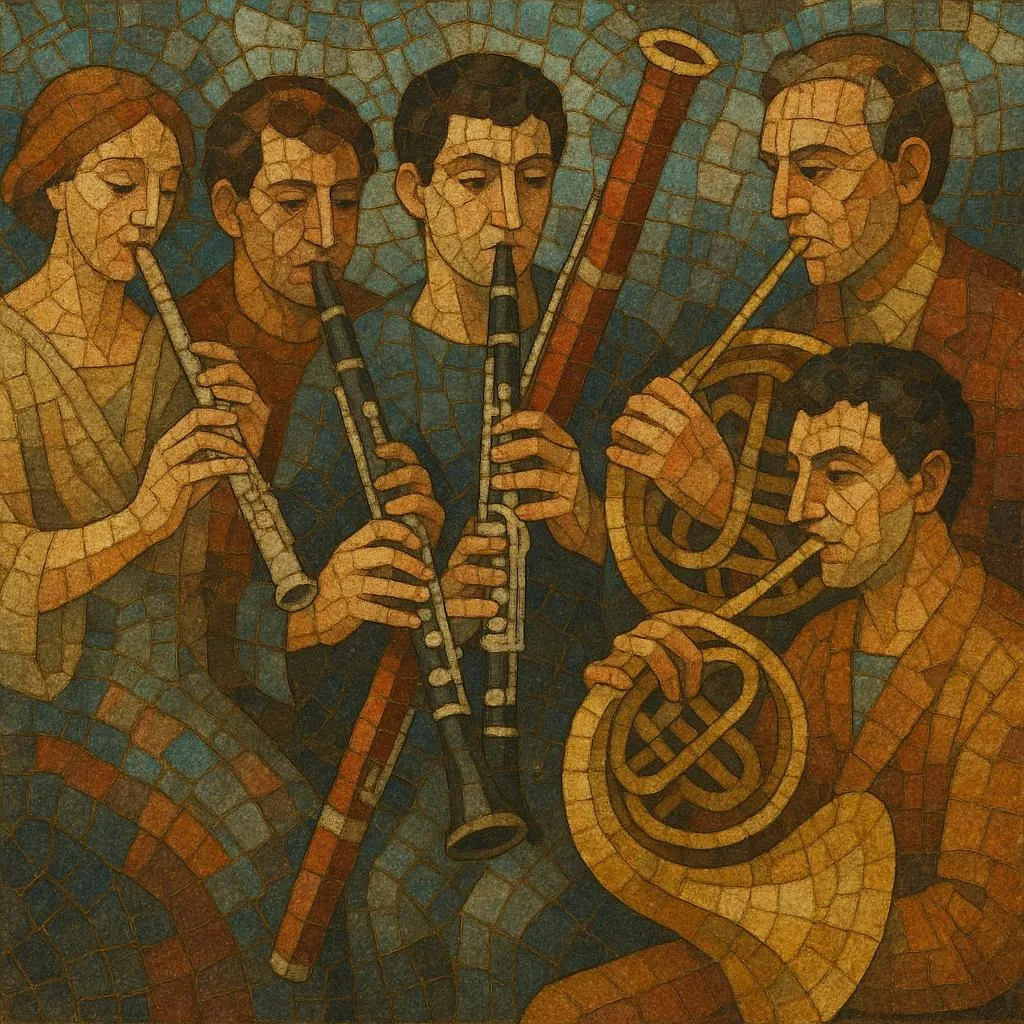
A wind quintet is a classical chamber ensemble and repertoire for five instruments: flute, oboe, clarinet (in B♭/A), bassoon, and horn (in F). The set is unique in chamber music because it mixes four woodwinds with a brass instrument, creating a wide spectrum of timbres—from the flute’s brilliance and the oboe’s pungency to the clarinet’s flexibility, the bassoon’s depth, and the horn’s glowing sonority.

Although winds were central to Classical-era Harmoniemusik, the standardized quintet crystallized in the early 19th century through the pioneering works of Anton Reicha and Franz Danzi. The genre has since grown into a vast repertoire of original works and arrangements that range from neoclassical elegance to modernist color and rhythm, often favoring transparent textures, conversational counterpoint, and lively, dance-derived movements.


Sources: Spotify, Wikipedia, Discogs, Rate Your Music, MusicBrainz, and other online sources

History

Origins (early 19th century)

The modern wind quintet coalesced in the 1810s, when Anton Reicha (then active in Paris) published landmark sets of quintets that treated each instrument idiomatically yet fused them into a coherent chamber unit. Franz Danzi quickly followed with his own cycles, confirming the lineup (flute, oboe, clarinet, bassoon, horn) and establishing formal and stylistic conventions—multi‑movement designs with agile inner voices, operatic cantabile writing, and playful finales.

19th-century development

Throughout the 19th century, the quintet benefited from the flourishing wind culture across Central Europe and France (fueled by conservatories and opera orchestras). While the core of the repertory remained Classical-to-early-Romantic in style, the ensemble became a vehicle for salon pieces, character movements, and arrangements of orchestral or keyboard classics, showcasing wind color in intimate venues.

20th-century renaissance

The 20th century brought a major renaissance. Composers such as Paul Hindemith (Kleine Kammermusik), Carl Nielsen (Wind Quintet, Op. 43), Jean Françaix (Wind Quintet No. 1), Darius Milhaud, Jacques Ibert (Trois pièces brèves), Samuel Barber (Summer Music), and György Ligeti (Six Bagatelles, arranged for quintet) expanded the idiom with neoclassical clarity, rhythmic bite, and new timbral games. Increasingly, professional ensembles commissioned and toured quintet programs worldwide, cementing the ensemble as a staple of 20th‑century chamber music.

Contemporary practice

In the 21st century, the wind quintet remains vibrant. Ensembles commission works that integrate extended techniques, cross-genre influences (jazz, folk, and non‑Western modalities), and dramatic programming, while also curating historically informed performances of 19th‑century pieces. The genre’s portability and coloristic range make it a teaching mainstay in conservatories and a favorite for community and new-music series.

How to make a track in this genre

Core instrumentation and ranges
•   Flute (C): brilliant high register; agile arpeggios and lyrical lines. •   Oboe (C): penetrating tone; ideal for cantabile melodies and incisive articulations. •   Clarinet (B♭/A): wide range and dynamic flexibility; blends and bridges instrument groups. •   Bassoon (C): bass foundation and dexterous tenor voice; superb for counterlines and humor. •   Horn (F): warm, noble color; supports harmony, provides fanfares, and enriches climaxes.
Texture, balance, and roles
•   Treat the quintet as five soloists in conversation. Rotate melody and accompaniment to avoid fatigue and timbral monotony. •   Use register planning to balance brightness (flute/oboe) with warmth (clarinet/horn) and grounding (bassoon). Avoid persistent tutti in the same register. •   The horn can function as harmonic glue and a coloristic pivot between woodwinds and brass sonority.
Form and rhetoric
•   Common multi‑movement designs: sonata‑form first movement, lyrical slow movement, scherzo/trio or character dance, and a lively rondo/variation finale. •   Favor clear motives and counterpoint; call‑and‑response and staggered entrances showcase each instrument. •   Include character contrasts (e.g., rustic dances, pastorales, rhythmic toccatas) to exploit timbral variety.
Harmony, rhythm, and color
•   Tonal or modal centers work well; chromatic/extended harmonies are effective if voice‑leading is clear. •   Write articulation-rich rhythms (staccato, accents, syncopation) to capitalize on wind attack/decay. •   Orchestrate with coloristic doublings (e.g., flute+clarinet for sheen; oboe+bassoon for reedy warmth; horn+clarinet for mellow depth).
Idiomatic writing and extended techniques
•   Respect breathing and phrase lengths; build rests into accompaniment figures. •   Exploit idioms: flutter‑tongue (flute), multiphonics and micro-intervals (clarinet/oboe, where appropriate), slap‑tongue (clarinet/bassoon), stopped horn and hand‑muting for color shifts. •   Keep technical lines within comfortable ranges to maintain blend at ensemble tempo.
Rehearsal and notation tips
•   Mark cue-sized inner voices to aid entrances; clarify balance targets (e.g., “bring out bassoon counter‑melody”). •   Provide clear transpositions (horn in F; clarinet in B♭/A) and practical page turns. •   Indicate character and style succinctly (e.g., “dolce, cantabile,” “con brio, playful staccato”).

Top tracks

Locked
Share your favorite track to unlock other users’ top tracks
Influenced by
Has influenced
Challenges
Digger Battle
Let's see who can find the best track in this genre

Download our mobile app

Get the Melodigging app and start digging for new genres on the go
© 2026 Melodigging
Melodding was created as a tribute to Every Noise at Once, which inspired us to help curious minds keep digging into music's ever-evolving genres.
Buy me a coffee for Melodigging