Your digging level
Description
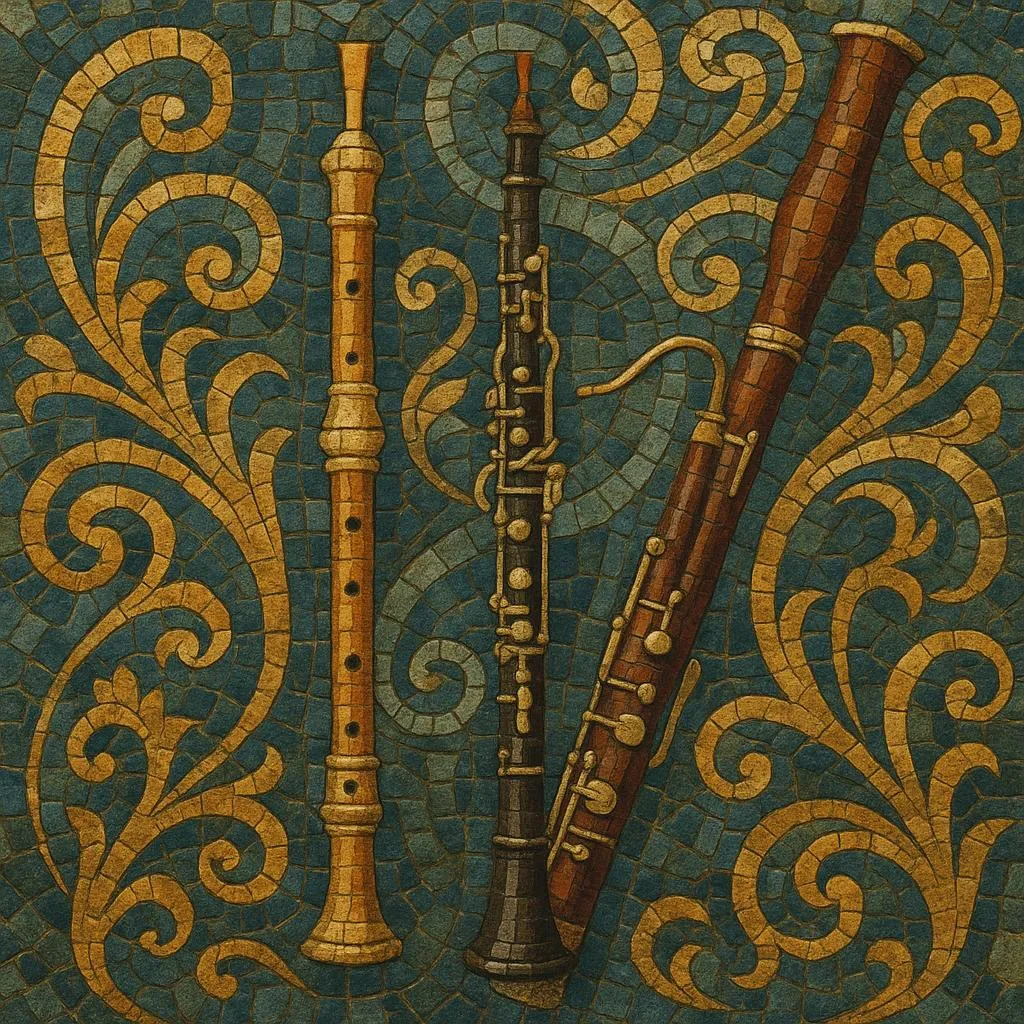
Baroque woodwind refers to the repertoire, instruments, and performance practices for wind instruments during the Baroque era (ca. 1600–1750). Core instruments include the recorder (blockflute), the one-keyed transverse flute (traverso), the Baroque oboe (hautbois), and the bassoon (evolving from the dulcian). These instruments were built with different bores, fingerings, and reeds from modern counterparts, yielding a more vocal, reedy, and delicately colored sound.
The style embraces solo sonatas with basso continuo, trio sonatas, orchestral suites, and concerti—often framed by dance-derived forms and ritornello structures. Ornamentation (agréments), rhetorical phrasing, notes inégales (in French contexts), and affect-driven articulation are essential, along with historically typical pitch (often around A=415) and well/meantone temperaments.
History
Baroque woodwind practice coalesced as wind instruments took on refined, new roles in court and church. In France, instrument makers and musicians around the royal court (notably the Hotteterre and Philidor families) formalized the modern oboe (hautbois) and cultivated the traverso. At the same time, the recorder—already prominent since the Renaissance—remained a favored solo and ensemble instrument.
Across Italy, Germany, and France, composers embraced woodwinds as soloistic voices. Italianate ritornello concerti flourished (especially for bassoon, oboe, and flute), while German composers integrated woodwinds deeply into church cantatas and chamber music. French composers emphasized elegance, dance-derived movements, and ornamental nuance. Treatises such as Hotteterre’s “Principes de la flûte traversière” (1707) and Quantz’s “Versuch einer Anweisung die Flöte traversiere zu spielen” (1752) codified technique, articulation, ornamentation, and expressive ideals.
Baroque woodwinds were typically pitched lower than modern standard (often around A=415) and played in well or meantone temperaments that shape the color of keys. Basso continuo (harpsichord, theorbo, cello/bassoon, etc.) underpins solo sonatas and trio sonatas, while orchestral works feature obbligato wind parts. Articulation imitates speech, with emphasis on rhetorical expression (Affektenlehre), tasteful improvisation of ornaments, and—in the French style—notes inégales.
By the later 18th century, the Classical style—and new instruments such as the multi-keyed flute and the clarinet—shifted aesthetics. In the 20th-century early-music revival, historically informed performers resurrected Baroque woodwinds, rebuilding instruments and reviving techniques. Today the repertoire remains central to early music programming and pedagogy, influencing how modern players approach tone, articulation, and ornamentation.