Your digging level
Description
Music of the Trecento refers to Italian secular (and some sacred) polyphony of the 14th century, roughly from the 1320s through about 1420. It is often called the Italian Ars Nova and is best known for three vernacular song forms: the madrigale, the ballata, and the caccia.
Stylistically, Trecento music favors melodically flowing upper voices, clear text declamation in Italian, and sweet-sounding cadential formulas—most famously the “Landini cadence.” Texts tend toward courtly love, pastoral, and urban vignettes (street cries, hunts), while the music explores two- and three-voice counterpoint with lively syncopations and occasional hocket.
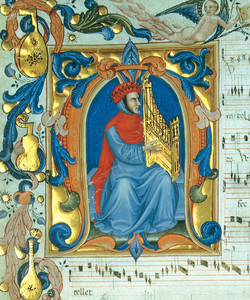
Our understanding of the repertory rests on lavish manuscripts such as the Rossi Codex (early) and the Squarcialupi Codex (early 15th century), which preserve hundreds of works by major Florentine and northern Italian composers.
History
Trecento (“three hundred”) designates the 1300s in Italy. In music, it marks a flourishing of Italian vernacular song parallel to developments in painting and poetry. Early sources such as the Rossi Codex show the emergence of Italian forms (madrigale, ballata, caccia) and a move from monophony to courtly polyphony.
Characteristic techniques include syncopation, hocket, and the widespread “Landini cadence,” which sweetens the arrival on the final.
Italian mensural notation aligns with the wider Ars Nova but shows local preferences. Monumental codices transmit the repertory: the Rossi Codex (with early madrigals, cacce, and rare monophonic ballate) and the Squarcialupi Codex (c. 1410–1415), the largest trove of Trecento song, organized by composer with illuminated portraits.
Florence (and northern courts such as Padua) nurtured composers including Landini, Jacopo da Bologna, Paolo da Firenze, and Bartolino da Padova. Their ballate and madrigals define the idiom, while transitional figures around 1400 (e.g., Zacara, Ciconia) connect Trecento practice to early Quattrocento styles.
By the 1390s–1410s the ballata dominates, and Italian song begins to interact with intricate international currents. Trecento technique—cantabile upper lines, cadential idioms, and flexible scoring—feeds directly into early 15th‑century Italian song and, later, the frottola and madrigal traditions.