Your digging level

For this genre
0/8
🏆
Sign in, then listen to this genre to level up

Description

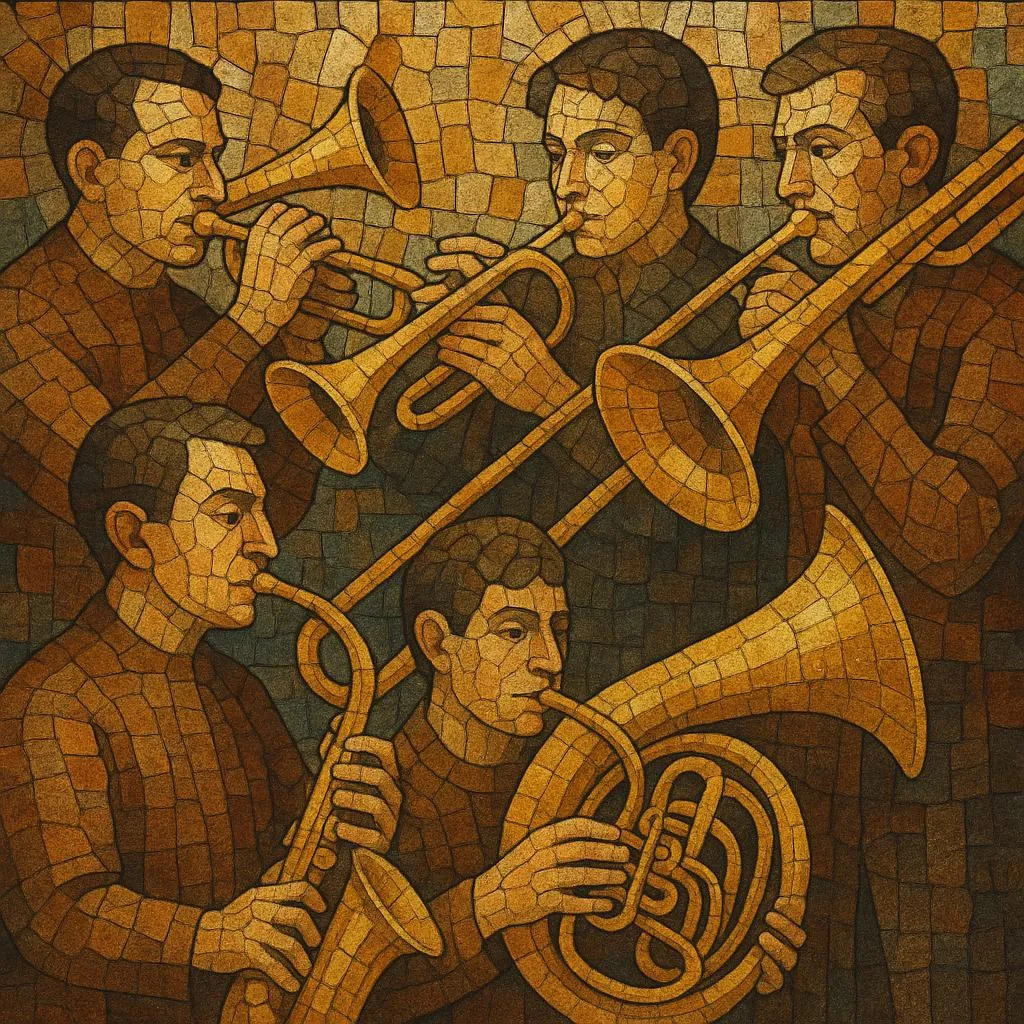
Brass ensemble refers to chamber groups made primarily or exclusively of brass instruments—typically trumpets, horns, trombones, euphoniums, and tubas—sometimes augmented by percussion. Unlike full symphonic brass sections or community brass bands, brass ensembles focus on chamber clarity, contrapuntal transparency, and a wide dynamic palette within a compact instrumentation.

Standard formats range from the brass quintet (two trumpets, horn, trombone, tuba) to larger dectets and flexible consort line‑ups. Repertoire spans original works written for brass, transcriptions of early antiphonal and Baroque music, Romantic fanfares and chorales, and contemporary idioms that emphasize extended techniques, mutes, spatial placement, and rhythmic precision.


Sources: Spotify, Wikipedia, Discogs, RYM, MB, user feedback and other online sources

History

Early antecedents (Renaissance–Baroque)

Antiphonal brass consorts trace back to late Renaissance and early Baroque sacred and civic traditions, where cornetts and sackbuts were deployed in churches and public squares. The spatial, chordal, and call‑and‑response writing of this era shaped the ensemble ideals—blend, antiphony, and chorale textures—that modern brass ensembles still cultivate.

Industrial age to early 20th century

The 19th century saw the rise of community and military brass bands (spurred by the invention of valved brass), but these were usually larger, outdoor‑projecting ensembles rather than chamber groups. Orchestral brass sections also grew in size and color, setting technical and timbral benchmarks for later chamber writing.

Modern chamber brass movement (1950s onward)

The modern brass ensemble—especially the standardized brass quintet—coalesced in the 1950s. Pioneering groups professionalized the idiom, commissioned new works, and established the brass ensemble as a serious chamber medium. From the 1960s–1980s, ensembles on both sides of the Atlantic expanded the repertoire through commissions, stylistically ranging from neo‑Baroque suites and Romantic transcriptions to modernist and minimalist pieces.

Contemporary developments

Today’s brass ensembles balance canonical transcriptions with original commissions that explore extended techniques (flutter‑tongue, half‑valving, multiphonics), coloristic mute writing, groove‑oriented ostinati, and spatial staging. Conservatories and festivals maintain a robust pipeline of performers and composers, while recording projects and media scoring continue to broaden the ensemble’s reach.

How to make a track in this genre

Instrumentation & roles
•   Core textures: brass quintet (2 trumpets, horn, trombone, tuba). Larger ensembles add extra trumpets/trombones, euphoniums, bass trombone, and optional percussion. •   Think registrally: trumpets handle brilliance and figuration; horn binds inner harmony and color shifts; trombone offers lyrical tenor and agile bass counterpoint; tuba anchors foundations and can provide melodic gravitas.
Texture, voicing, and balance
•   Write with chorale clarity: closed‑position, parallel mutes, and careful balancing of overtones to avoid harshness in block chords. •   Use antiphony and spatial placement for dialogue and echo effects. •   Exploit mutes (straight, cup, harmon, bucket) to create contrasting timbral layers.
Rhythm and articulation
•   Brass speaks with articulation: alternate crisp marcato and legato cantabile to shape phrases. •   Favor clear rhythmic ideas: fanfares, ostinati, hemiolas, and syncopations are idiomatic; leave “breathing commas” for long passages.
Harmony and form
•   Chorale‑based writing (quartal/quintal stacks, added‑tone triads) works well; avoid dense low‑register clustering that muddies the texture. •   Common forms: fanfare → chorale → toccata finale; suite movements; theme‑and‑variations; modern miniature sets.
Technique & range
•   Respect comfortable ranges and endurance: rotate lead lines; build rests into parts; avoid sustained fortissimo in upper tessitura. •   Idiomatic flourishes: trumpet clarino figurations, horn stopped‑note color, trombone glissandi (tastefully), tuba agile bass lines.
Arranging tips
•   Transcribe contrapuntal keyboard or choral works by redistributing lines for breath and color. •   Keep voice‑leading singable and assign sustained lines to players with breath capacity (horn/trombone/tuba), or stagger entrances for continuous texture.

Top tracks

Locked
Share your favorite track to unlock other users’ top tracks

Upcoming concerts

in this genre
Influenced by
Has influenced

Download our mobile app

Get the Melodigging app and start digging for new genres on the go
© 2026 Melodigging
Melodding was created as a tribute to Every Noise at Once, which inspired us to help curious minds keep digging into music's ever-evolving genres.
Buy me a coffee for Melodigging