

Your digging level
For this genre
0/8
🏆
Sign in, then listen to this genre to level up
Description
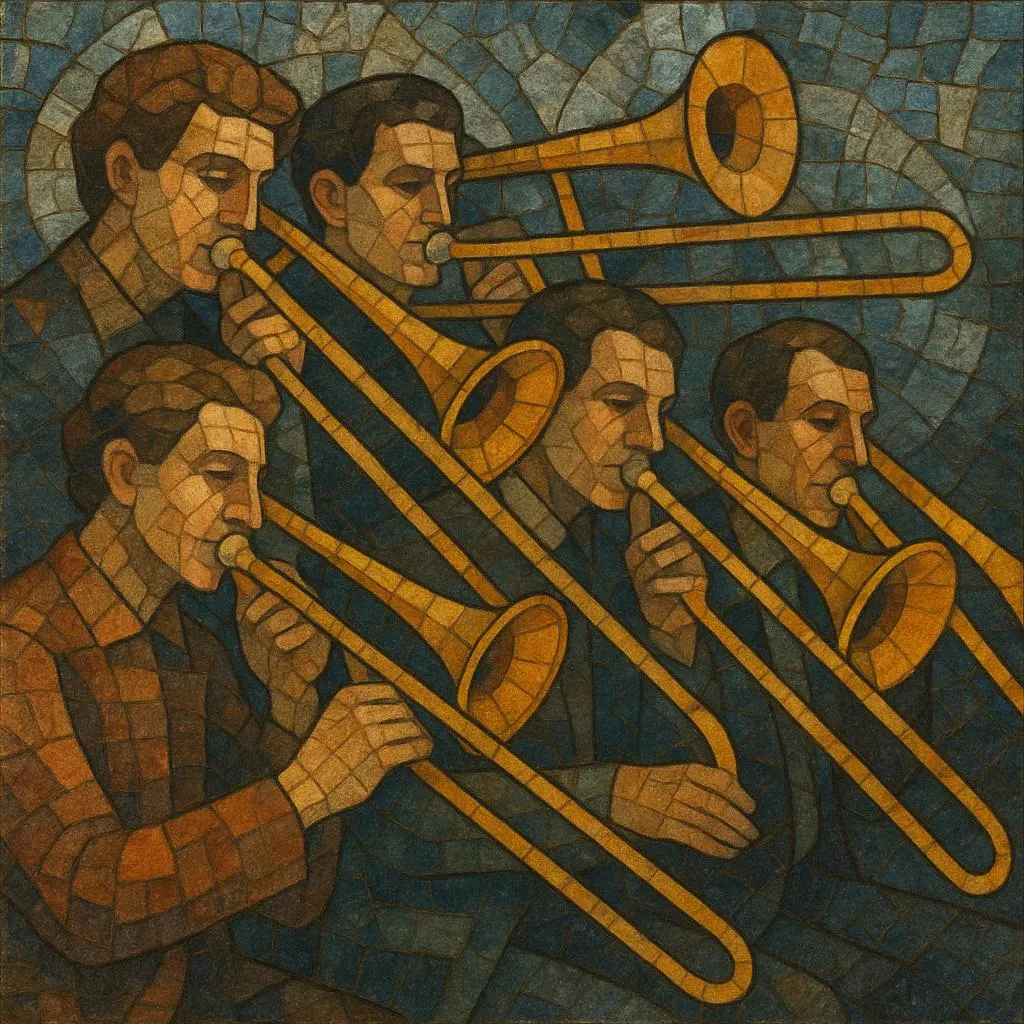
A trombone ensemble (often called a trombone choir or trombone consort) is a homogeneous brass group built from the family of trombones—historically alto, tenor, and bass (and today sometimes contrabass)—that performs polyphonic, chorale-like, antiphonal, and fanfare textures.
The sound world emphasizes warm, vocal-style legato and clear contrapuntal lines reminiscent of Renaissance and Baroque choral writing, but the format has expanded to include Romantic/modern concert works and jazz-oriented trombone sections and choirs. Typical sizes range from quartets (SATB-like) to larger choirs of 6–12 or more players, occasionally with organ, choir, or rhythm section.
History
Origins (16th–17th centuries)
• The trombone ensemble traces to the Renaissance sackbut consort, notably in Italy and German-speaking lands. At Venice’s St. Mark’s Basilica, composers such as Giovanni Gabrieli wrote antiphonal canzonas and sonatas for mixed brass and voices, with sackbuts (early trombones) doubling or substituting vocal parts.
• The instrument’s vocal timbre and slide-enabled intonation made it ideal for sacred polyphony and chorales; city wind bands (Stadtpfeifer) across Lutheran Europe also employed trombone consorts.
18th–19th centuries
• Although orchestral roles developed and the independent consort waned in visibility, local church music and civic ensembles continued to feature small trombone groups for chorales, funerary music, and processions, especially in Central Europe.
• Romantic composers sporadically explored low-brass chamber textures, keeping the idiom alive alongside growing orchestral practice.
20th-century revival and institutionalization
• In the mid-20th century, American conservatories revived the “trombone choir” as a pedagogical and concert medium. Emory Remington’s Eastman Trombone Choir (University of Rochester/Eastman School) became a model, inspiring dedicated ensembles and a new body of arrangements and original works.
• Parallel developments in jazz featured dedicated multi-trombone groups (e.g., J. J. Johnson & Kai Winding projects; Slide Hampton’s World of Trombones), translating section voicings, mutes, and riff-based writing into concertized trombone-ensemble formats.
Contemporary practice
• Today, trombone ensembles thrive in universities and professional settings worldwide. Repertoires span Renaissance transcriptions, modern commissions, film/game arrangements, and jazz/funk charts. Instrumentation often includes alto–tenor–bass–contrabass combinations, with frequent collaborations with organ, choir, percussion, or rhythm section.
Instrumentation and voicing
• Core voicing mirrors a choir: Alto (upper line), Tenor(s) (inner), Bass (lower), optionally Contrabass for foundation. A classic quartet is ATTB or TTTB; larger choirs often divide into 6–12 parts.
• Write within comfortable ranges (Alto: roughly F3–B♭5; Tenor: E2–B♭4; Bass: B♭1–F4; Contrabass extends lower). Favor singable, lyrical lines and smooth slide-friendly intervals.
Texture, counterpoint, and harmony
• Exploit chorale and polyphonic textures: voice-leading clarity, controlled spacing (closer in upper voices, wider down low), and gradual dynamic shaping.
• For Renaissance/Baroque idioms, use modal or functional harmony with suspensions, imitative entries, and antiphonal exchanges (call-and-response between sub-choirs).
• For modern/jazz styles, use close voicings, drop-2/drop-3 techniques, guide-tones, and color extensions (9ths, 11ths, 13ths). Consider cup/straight/wa‑wa mutes for color.
Rhythm and articulation
• Chorales benefit from legato and sustained phrases; mark slurs clearly and use breath marks to align phrasing.
• Fanfare writing can feature marcato attacks, rhythmic unisons, and hemiolas. In jazz charts, incorporate swing phrasing, syncopations, and “shout chorus” block voicings.
Form and orchestration ideas
• Effective forms include: 1) Antiphonal canzona with spatially separated groups; 2) Theme-and-variations chorale; 3) Jazz head–solos–shout chorus–coda.
• Combine organ or choir for liturgical grandeur; add percussion (timpani, cymbals) for ceremonial works; or a rhythm section (bass, drums, piano/guitar) for jazz/funk pieces.
Notation and practical tips
• Indicate mute changes and divisi clearly; avoid excessive rapid slide shifts on repeated notes—use alternate positions where possible.
• Plan breathing and staggered sustains in long chords. Provide clear cues for antiphonal entries if using spatial placement.
• Balance: keep low voices lighter in dynamic when upper parts carry melody; use dynamic terracing for architectural clarity.

Best playlists


Top tracks
Locked
Share your favorite track to unlock other users’ top tracks
Upcoming concerts
in this genre
