Your digging level
Description
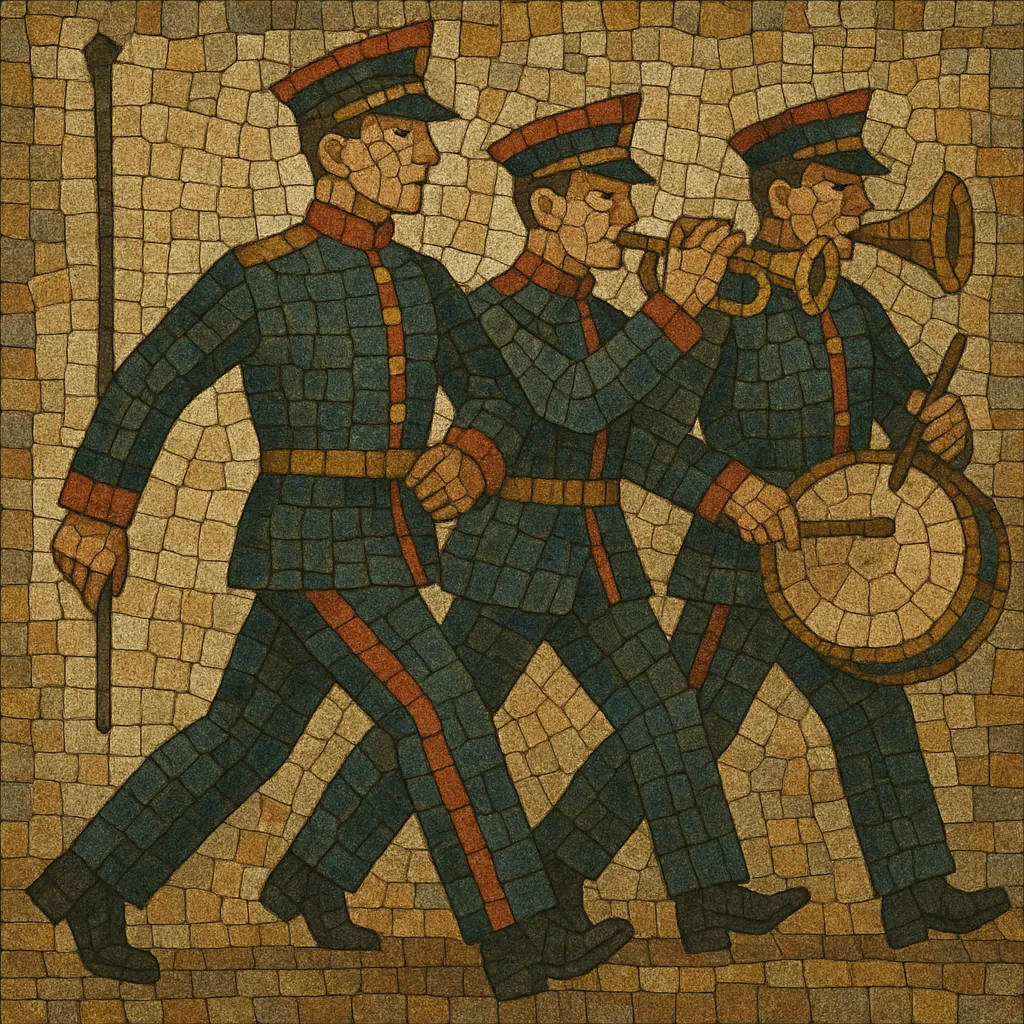
A march is a musical genre and form designed to accompany orderly movement, most commonly military processions, parades, and ceremonial events. It is typically in duple meter (2/4 or 4/4) or compound duple (6/8), with a steady tempo that supports synchronized stepping.
Classical and concert marches evolved a characteristic multi-strain structure: an introduction, two strains, a key-changing trio, a break strain ("dogfight"), and a final strain, often with a strong cadential "stinger." Instrumentation centers on winds and percussion—brass, woodwinds, snare and bass drums, and cymbals—producing a bright, projecting sonority suitable for outdoor performance.
While the style is pan-European in origin, the late-19th- and early-20th-century "golden age" of the American march, led by John Philip Sousa, codified the concert march’s form, orchestration, and performance practice, influencing wind band music worldwide.
History
European military organizations standardized step and drill in the 17th and 18th centuries, and music to coordinate movement coalesced into the march. Prussian and other German states professionalized wind and percussion bands for signaling and morale. Ottoman Janissary bands (mehter) introduced powerful percussion and bright winds to European ears, catalyzing the taste for martial sonorities and regular pulse.
By the Classical era, the march became both functional and symbolic. Composers from Haydn and Mozart to Beethoven incorporated march movements and processional episodes in symphonies, operas, and incidental music, while military and civic bands spread standardized march repertory across Europe. In the 19th century, British and Central European regimental traditions refined ensemble organization and repertoire.
In the United States, John Philip Sousa and contemporaries (Karl L. King, Henry Fillmore, Edwin Franko Goldman) transformed the march into a concert showcase. The formal blueprint—intro, first and second strains, trio in the subdominant with a new melody, break strain (dogfight), and grandioso reprise—became widely emulated. Publication, touring bands, and early recordings disseminated these pieces globally.
Through school, community, and military bands, marches became foundational to wind-band pedagogy. The idiom influenced parade traditions, drum and bugle corps pageantry, and brass band cultures (including New Orleans brass bands). Contemporary composers continue to write concert marches, while historic repertory remains central to civic ceremonies, sporting events, and parades.