Your digging level

For this genre
0/8
🏆
Sign in, then listen to this genre to level up

Description

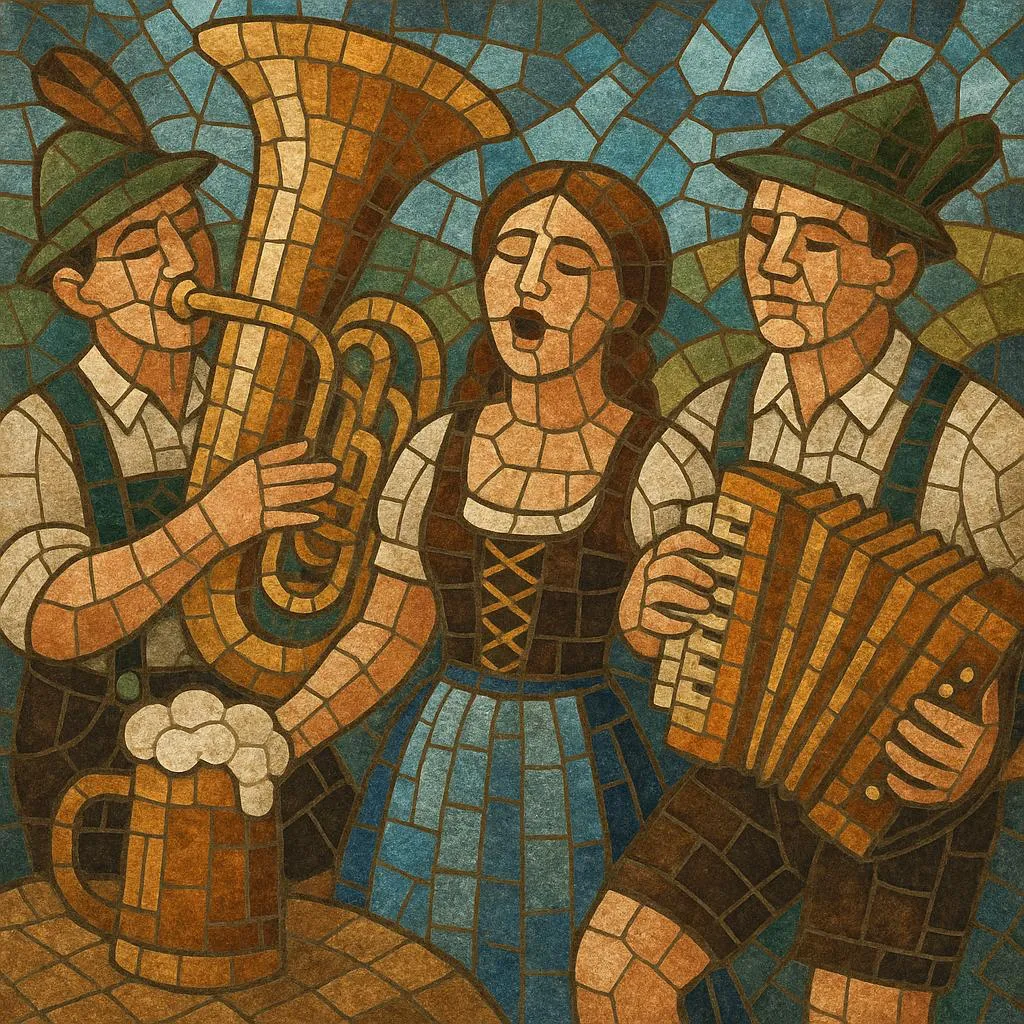
Oktoberfest music refers to the lively mix of Bavarian/Alpine brass band tunes, polkas, waltzes, marches, and modern sing‑along party hits heard in beer tents during the Munich Oktoberfest and its global spin‑offs.

Its core sound is built on oompah brass rhythms (tuba/bass on the beat with off‑beat chords in the horns), massed choruses, and simple, catchy refrains designed for communal toasting, dancing on benches, and call‑and‑response. Traditional sets (Ländler, polka, waltz, Marsch) sit comfortably alongside volkstümliche Musik and Schlager, plus contemporary crowd‑pleasers adapted to the beer‑hall idiom.

The result is a festive, high‑energy repertoire whose function is social: keep the tent singing, clapping, and raising steins every few minutes.


Sources: Spotify, Wikipedia, Discogs, Rate Your Music, MusicBrainz, and other online sources

History

Roots (19th century)

The Oktoberfest festival began in Munich in 1810. From its earliest decades, brass bands and military/municipal ensembles provided music for parades, processions, and dances. The regional dance forms of Bavaria and the Alpine world—polka (2/4), Ländler and waltz (3/4), and various marches—defined the foundational repertoire, performed by wind/brass bands (Blasmusik) and string/accordion groups.

Professionalization and tent culture (early–mid 20th century)

As the fair grew, large beer tents institutionalized all‑day music. Bohemian/Egerländer and Oberkrainer styles (with clarinet, flugelhorn, baritone/euphonium, tuba, accordion) strongly colored the sound. Bandleaders codified the upbeat "oompah" feel and audience participation practices—clapping patterns, toast songs such as the ubiquitous short "Prosit"—to keep crowds engaged.

Postwar Schlager and volkstümliche Musik (1950s–1980s)

Radio, records, and television popularized Schlager and volkstümliche Musik, both readily embraced in the tents. Brass arrangements of polkas and marches alternated with major‑key Schlager sing‑alongs, cementing the modern Oktoberfest set: traditional numbers, dance tunes, and easy pop choruses everyone can sing after a toast.

Party era and global spread (1990s–present)

Since the 1990s, bands routinely adapt contemporary hits to the beer‑tent idiom (faster tempos, oompah beat, massed choruses), while alpine pop groups bring high‑energy showmanship. Replica Oktoberfests worldwide (North America, Asia, Australia) imported the format—brass‑led dance tunes, Schlager sing‑alongs, and toasts every 15–20 minutes—making the musical style a global shorthand for Bavarian festivity.

How to make a track in this genre

Ensemble and instrumentation
•   Core tent band: trumpets/flugelhorns, clarinets/sax, tenor horn/baritone/euphonium, trombone, tuba (or sousaphone), accordion, drum kit/percussion. A keyboard or guitar may double harmony in modern acts. •   Seating/placement favors a tight rhythm core (tuba + drums) and a melody block (trumpet/clarinet) for clear call‑and‑response with the crowd.
Rhythm and groove
•   Polka (2/4): tuba plays steady roots on each beat; off‑beat "pah" chords in horns create the oompah. Typical tempos: 120–140 BPM. •   March (2/4): similar engine but more square accents and cadences for clapping and parade feel. •   Waltz/Ländler (3/4): flowing bass on beats 1–2–3 with horn off‑beats on 2–3; keep phrasing lyrical for swaying and communal singing. •   Party covers: re‑arrange pop hooks into oompah backbeats; raise tempo, simplify syncopations, and foreground the chorus.
Harmony and melody
•   Use bright, singable major‑key tunes (Bb, Eb, F are brass‑friendly). Harmonies are diatonic with occasional secondary dominants; cadences are emphatic (V–I) to cue audience response. •   Melodies should be short, periodic, and easily whistled. Double the lead in octaves/unison across trumpets and clarinets for presence.
Form and crowd interaction
•   Alternate instrumental polkas/marches with vocal sing‑alongs. End phrases with rallentando or drum fills that cue claps or shouts. •   Insert short toast numbers (e.g., a 30–45 second prosit) roughly every 15–20 minutes to reset energy. •   Use call‑and‑response chants, count‑offs, and simple German/Bavarian refrains. Encourage stomps/claps on 2 and 4 in 2/4.
Orchestration and dynamics
•   Keep rhythm section tight and loud enough for large tents; stack brass pads in mid register; feature clarinet/trumpet obligatos between vocal lines. •   Modulate up a whole step for a final chorus to lift the tent.
Repertoire planning
•   Build sets that cycle: traditional dance (polka/waltz) → Schlager sing‑along → quick toast → modern party cover → march. Repeat, gradually raising average tempo and key center to maintain momentum.

Top tracks

Locked
Share your favorite track to unlock other users’ top tracks
Influenced by
Has influenced
Challenges
Digger Battle
Let's see who can find the best track in this genre

Download our mobile app

Get the Melodigging app and start digging for new genres on the go
© 2026 Melodigging
Melodding was created as a tribute to Every Noise at Once, which inspired us to help curious minds keep digging into music's ever-evolving genres.
Buy me a coffee for Melodigging