Your digging level
Description
Mechanical music is music generated by self‑playing instruments that read and reproduce music through purely mechanical means, with no major electronically controlled elements.
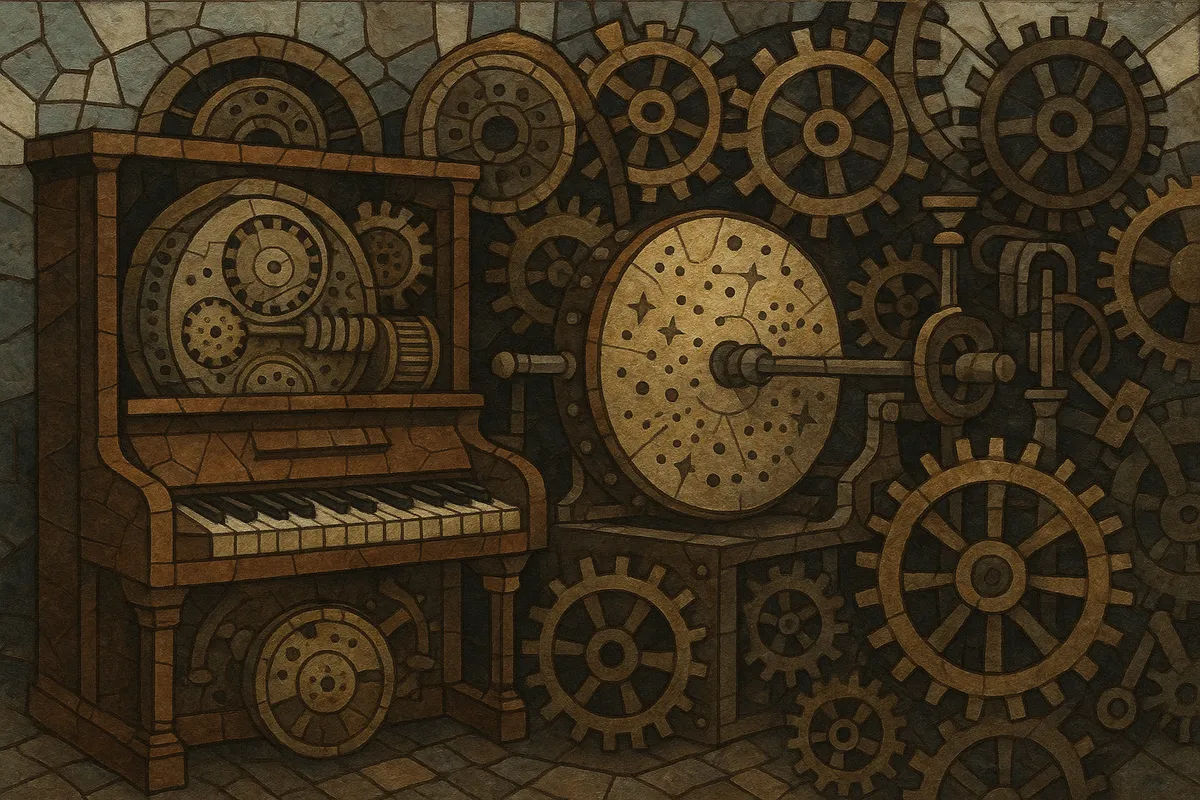
Typical carriers include pinned cylinders and discs (music boxes and barrel organs), perforated paper rolls (player pianos), and cardboard music books (fairground and dance organs). Sound is produced by physical actions—plucked steel teeth, organ pipes driven by bellows, struck strings or percussion—set in motion by clockworks, cranks, weights, or pneumatic actions. The result is a precise, repeatable performance that reflects both the arrangement encoded on the medium and the tonal character of the instrument.
History
Carillons, automata, and barrel organs in the Low Countries, France, and Germany demonstrated that complex music could be encoded mechanically. By the late 1700s, Swiss makers in Geneva and Sainte‑Croix refined the cylinder music box (often credited to Antoine Favre), standardizing tooth scales and interchangeable barrels.
The 1800s saw a boom in mechanical instruments: disc music boxes (Polyphon, Symphonion) offered louder sound and easier disc swapping; orchestrions and fairground organs from firms like Gavioli, Limonaire Frères, and Gebrüder Bruder brought full “orchestras” to public spaces. In the 1890s, the player piano and the Pianola roll system (Edwin S. Votey; Aeolian Co.) enabled detailed, dynamic piano performances encoded on perforated rolls.
Dance halls, traveling fairs, and amusement parks relied on large organs and orchestrions, while parlors featured music boxes and player pianos. Wurlitzer and Mortier expanded the tonal palette with percussion and colorful registrations. Although some instruments adopted electric blowers, control remained fundamentally mechanical.
Radio, records, and electrical amplification reduced demand for mechanical instruments. Many were scrapped or converted; others were preserved by collectors and new museums. Composers like Conlon Nancarrow revitalized the medium by exploiting the precision of player‑piano rolls for polyrhythms and tempos impossible by hand.
Restoration workshops, festivals, and maker guilds keep mechanical music alive. New rolls, pinned cylinders, and book music are still arranged; composers occasionally write for barrel organs or mechanical organs. The aesthetic of exact repetition and physical sound production informs strands of minimalism, process music, and sound art.