Your digging level
Description
New Orleans jazz is an early jazz style that emerged in New Orleans as small ensembles blended African-American musical practices with European instrumentation.
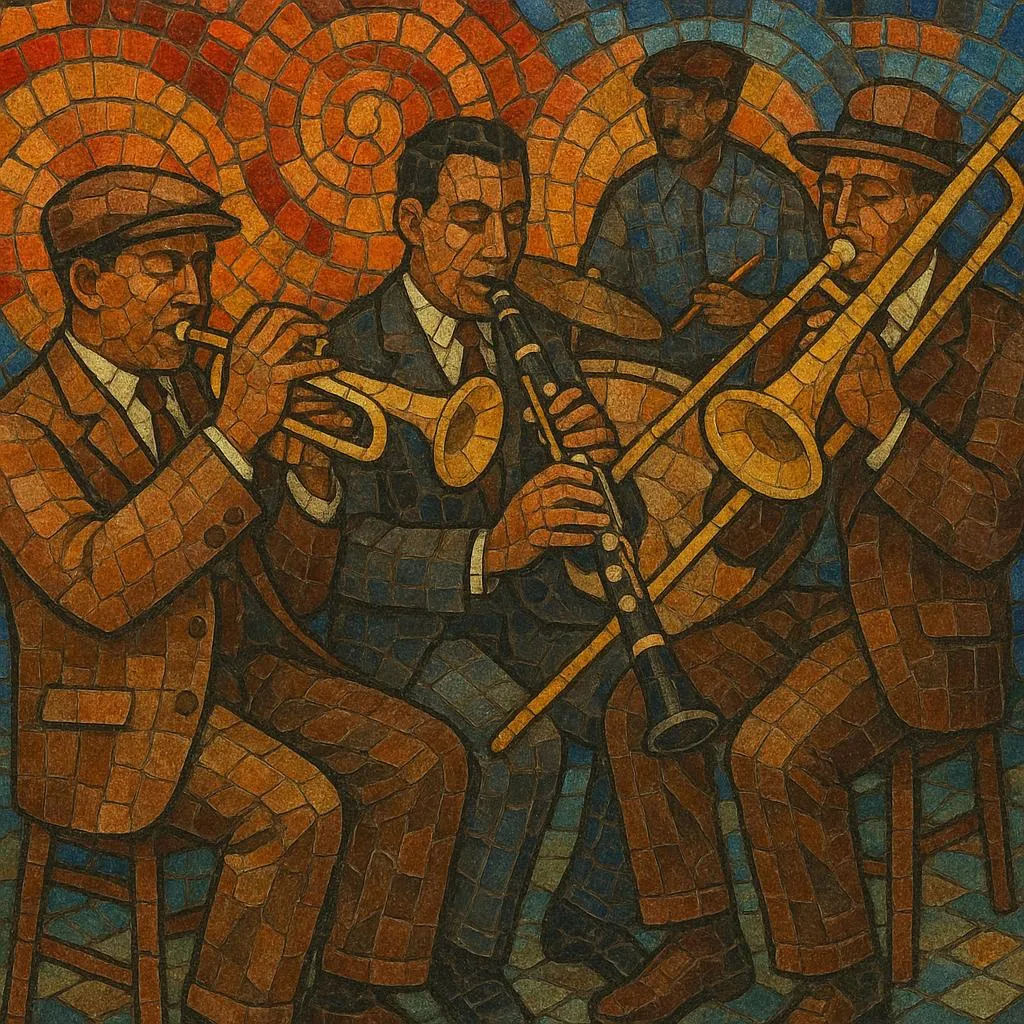
It is characterized by collective improvisation, where multiple frontline instruments (typically cornet/trumpet, clarinet, and trombone) improvise simultaneously around the melody.
Rhythm is driven by a steady, marching-band-derived pulse and syncopation, often supported by tuba (or string bass), banjo (or guitar), drums, and sometimes piano.
The repertoire commonly draws on blues, ragtime, marches, quadrilles, hymns, and popular songs, with frequent use of call-and-response phrasing and a strong sense of swing that predates later big-band styles.
In many catalogs this tradition overlaps with what is later called Dixieland, though historically it includes both African-American New Orleans styles and subsequent revival interpretations.
History
New Orleans jazz grew out of the city’s brass band culture, parade music, ragtime syncopation, the blues, and dance music heard in neighborhoods, social clubs, and venues such as Storyville.
Musicians adapted march and hymn repertoire for dance and parade settings and began expanding melodic variation into full collective improvisation.
As New Orleans musicians traveled to Chicago, St. Louis, and New York, the style spread nationally.
The first widely distributed jazz recordings appeared in the late 1910s, and the 1920s saw the vocabulary of New Orleans jazz formalize through both African-American innovators and popular revival/interpretation ensembles.
As jazz moved toward arranged big-band swing, the original small-group New Orleans approach became less dominant in mainstream venues.
However, a strong revival tradition developed, preserving the repertoire and ensemble roles and reintroducing the style to new audiences.
New Orleans jazz established foundational jazz practices: blues language, swing feel, polyphonic frontline interaction, and the idea of improvisation as a central musical value.
Its DNA persists in traditional jazz revivals, early jazz scholarship, and New Orleans’ ongoing parade and second-line performance culture.
-
•
Intro (2–4 bars, often a vamp or turnaround)
•Head (melody with collective counterlines)
•Several improvised choruses (feature one or two soloists while others provide light background)
•Shout/ensemble chorus (full collective improvisation)
•Tag ending or coda (repeat last phrase, end with a strong cadence)