Your digging level
Description
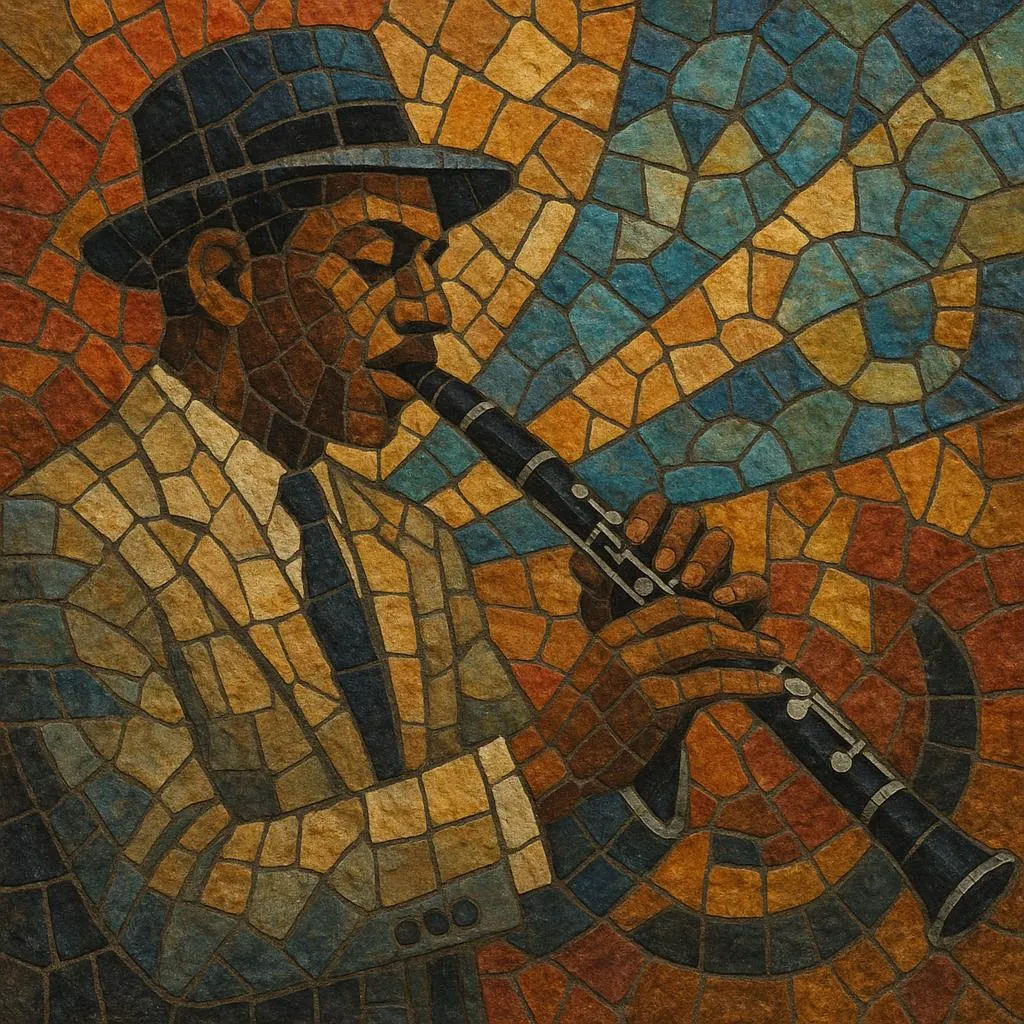
Jazz clarinet is the practice and tradition of playing the clarinet as a lead melodic and improvising voice within jazz.
From New Orleans parade bands and early small-group hot jazz to the big-band Swing Era and modern post-bop, the clarinet has offered a uniquely vocal timbre—capable of smooth legato lines, swooping glissandi, woody low-register growls, and brilliant altissimo sparkle. Its role has evolved from collective frontline counterpoint with cornet/trumpet and trombone to featured soloist in large ensembles and versatile voice in contemporary crossover settings.
History
The clarinet became a frontline instrument in early New Orleans ensembles, where it threaded countermelodies around cornet or trumpet leads and trombone tailgates. Its agility and wide dynamic range suited the polyphonic texture of hot jazz and parade repertoires, carrying over from brass-band and marching traditions. Blues phrasing and ragtime syncopations shaped the instrument’s melodic language, while players borrowed expressive devices such as smears, bends, and growls to make the clarinet sound vocal and earthy.
During the Swing Era, the clarinet stepped into the spotlight as a virtuoso solo instrument and even a bandleading voice. Its brilliance cut clearly through big-band textures, and arrangers often wrote signature reed soli passages that featured or framed the clarinet. This period codified much of the idiomatic swing phrasing—laid‑back eighths, buoyant articulation, and rhythmic call‑and‑response with sax sections and rhythm sections—that still defines the “jazz clarinet sound.”
While saxophones became dominant voices in bebop and hard bop, a number of clarinetists adapted modern harmonic language—fast-moving ii–V cycles, altered dominants, and extended chord-scale relationships—onto the instrument. Others explored third stream and chamber-jazz hybrids, expanded techniques, and broader timbral palettes. In parallel, traditional and revivalist scenes kept New Orleans and small‑group swing clarinet playing vital.
Since the late 20th century, jazz clarinet has thrived across multiple currents: post-bop, Afro‑Cuban and Brazilian fusions, klezmer‑jazz hybrids, and chamber-jazz contexts. Modern players pair classic swing vocabulary with contemporary harmony, odd meters, and global grooves, reaffirming the clarinet’s flexibility from intimate trios to large ensembles.