Your digging level

For this genre
0/8
🏆
Sign in, then listen to this genre to level up

Description

Musique alsacienne refers to the traditional and popular music of Alsace, a culturally bilingual region on the Upper Rhine now within France. It blends Germanic Volksmusik aesthetics (Alemannic dialect song, village wind bands, waltzes and polkas) with French chanson sensibilities and urban dance-hall tastes.

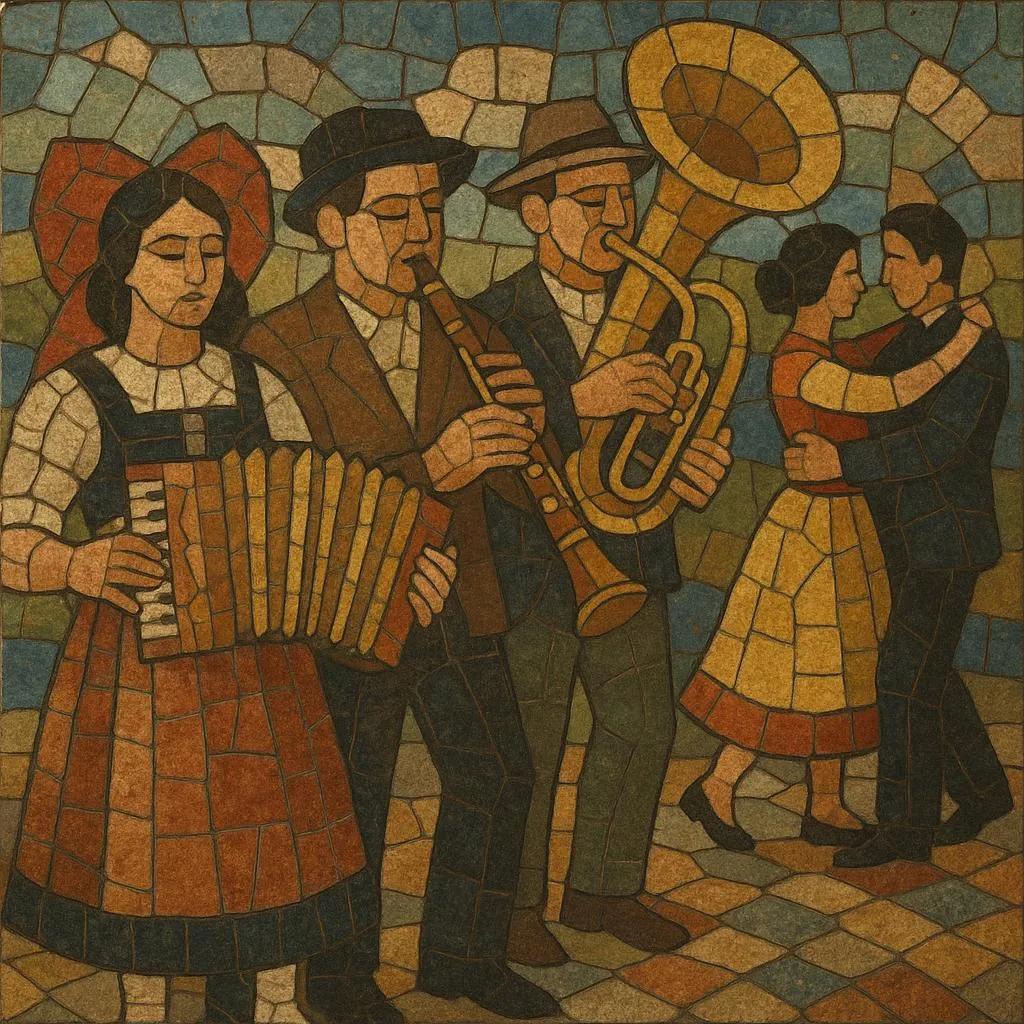
Typical textures come from fanfares/harmonies (community wind bands), small dance ensembles with accordion, clarinet, fiddle, and brass rhythm (oom‑pah bass with off‑beat chords), and male or mixed choirs. Songs are frequently performed in Alsatian (an Alemannic German dialect) as well as in French, celebrating wine-making, village life, carnival, and local humor. Dance forms such as waltz (3/4), polka (2/4), schottische, and marches underpin much of the repertoire.

Since the 20th century, the tradition has coexisted with cabaret and variety formats, and, in recent decades, has seen folk revivals and crossovers with chanson, pop, and rock while retaining a strong communal and festive identity.


Sources: Spotify, Wikipedia, Discogs, RYM, MB, user feedback and other online sources

History

Early roots (pre‑19th century)

Alsace’s musical identity formed at a crossroads of Latin/French and Germanic worlds. Medieval and early-modern urban music (guild pipers, church choirs, and civic bands) provided durable practices of community performance. Village dance repertoires absorbed pan‑Central European couple dances and local song dialects.

19th century: Codification and community ensembles

In the 1800s, Alsatian dialect songs (Volkslieder) were collected and printed, and local wind bands (fanfares/harmonies) proliferated in towns and villages. Dance music aligned with the European vogue for waltzes, polkas, schottisches, and marches. Choral societies and parish choirs flourished, shaping a participatory, civic soundscape.

1900s–1940s: Border shifts and popular modernity

Alternations of political sovereignty (French/German) intensified bilingual performance cultures. Brass bands and small dance orchestras animated fêtes, kermesses, wine fairs, and carnival. Recording and radio brought Parisian chanson and German Schlager into local repertoires, while dialect song remained central at cabarets and community halls.

Post‑war to late 20th century: Cabaret, chanson, and revival

After 1945, dialect cabarets and variety troupes popularized witty, locally flavored songs. Community wind bands and choirs continued to anchor municipal life. From the 1970s onward, folk revivals (“musique trad”) revalorized acoustic dance music, leading to new ensembles that mixed Alsatian tunes with French folk circuits and pan‑Alpine/Upper‑Rhine sounds.

21st century: Hybrids and cultural continuity

Contemporary artists blend Alsatian dialect song with chanson, folk‑rock, and pop/variety. Festivals, wine fairs, and carnival sustain demand for danceable waltzes/polkas, while youth projects and cultural institutions preserve dialect lyrics and repertoire. Musique alsacienne today is both heritage and living practice, adaptable to stages from village squares to urban theaters.

How to make a track in this genre

Core meter, tempo, and groove
•   Favor couple dances: waltz (3/4, ~84–100 BPM felt in dotted sweep), polka (2/4, ~110–130 BPM), schottische (alternating steps), and marches (2/4 or 4/4, ~100–120 BPM). •   Use an oom‑pah foundation: bass notes (tuba/accordion left hand) on the downbeat and chordal off‑beats (brass/accordion/guitar) for lift.
Harmony and melody
•   Keep harmony diatonic and singable: I–IV–V is common; spice with secondary dominants and occasional borrowed ii or vi. •   Compose folk‑like, stepwise melodies with memorable hooks; phrase symmetrically (4+4 or 8+8 bars) for danceability. •   In waltzes, write long, arching lines; in polkas, use sprightly motifs and call‑and‑response between melody (clarinet/fiddle/accordion right hand) and brass.
Instrumentation
•   Small dance ensemble: diatonic or piano accordion, clarinet or fiddle for lead, trumpet/trombone and tuba for brass rhythm, guitar/banjo for harmony, light percussion (snare, cymbals) for marches and carnival. •   Community band scoring: woodwinds (flute/clarinet/sax), brass (cornet/trumpet, horn, trombone, tuba), snare/bass drum; double the melody in clarinets and flugelhorns for warmth.
Lyrics and language
•   Write in Alsatian dialect (Alemannic) and/or French; celebrate vineyards, the Rhine, village humor, carnival, seasons, and courtship. •   Balance levity and sentiment: couplets with catchy refrains; include local idioms and place‑names to root the song.
Arrangement and form
•   Standard strophic song with intro–verse–refrain–instrumental–verse–refrain–coda. •   Insert a modulating instrumental strain for variety (up a whole step) before a final refrain; feature clarinet or accordion solo.
Performance practice
•   Keep articulation buoyant (short off‑beats, lifted endings of phrases). •   In choirs, use clear unison/parallel thirds and homophony; for bands, prioritize balance so melody projects above the oom‑pah bed.

Top tracks

Locked
Share your favorite track to unlock other users’ top tracks

Upcoming concerts

in this genre
Influenced by
Has influenced
No genres found

Download our mobile app

Get the Melodigging app and start digging for new genres on the go
© 2026 Melodigging
Melodding was created as a tribute to Every Noise at Once, which inspired us to help curious minds keep digging into music's ever-evolving genres.
Buy me a coffee for Melodigging