Your digging level
Description
Musikkorps refers to the Central European wind- and brass-band tradition—especially the Germanic “music corps” of the army and civic life—that performs marches, ceremonial pieces, chorales, and concert works.
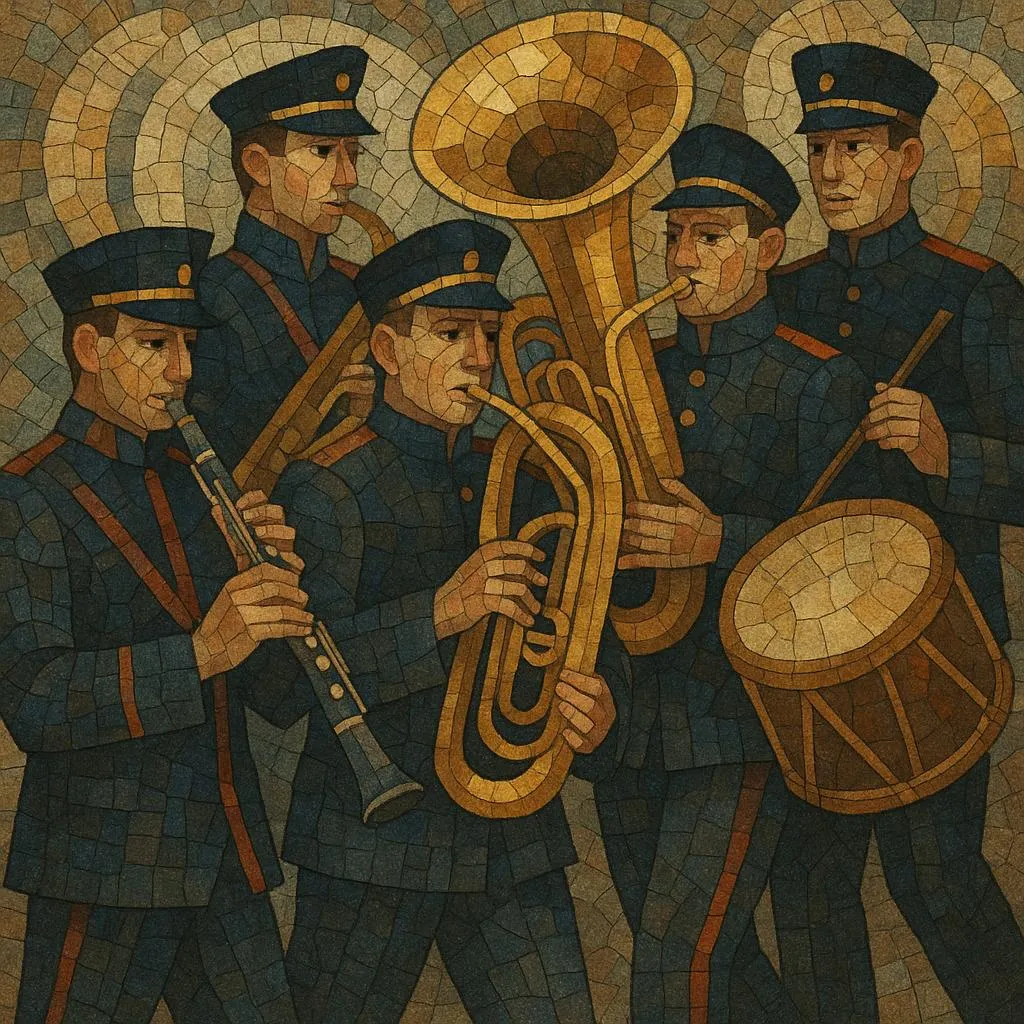
The ensemble is built around woodwinds (piccolo, flutes, clarinets, saxophones), brass (cornets/trumpets, horns, trombones, baritones/euphoniums, tubas) and battery/percussion, sometimes augmented by fanfare trumpets or historical fifes and drums. The core idiom is the march and related parade/ceremonial repertory, but modern musikkorps also play overtures, arrangements of popular or classical music, and hymn-like pieces for solemn events.
Stylistically, musikkorps emphasizes crisp articulation, symmetrical phrasing, strong duple or compound meters for marching, and brilliant, antiphonal brass writing contrasted with woodwind filigree. It functions both as outdoor parade music and as an indoor concert-band format, bridging military, civic, and educational music-making.
History
Modern musikkorps practice cohered in the German states during the early 1800s, when the adoption of valved brass, standardized instrumentation, and codified drill transformed earlier fife‑and‑drum units and ad‑hoc wind groups into disciplined military music corps. In Prussia, band reformer Wilhelm Wieprecht (active 1830s–1840s) unified instrumentation and elevated repertoire, helping to define the bright, rhythmically precise sound and the ceremonial role that would characterize the tradition.
By the late 1800s, musikkorps were integral to public life across German‑speaking lands and neighboring regions. They provided music for parades, regimental ceremonies, public concerts, and civic festivities, and became vehicles for national and regional identity through popular marches, patriotic songs, and transcriptions of opera and orchestral music. The bandstand and open‑air concert became important cultural spaces, and standardized march forms (intro–strain–strain–trio–break–finale) took hold.
Across the 20th century, state and military bands remained professional flagships while civic, factory, police, and school bands proliferated. After mid‑century, newly formed or reestablished military bands in countries like (West) Germany continued the musikkorps lineage under modern administration, and Austrian, Swiss, Norwegian, and Swedish military/civic bands cultivated closely related aesthetics. Recordings and radio broadened the reach of march and ceremonial repertoire, and concert‑band literature expanded with original works for wind ensemble.
Today musikkorps denotes both professional military/state bands and the wide constellation of civic/community wind bands in Central and Northern Europe. They perform ceremonial duties, national commemorations, and concert programs ranging from historical marches and chorales to contemporary wind‑ensemble compositions and popular arrangements. The tradition remains a training ground for ensemble precision, distinctive march interpretation (including classic central‑European trio practices), and public music‑making tied to civic ritual.