Your digging level
Description
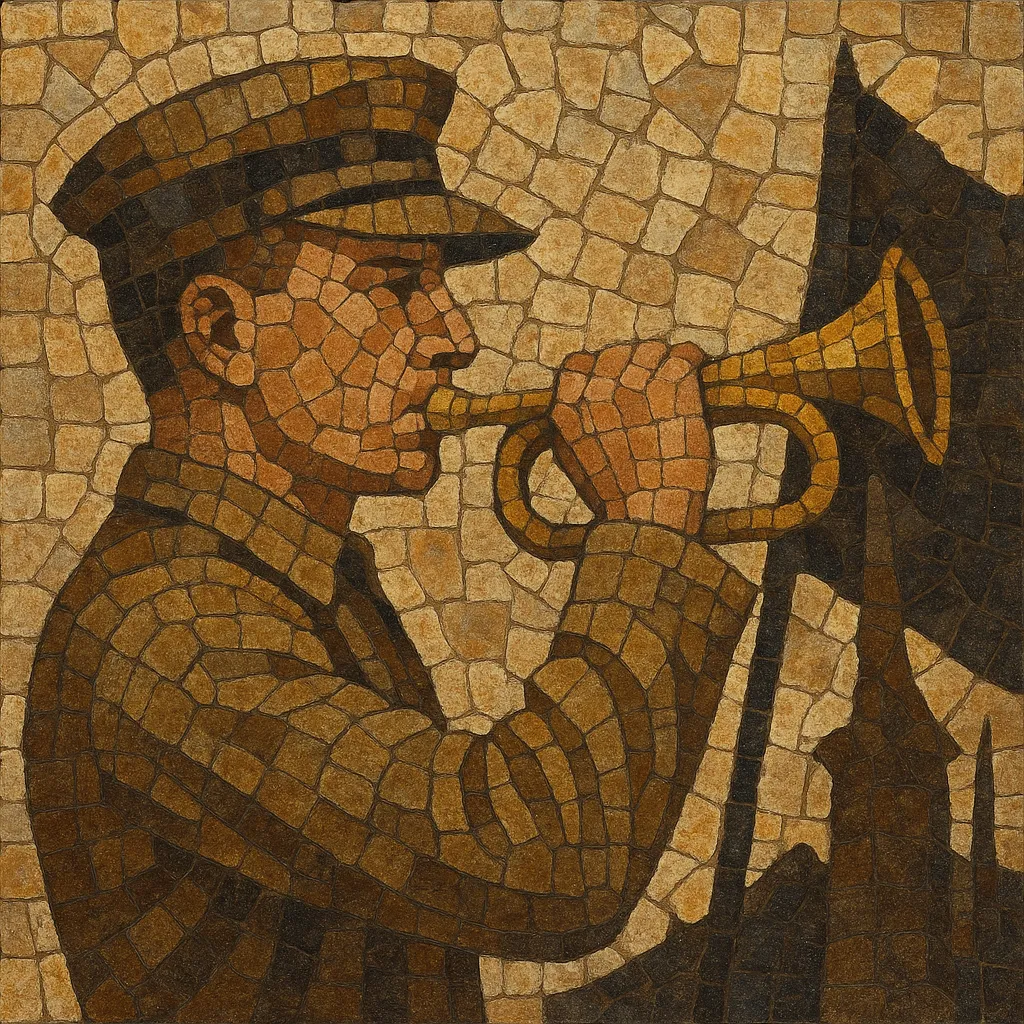
Bugle call is a functional, highly codified form of military field music performed on a natural (valveless) bugle. Each call is a short, unaccompanied melody that conveys specific commands or signals—such as assembly, revelry, meals, lights out, or ceremonial honors.
Because the bugle can only produce notes from its natural harmonic series, bugle calls rely on clear rhythmic patterns and strong intervallic leaps (fourths and fifths) to be audible and unambiguous outdoors. The style prioritizes projection, brevity, and clarity over harmony or ornamentation, making it immediately recognizable and practical for drill, ceremony, and timekeeping.
History
Bugle calls emerged from earlier trumpet and fife-and-drum signaling traditions used across European armies. While battlefield trumpets and fifes had conveyed commands for centuries, the adoption of the compact, valveless bugle by light infantry in the late 18th to early 19th centuries—especially in the British Army—accelerated the standardization of concise, easily projected signals.
During the 1800s, armies in Britain, the United States, and continental Europe formalized call repertoires and notation, publishing manuals that codified tempo, rhythm, and purpose. The bugle’s limited harmonic series encouraged unison, monophonic calls with sharply articulated rhythms in duple meter. By mid-century, distinct sets of calls governed daily camp routines and battlefield commands.
The American Civil War era cemented the cultural resonance of calls such as Reveille, Assembly, and Tattoo. In 1862, Union General Daniel Butterfield authored the call later known as “Taps,” which became a solemn emblem of military funerals and remembrance. In the British tradition, “The Last Post” (with “Rouse”) became central to memorial observances throughout the Commonwealth.
As electronic communications replaced acoustic signaling in combat, bugle calls remained vital in ceremonial contexts—guard mountings, memorial services, and daily routines on bases and ships. The style’s concise fanfare-like cells also permeated popular culture; brief bugle riffs such as the six-note “Charge!” became staples of stadium atmosphere and marching traditions. Today, calls are preserved by military bands, drum and bugle corps, veterans’ organizations, and ceremonial units worldwide.