Your digging level

For this genre
0/8
🏆
Sign in, then listen to this genre to level up

Description

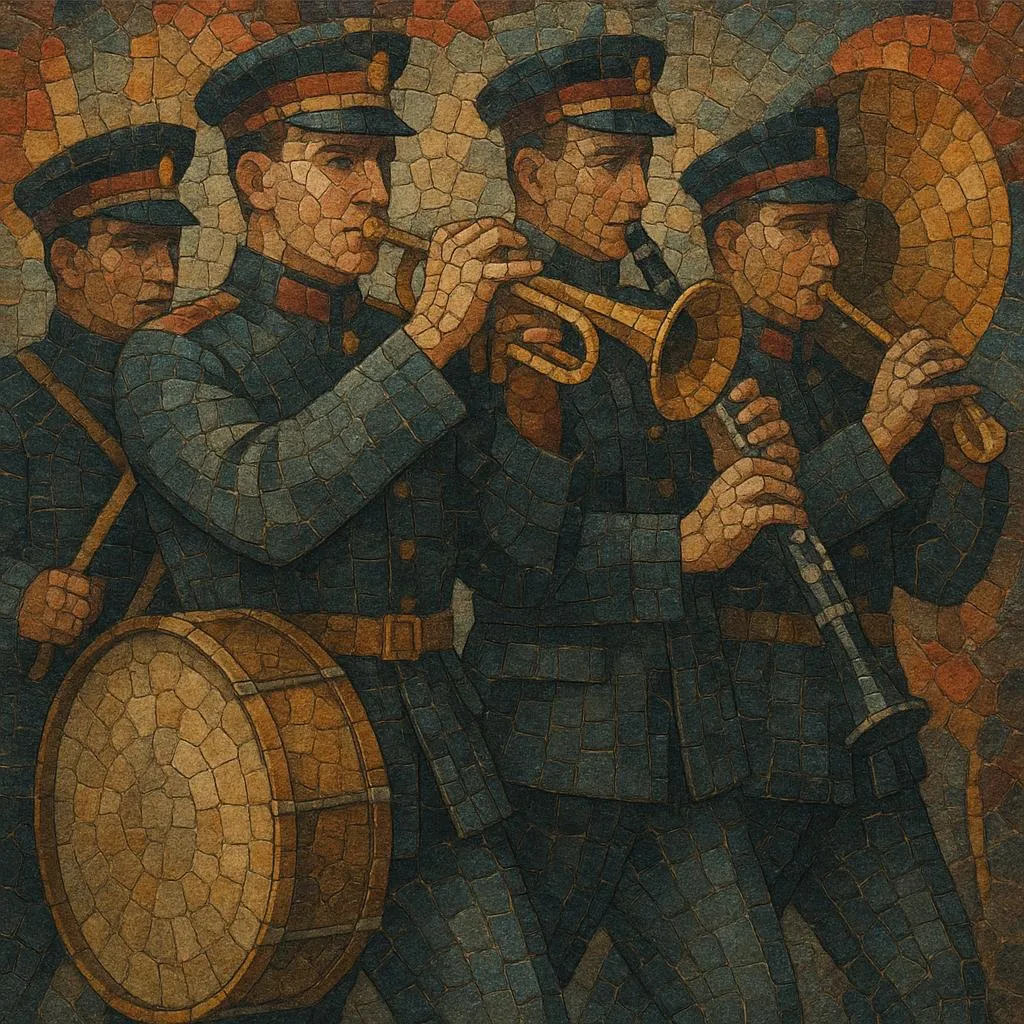
Military band is a tradition of disciplined wind, brass, and percussion ensembles attached to armed forces for signaling, ceremony, and public display. In modern practice, it encompasses parade and review music (quick and slow marches), fanfares, hymn-tunes, and concert transcriptions, often performed with immaculate precision and visual drill.

Typical instrumentation centers on brass (cornets/trumpets, horns, trombones, euphoniums, tubas), woodwinds (piccolo, flutes, clarinets, saxophones), and field percussion (snare, bass drum, cymbals), with occasional specialist colors (fanfare trumpets, herald trumpets, or, in some regiments, bagpipes as a companion pipe band). The sound is bold, projecting outdoors, with clear rhythmic profiles and strong melodic lines meant to carry across open spaces.

While its roots lie in battlefield communication and morale, the military band has evolved into a ceremonial and concert institution that shapes civic identity, national rituals, and musical education.


Sources: Spotify, Wikipedia, Discogs, Rate Your Music, MusicBrainz, and other online sources

History

Origins (Ottoman and Early European)

The prototype for the military band in Europe was influenced by the Ottoman mehter (Janissary) ensembles, documented from the late medieval to early modern periods. Their piercing shawms, kettledrums, and cymbals inspired fascination and imitation across European courts and armies. By the 1700s, European powers began organizing permanent military music units for signaling, drill, and ceremonial pomp.

18th–19th Centuries: Standardization and Brass Revolution

As European armies professionalized, bands shifted from loud shawms/oboists toward mixed wind forces. The invention and adoption of valves (19th century) transformed brass playing, enabling fully chromatic parts and richer harmonic writing. This period formalized the march as a foundational genre (quick and slow time), codified dress and drill, and created enduring regimental traditions.

Late 19th–Early 20th Centuries: Public Concerts and Civic Identity

Military bands became prominent public ensembles, playing park concerts, national celebrations, and tours. They performed arrangements of operatic overtures, symphonic excerpts, and popular airs, helping democratize art music. Their precision and portability also influenced civilian brass bands and the eventual concert/marching band culture.

Mid–Late 20th Century: From Battlefield to Ceremony

Technological changes (radio, telephony) reduced battlefield signaling roles, but ceremonial, diplomatic, and community functions broadened. Military bands enhanced state occasions, honors, and remembrance, while also serving as elite training grounds for wind/percussion performance and arranging.

Today: Ceremonial Excellence and Educational Impact

Modern military bands maintain dual identities as ceremonial units and high-level concert ensembles. They commission new works, uphold march traditions, collaborate with choirs and orchestras, and act as cultural ambassadors—preserving historic repertoire while evolving with contemporary techniques and repertoire.

How to make a track in this genre

Core instrumentation and scoring
•   Score for winds, brass, and percussion with outdoor projection in mind: picc/flutes, clarinets (B♭/E♭), saxophones, cornets/trumpets, horns, trombones, euphoniums, tubas, snare/bass/cymbals, plus optional fanfare trumpets. •   Use transposed parts and traditional voicings: clarinets carry melody/filigree, cornets/trumpets project fanfares, horns/trombones thicken harmony, euphoniums sing inner countermelodies, tubas ground the bass.
March forms and rhythm
•   Classic quick march form: Intro → 1st strain (repeat) → 2nd strain (repeat) → Trio in the subdominant (often with reduced dynamics and added counterline/piccolo obbligato) → Break strain ("dogfight") → Final strain with full ensemble. •   Meters: 2/4 or 6/8 for quick time; slower ceremonial marches in common time. Keep percussion crisp: open rolls and rudiments in snare, steady pulse in bass drum, unison crashes in cymbals.
Harmony, melody, and texture
•   Harmonies are diatonic with functional progression for clarity in open air. Save chromaticism for color. •   Write bold, singable melodies with clear phrase endings for drill cues. Use antiphonal brass fanfares and call-and-response between choirs. •   Balance is paramount: avoid over-doubling low brass if outdoors; ensure woodwind filigree remains audible against brass.
Repertoire beyond marches
•   Include hymn settings (broad chorales), patriotic airs, fanfares, and concert transcriptions. •   Orchestrate with dynamic terracing and clear climaxes; exploit coloristic contrasts (piccolo over muted brass, tenor horn/euphonium duets, trombone glissandi sparingly).
Rehearsal and presentation
•   Emphasize uniform articulation, rhythmic unanimity, and dynamic control. Align musical phrasing with stepping/drill when used in parade. •   Outdoors: prioritize projection and clarity; indoors: explore softer dynamics, broader phrasing, and more detailed balance.

Top tracks

Locked
Share your favorite track to unlock other users’ top tracks
Influenced by
Has influenced
Challenges
Digger Battle
Let's see who can find the best track in this genre

Download our mobile app

Get the Melodigging app and start digging for new genres on the go
© 2026 Melodigging
Melodding was created as a tribute to Every Noise at Once, which inspired us to help curious minds keep digging into music's ever-evolving genres.
Buy me a coffee for Melodigging