Your digging level
Description
Wind music is music written primarily for wind instruments, including woodwinds and brass, often with optional percussion.
It spans concert music (wind quintets, wind octets, Harmoniemusik, and wind ensembles), ceremonial and military repertoire (marches, fanfares), and modern concert band / wind symphony literature.
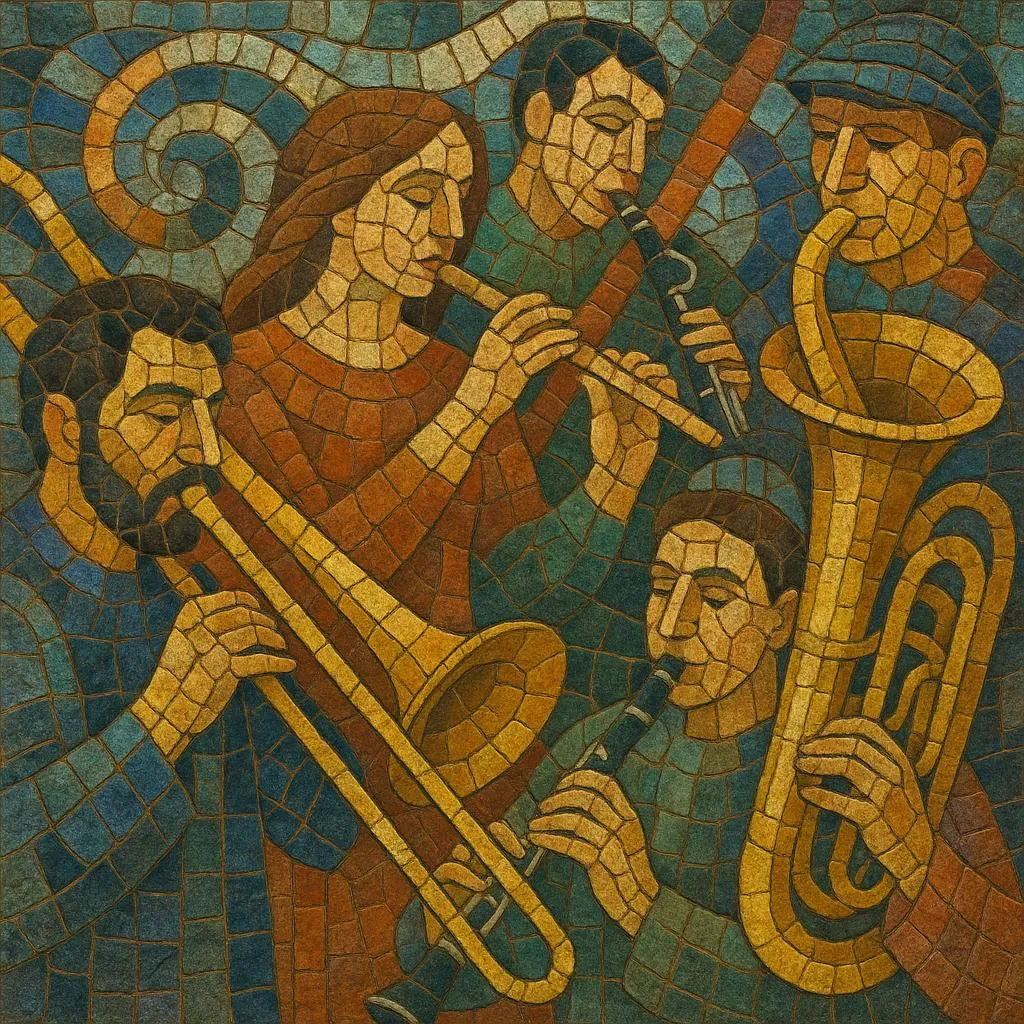
The defining feature is the use of breath-driven timbres (flute, oboe, clarinet, bassoon, saxophone, horn, trumpet, trombone, euphonium, tuba) to carry melody, harmony, and color, sometimes replacing or supplementing strings.
History
European courts popularized Harmoniemusik—outdoor and indoor entertainment played by wind ensembles (often pairs of oboes, clarinets, horns, and bassoons).
These groups served social functions similar to string ensembles but were better suited to outdoor projection.
Wind music expanded through military bands and civic ensembles, with marches, transcriptions, and public concerts.
Composers and bandleaders created repertoire designed for massed winds, strong rhythmic drive, and clear melodic projection.
In the 1900s, composers increasingly wrote original, large-scale works specifically for concert band / wind ensemble, not just transcriptions.
National traditions (especially in Europe and North America) developed distinct band sound ideals, balancing orchestral color with wind-specific articulation and breath phrasing.
Today, wind music includes concert band and wind symphony repertoire, chamber wind works, educational band literature, and hybrid works influenced by jazz, film scoring, and electronic techniques.
Wind ensembles rely heavily on vertical voicing clarity because sustained winds can saturate the texture.
•Use register separation to avoid muddiness (e.g., keep low brass fundamental clear, avoid overcrowding mid-low clarinets/tenor sax/trombones).
•Common effective techniques:
•Chorale writing (especially for horns/low brass and clarinet choir).
•Antiphonal call-and-response between woodwinds and brass.
•Layered timbre orchestration (melody in clarinets + horn support, countermelody in saxophones, bass line in tuba/euphonium).
Exploit idiomatic colors:
•Clarinets for agile, blended melody.
•Horns for warm inner harmonies and heroic calls.
•Trumpets/trombones for brilliance and fanfares.
•Saxophones for a bridge between woodwind blend and brass power.
•Balance long tones with rest cycles so players can recover breath.
Wind music often excels in:
•March form (intro–strain–trio–break strain).
•Theme and variations and overture-like forms.
•Programmatic tone pieces where timbre changes depict scenes.
•Plan climaxes carefully: full ensemble fortissimo is powerful, so save it for structural peaks.