Your digging level
Description
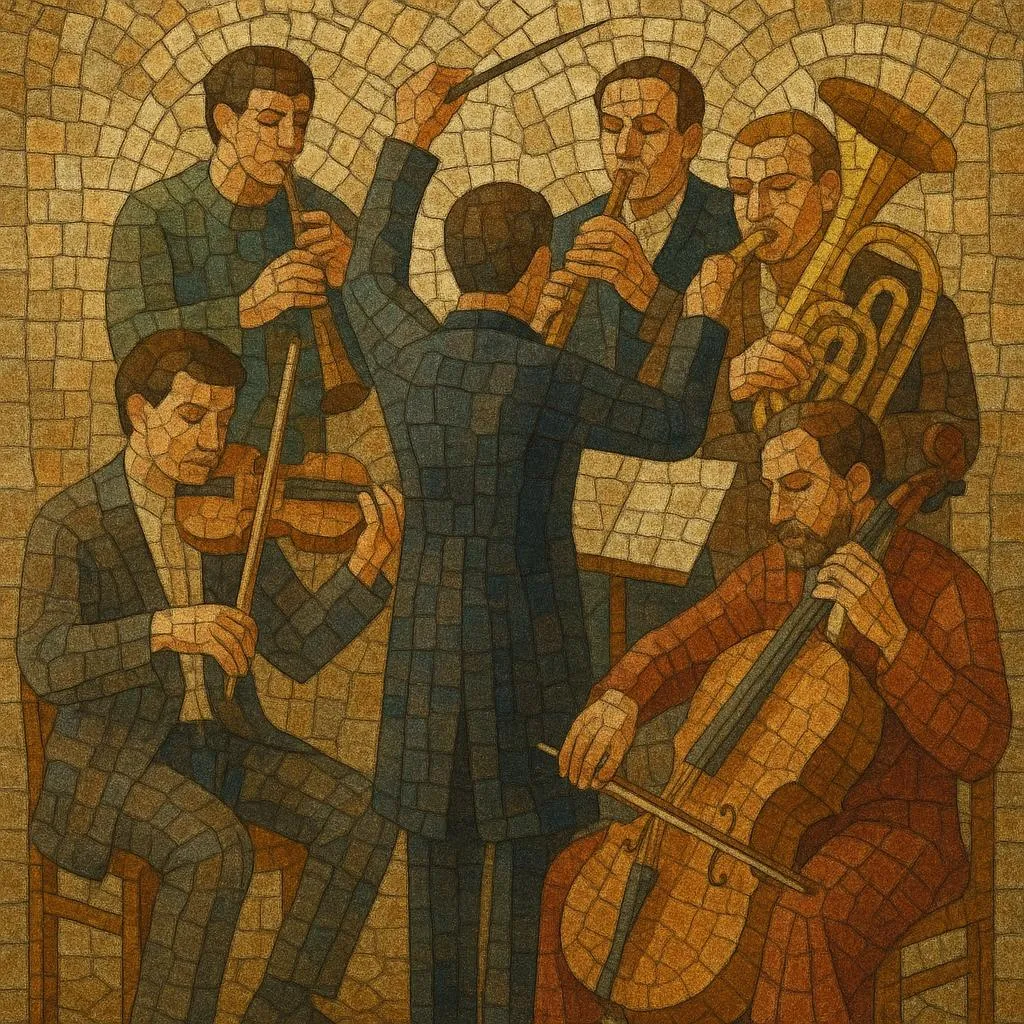
A chamber orchestra is a small, flexible orchestra typically ranging from about 15 to 45 musicians. It preserves the clarity and intimacy of chamber music while retaining orchestral color and range. Compared with a full symphony orchestra, it uses reduced forces—often single or paired winds and brass, a compact string body, and limited percussion—producing a transparent, agile sound.
Chamber orchestras perform repertoire from the Baroque and Classical eras through to contemporary works, and they frequently revive older pieces with historically informed approaches. The format lends itself to conductor-led or conductorless performance, encouraging close ensemble listening, elegant phrasing, and finely detailed articulation.
History
Small orchestral forces were the norm in the Baroque and Classical periods, when court and civic ensembles often numbered a few dozen players at most. Repertoires such as suites, divertimenti, serenades, and early symphonies by composers like Haydn and Mozart were conceived for modest forces in resonant but intimate rooms. Although the term “chamber orchestra” was not yet current, the scale and function foreshadowed today’s practice.
The modern idea of a permanent "chamber orchestra" crystallized in the early 1900s, spurred by neoclassicism, early music revivals, and practical needs for agile ensembles in smaller venues and radio studios. Composers such as Schoenberg (Chamber Symphony, Op. 9) and Stravinsky wrote works tailored to smaller orchestral groups, emphasizing clarity, counterpoint, and crisp rhythm.
After World War II, dedicated chamber orchestras flourished worldwide. Their core Classical-era repertoire coexisted with new commissions, arranging traditions (e.g., string-orchestra transcriptions), and historically informed practices. The format’s responsiveness made it ideal for contemporary premieres, crossover projects, and conductorless models, all of which highlighted democratic music-making and ensemble precision.
Chamber orchestras now occupy a central place in concert life. They champion repertoire from Baroque to brand-new works, tour widely, collaborate with soloists and choirs, and explore both modern instrument and period-informed styles. Their scale continues to inspire composers seeking a balance of orchestral color and chamber-like clarity.