Your digging level
Description
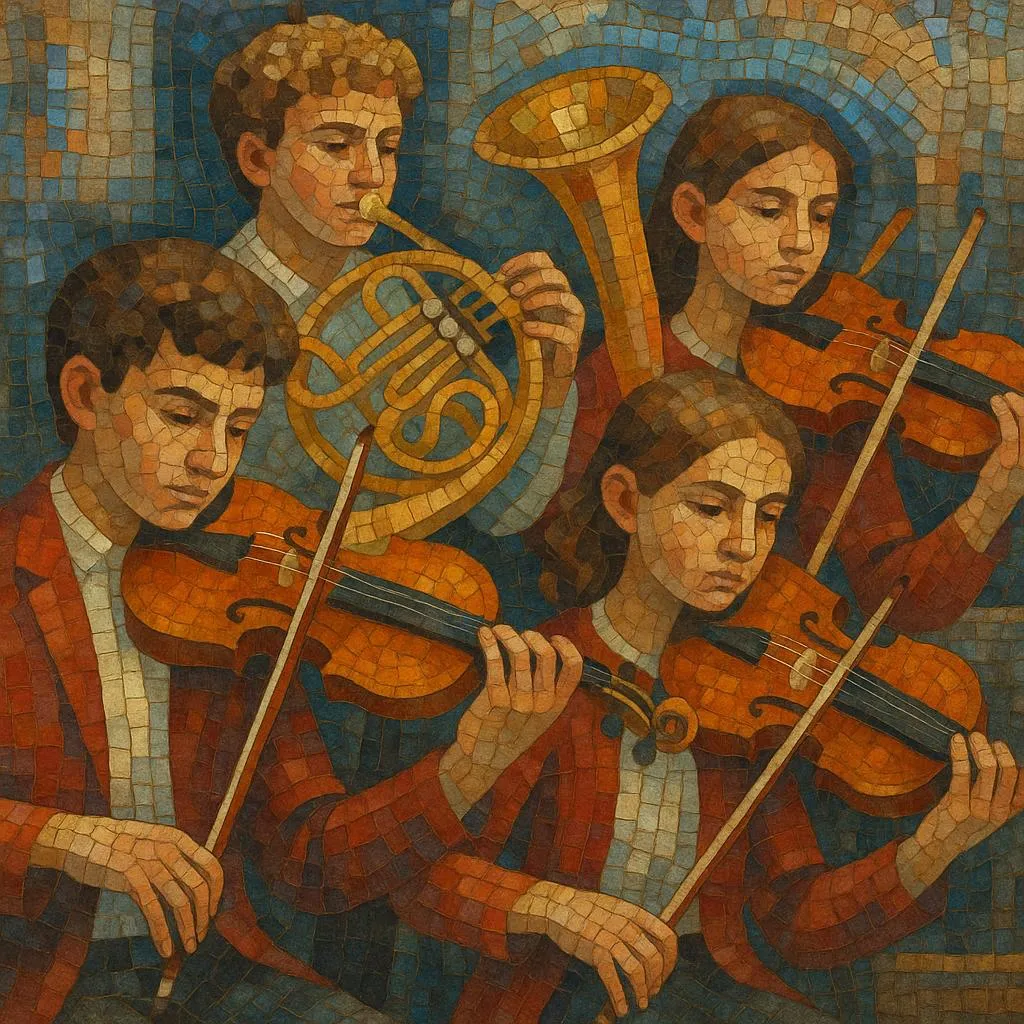
Youth orchestra refers to a full symphony orchestra composed primarily of young musicians (often ages 12–26) who rehearse and perform standard orchestral repertoire alongside contemporary works under professional coaching.
Unlike school bands or string orchestras, youth orchestras mirror the instrumentation, seating, and rehearsal practices of a professional symphony orchestra. Their mission blends artistic excellence with pre‑professional training, access, and social development, offering pathways for talented players to progress into conservatories, festival orchestras, and professional ensembles.
Repertoire spans Baroque to 21st‑century music, film and game scores, national traditions, and newly commissioned pieces. Educational aims include ensemble discipline, score literacy, stylistic awareness, sectional teamwork, and concertcraft.
History
Student and conservatory orchestras have existed since the late 19th and early 20th centuries, giving young players their first experience with large ensemble repertoire and rehearsal discipline. These institutional orchestras created the pedagogical models—sectional coaching, principal leadership, and rotating seating—that youth orchestras later adopted outside of schools.
After World War II, the idea of a dedicated, extra‑school, regional or national youth symphony became a cultural priority in several countries. The establishment of national youth orchestras in Europe (notably in the United Kingdom in 1948) proved that young players could perform complex repertoire at a high level. By the 1970s, pan‑national ensembles and festival orchestras further professionalized the pipeline between youth training and professional careers.
From the 1980s onward, youth orchestras proliferated worldwide. New national ensembles and international festival orchestras (e.g., Germany’s Bundesjugendorchester, Orchestre Français des Jeunes, Asian Youth Orchestra, Youth Orchestra of the Americas, and others) broadened access and emphasized cultural exchange. Youth orchestra participation increasingly became a bridge to conservatory study, mentorship with major conductors, and international touring.
Parallel to this growth, publicly funded and community‑based programs demonstrated how orchestral training can advance social inclusion, educational achievement, and community cohesion. Youth orchestras became important commissioners and advocates for living composers, as well as curators of heritage repertoire.
Today, youth orchestras range from county and city ensembles to national and transnational groups. Many collaborate with composers on premieres, perform film/game music to reach new audiences, and integrate digital tools for auditions and remote coaching. Alumni networks connect players to leading conservatories and professional orchestras. The format remains a cornerstone of classical music education and audience development.
Write for a standard symphony orchestra (2–3 woodwinds per part, 2–4 horns, 2–3 trumpets, 3 trombones + tuba, timpanist + 2–4 percussionists, harp/piano/celesta ad lib., and full strings). Provide clear doublings if winds/brass numbers may vary, and consider optional parts (e.g., bass clarinet, contrabassoon) to maintain balance when absent.