Your digging level
Description
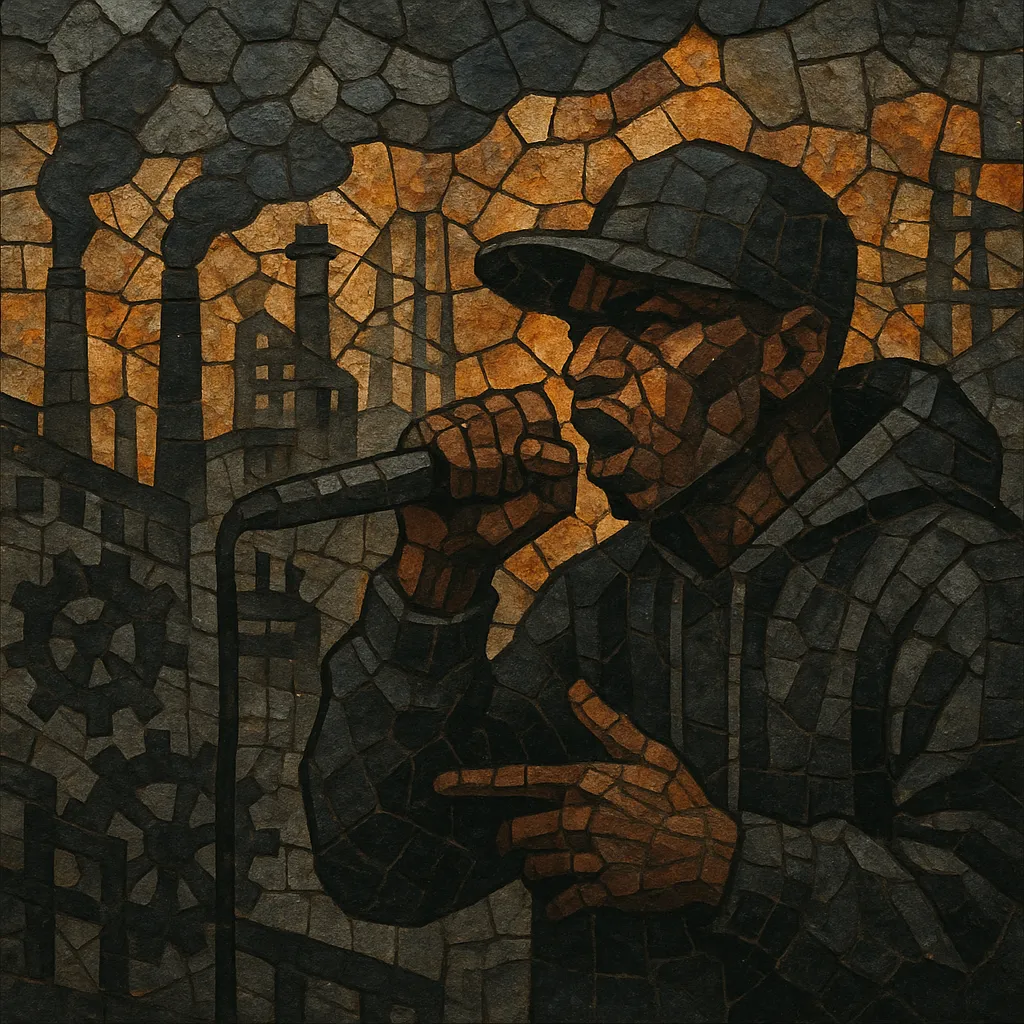
Industrial hip hop is a fusion genre that threads the rhythmic backbone of hip hop with the abrasive textures, mechanical timbres, and confrontational aesthetics of industrial music. It typically features heavy, distorted percussion, metallic hits, harsh noise layers, and sample collage techniques, while retaining MC-driven vocals or spoken-word cadences.
The style leans into sonic extremity: detuned or bitcrushed drums, re-amped breaks, atonal drones, and saturated bass coexist with turntablism, dub-informed space, and politically charged lyricism. Tempos often sit in the 80–110 BPM range, but feel lurching and monolithic due to swung grooves, halting gates, and heavy compression.
Lyrically and thematically, industrial hip hop embraces dystopian urban imagery, media critique, and social protest, mirroring its rugged sound design with stark, incisive narratives.

History
Industrial hip hop emerged in the mid-to-late 1980s as artists on both sides of the Atlantic began fusing hip hop’s rhythmic language with the abrasive, machine-driven sonics of industrial and post-punk. It built on dub’s studio-as-instrument ethos, early hip hop’s sampling ingenuity, and industrial music’s transgressive sound palette.
In the United Kingdom, figures tied to post-punk and the On-U Sound milieu—such as Mark Stewart (with The Maffia) and Tackhead—laid crucial groundwork by combining militant funk breaks, live bass, and cavernous dub processing with metallic noise and tape-saturated samples. Parallel experiments by acts like Meat Beat Manifesto extended the template with hard breakbeats and sample collages, while in the United States, groups such as The Beatnigs and later Consolidated fused activist messaging with industrial textures and hip hop cadence.
The 1990s saw a diversification of approaches. The Bomb Squad’s wall-of-noise production for Public Enemy validated the collision of dense sampling and abrasive timbres, even as they remained within hip hop. UK/US cross-pollinations—Techno Animal (Kevin Martin and Justin Broadrick) in particular—pushed the sound toward bass-heavy, dystopian atmospheres, influencing illbient and experimental hip hop circles. Concurrently, independent American artists explored politically conscious, industrial-tinged rap, while club-adjacent scenes absorbed the aesthetic into alternative dance and industrial rock contexts.
Artists like Dälek codified a distinctly noise-forward, droning take on the style—slow, pummeling beats under vast feedback and granular textures—while producers such as El-P popularized gritty, mechanized sound design within alternative hip hop. This period cemented industrial hip hop as a recognized lane within experimental and underground rap rather than a passing crossover.
The 2010s brought the style renewed visibility through acts like Death Grips and clipping., whose maximalist distortion, breakneck edits, and conceptual frameworks resonated beyond traditional hip hop audiences. The genre’s vocabulary has since bled into trap-adjacent forms (e.g., trap metal), digital hardcore, and witch house-adjacent scenes, while continuing to inform avant-rap production, performance art aesthetics, and political sonic protest.



Top albums