Your digging level

For this genre
0/8
🏆
Sign in, then listen to this genre to level up

Description

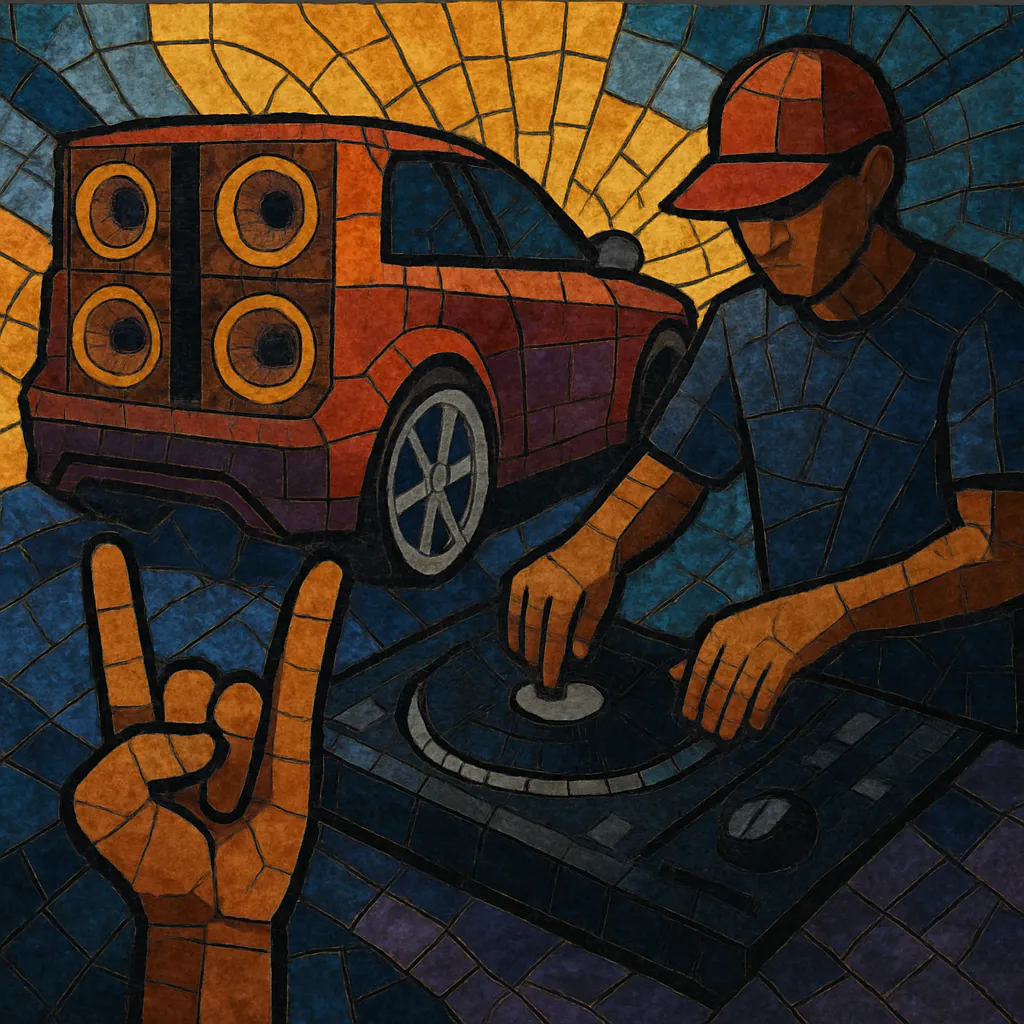
Funk automotivo is a Brazilian club- and street-oriented strain of funk built for massive car sound systems (aparelhagens) and roadside parties. It emphasizes catchy, repetitive synth riffs, a relentless four‑on‑the‑floor kick, and bass designed to shake trunks and doors.

Vocals are often short, chanted phrases or hooks processed with heavy reverb and delay so they bloom over the beat. Arrangements are minimalist and loop‑driven, leaving space for sub‑bass weight, airhorns, sirens, claps, and car‑horn samples. The result is a high‑impact, dance‑primed sound that carries far in open air and feels explosive in enclosed cars.


Sources: Spotify, Wikipedia, Discogs, Rate Your Music, MusicBrainz, and other online sources

History

Roots (2000s)

Funk automotivo grows out of Brazil’s car‑audio culture and the Northern/Northeastern party tradition of giant mobile sound systems. Early DJs adapted funk carioca and tecnobrega aesthetics to emphasize sub‑bass and piercing FX so the music would read clearly outdoors and through cars.

Consolidation and Naming (2010s)

Through the 2010s, producers began labeling tracks explicitly as “automotivo,” codifying a recipe of four‑on‑the‑floor kicks, repetitive synth lines, sirens, and reverberant, shouted vocals. Online distribution and DJ edit culture (montagens) helped spread the style beyond its regional base.

Mainstream and Viral Era (late 2010s–2020s)

The sound crossed into national and global awareness via streaming platforms and short‑video apps, where the style’s bold drops and chantable hooks thrived. Viral singles and DJ sets cemented the tag, while the faster 150 BPM wave, mandelão, and trap‑leaning variants borrowed automotivo’s car‑system power and FX vocabulary.


How to make a track in this genre

Rhythm and Tempo
•   Aim for 130–150 BPM with a four‑on‑the‑floor kick pattern. Keep the groove simple and driving so it translates on car systems. •   Layer bright claps and tight hi‑hats; use off‑beat shakers for forward motion.
Sound Design and Bass
•   Design a sub‑bass that holds steady fundamental notes (often root or fifth) with controlled saturation to stay audible on small speakers but powerful in subs. •   Sidechain the bass and synth bus hard to the kick for the signature pumping feel. •   Add ear‑catching FX (sirens, airhorns, car horns, risers) to announce drops and call attention in open spaces.
Harmony and Melody
•   Keep harmony sparse: single‑note bass and two‑chord loops are common. Lead with a repetitive, hooky synth motif using bright, detuned leads or brassy stabs.
Vocals and Hooks
•   Use short, chant‑like phrases or call‑and‑response hooks. Process with heavy reverb/delay to create a large, echoing presence over the beat.
Arrangement and Mix
•   Structure around intro (DJ‑friendly), build, drop, and taggable breakdowns. Leave negative space to spotlight FX. •   Mix for cars: firm low‑end at 40–60 Hz, controlled low‑mids, crisp highs; use mono‑compatible bass and widen higher synth layers.

Top tracks

Locked
Share your favorite track to unlock other users’ top tracks
Influenced by
Has influenced
Challenges
Digger Battle
Let's see who can find the best track in this genre
© 2026 Melodigging
Melodding was created as a tribute to Every Noise at Once, which inspired us to help curious minds keep digging into music's ever-evolving genres.
Buy me a coffee for Melodigging