Your digging level
Description
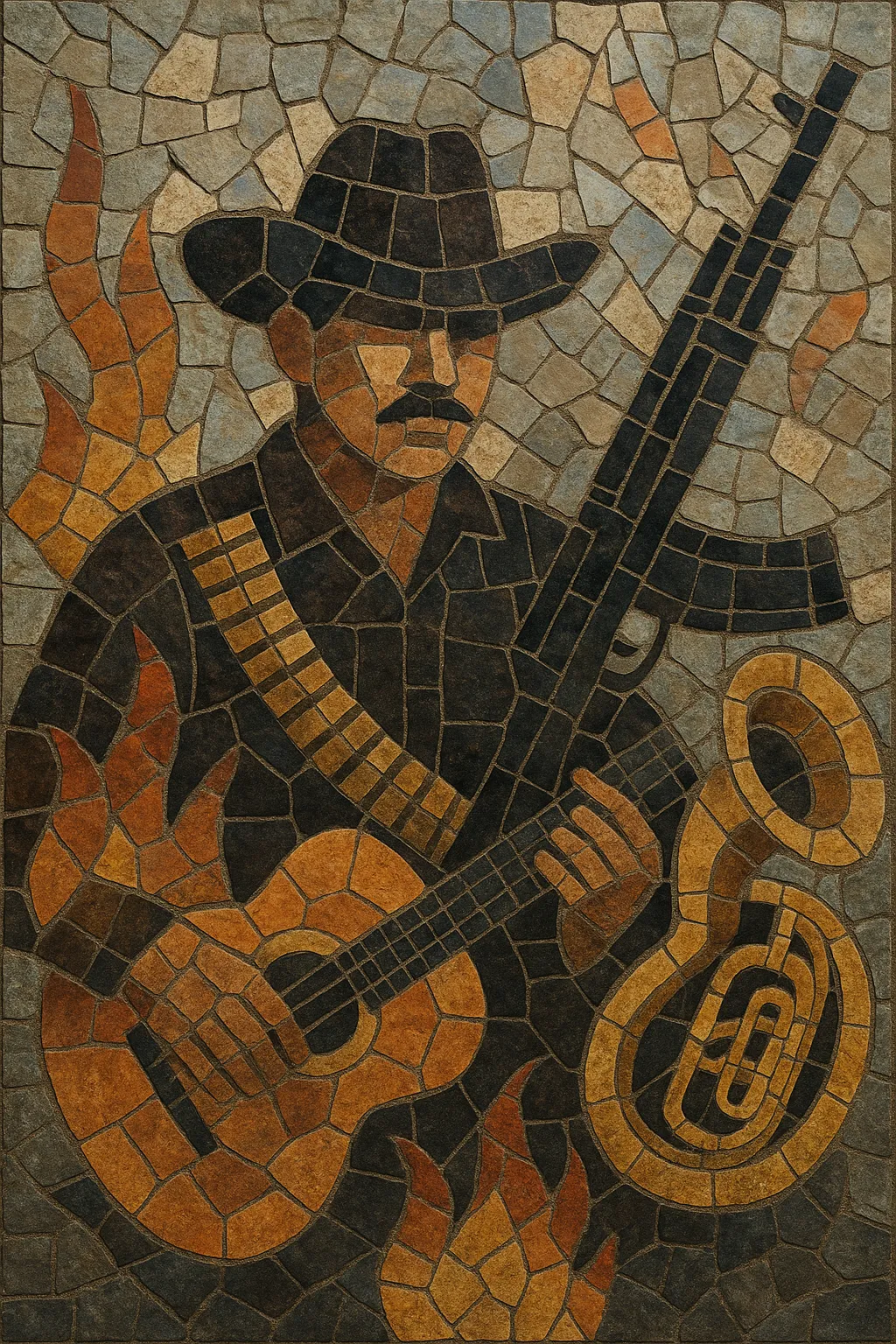
Corridos bélicos are a contemporary, hard-hitting branch of the Mexican corrido that foregrounds militaristic imagery, aggressive bravado, and street-informed swagger. The sound keeps the acoustic backbone of regional mexicano—sierreño trios, norteño/banda textures—while adopting the lyrical posture, ad‑libs, and urgency of trap and hip hop.
Typical arrangements feature requinto and harmony guitars, tololoche or electric bass, snare-driven grooves, and sometimes tuba for low-end punch. Melodies skew minor or modal, with rapid ornamental runs, call‑and‑response riffs, and terse, talk‑sung vocal cadences. Thematically, songs chronicle power, risk, and status symbols, often coded in “bélico” (war-like) aesthetics—tactical gear, convoys, radios—delivered with taut, forward momentum.


History
Corridos bélicos grow out of a long corrido tradition (story-songs of heroes, outlaws, and social reality) and its late-20th/early-21st-century variants. Narcocorridos and the high-adrenaline Movimiento Alterado era pushed lyrical intensity and bellicose themes, while sierreño and norteño/banda ensembles refined the acoustic language that would underpin the new wave.
In the late 2010s, younger artists began fusing corrido storytelling with the posture and production sensibilities of trap—a current that coalesced in corridos tumbados. Within that space, a more militant, faster, and sharper-edged style emerged: corridos bélicos. The term “bélico” (war-like) codified a lyrical and visual aesthetic—tactical motifs, operational slang, and terse delivery—paired to propulsive polka-derived grooves and minor-key riffs.
From 2021 onward, acts based in Mexico and Mexican-American hubs (especially Southern California) propelled the sound to streaming charts. High-profile collaborations and viral singles in 2022–2023 amplified international visibility, with guitar-led corridos heard alongside urbano hits on major playlists. Media attention focused on the contrast between traditional instruments and the modern, confrontational stance.
While the music’s energy and craft earned wide audiences, lyrics sparked debate regarding glorification of violence and illicit economies. Many artists navigate this with allegory, coded language, or character-driven narratives. Musically, corridos bélicos continue to hybridize—folding in denser percussion, studio punch, and crossovers that paved the way for fusions like electro corridos and “bélico” flavors in dembow and reggaetón.
• Acoustic string core (requinto + segunda), snare-forward drive, optional tuba/tololoche.
• Minor/modal riffs, fast ornamental passages, unison thirds/sixths, and rhythmic stabs.
• Short, declarative vocal lines, ad-libs, and hooky gang responses.
• Lyrical focus on power, readiness, status, and risk, filtered through “war-like” codes.
• Requinto (lead 12‑string or high‑tension acoustic) for riffs, tremolos, and fills.
• Segunda/rhythm guitar to lock the groove with steady down-up strokes.
• Bass foundation via tololoche or electric bass; add tuba for heavier low end.
• Drums/percussion centered on snare (2/4 accents), rimshots, and occasional cymbal lifts; claps and stomps can add hype.
• Start with a brisk corrido/norteño pulse in 2/4 or 4/4 at ~95–120 BPM (feels fast due to subdivision).
• Emphasize strong beats with snare pops; inject off‑beat guitar chucks and bass walk-ups for momentum.
• Use breaks and shout-cues before drops to heighten tension and “bélico” impact.
• Favor minor keys and modal colors (Aeolian, Dorian); progressions often revolve around i–VII–VI–V or i–iv–V.
• Requinto hooks use rapid slides, mordents, trills, and parallel thirds/sixths.
• Arrange call‑and‑response between lead guitar and voice; punctuate phrases with unison stabs.
• Deliver verses in tight, speech-like cadences with assertive projection; sprinkle ad‑libs and crew shouts.
• Write concise, image-driven lines using coded “bélico” vocabulary (readiness, logistics, convoy/gear metaphors) rather than explicit detail.
• Hooks should be short, repeatable, and slogan-like.
• Keep strings upfront and dry; use subtle compression and transient shaping on snare for crack.
• Double or triple guitars for thickness; pan for stereo width while preserving a live feel.
• Drop out rhythm briefly before hook entries; use gang vocals to mark key lines.
• Maintain tight timekeeping between requinto and snare; dynamics matter—dig in on choruses.
• Let the bass/tuba articulate transitions (walk-ups, turnarounds) to signal form changes.
• Stage presence should match the music’s urgency—short cues, head-nods, and coordinated hits.