Your digging level
Description
Oriental classical is an umbrella label used in the West for the courtly and urban "art music" traditions of the Eastern Mediterranean and Middle East, especially the Ottoman/Turkish, Arab, and Persian classical lineages. It is modal rather than functional-harmonic, built on families of maqam/makam/dastgah that define characteristic scales, intonations (including microtones), cadences, and melodic pathways.
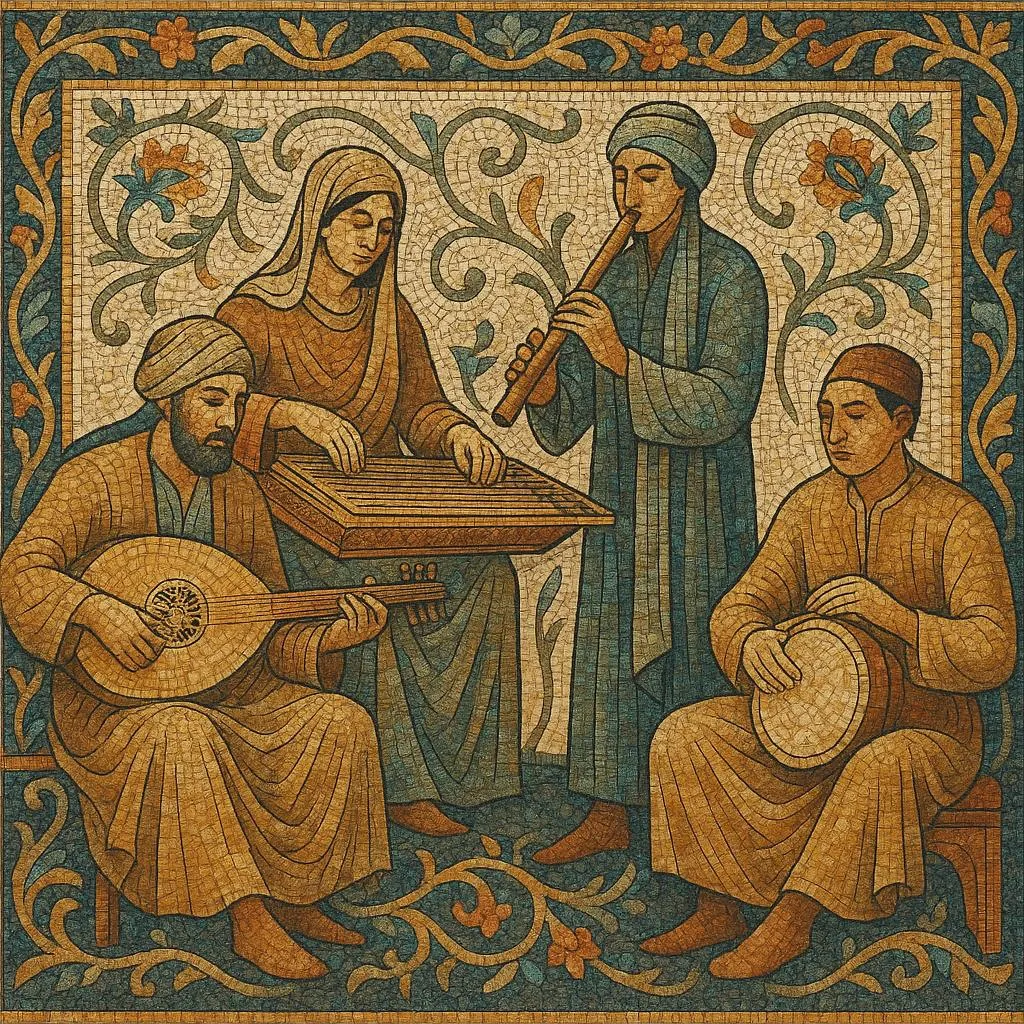
Performance is typically heterophonic: a small ensemble (takht/ince saz) of melodic instruments such as oud, qanun, ney, kamancheh/violin, santur/tar, and a light percussion team (riqq, darbuka, daf) render the same melody with individual embellishment. Repertoire alternates between composed forms (peşrev, semai, samai, longa, muwashshah, peshrev/semai) and unmetered/metrical improvisations (taqsim/taksim/avaz). Rhythmic organization relies on cyclical iqaʿ/uşûl patterns (e.g., samai thaqil 10/8), ranging from languid to dance-like grooves.
Across regions, the aesthetics prize vocal melisma, nuanced ornamentation (trills, slides, mordents), and expressive modulations (sayr/seyr) within and between modes, producing long-arched melodies that can feel devotional, romantic, contemplative, or exalted.
History
The roots of Oriental classical lie in the medieval and early modern courts and cosmopolitan cities of the Eastern Mediterranean and Iran. Theory and practice coalesced around modal systems: Ottoman makam, Arab maqam, and Persian dastgah/avaz. Learned chant traditions (e.g., Byzantine) and Andalusian continuities in North Africa supplied melodic and poetic frameworks, while Sufi orders nurtured refined performance practices.
By the 1700s–1800s, composers and master-performers standardized forms and cycles. In the Ottoman realm, composers such as Sultan Selim III and Hammamizade Dede Efendi codified long-form suites and usul rhythms; instrumental geniuses like Tanburi Cemil Bey expanded the expressive possibilities of taksim. In Arabic centers (Cairo, Aleppo), wasla/suite structures and muwashshahat flourished; in Persia, radif repertoires were curated and transmitted as canonical pathways through modes.
Early recording and radio amplified the reach of star vocalists and composers. In Egypt, Umm Kulthum, Mohamed Abdel Wahab, and Riyad Al Sunbati fused classical maqam craft with orchestral modernity. In Iran, the radif was taught systematically; later, artists like Mohammad-Reza Shajarian and Hossein Alizadeh advanced performance and composition. In Iraq, oud master Munir Bashir globalized the lyricism of maqam, while Levantine and North African schools preserved local suites and nawba traditions.
Revival movements, university programs, and festivals have revitalized archival repertoires and historical tunings. At the same time, the idiom influences jazz, rock, and electronic scenes (Arabic jazz, oriental metal, ethnic electronica), while historically informed ensembles foreground period instruments and heterophony. Digital platforms now connect diverse sub-lineages under the broad, if imprecise, label "oriental classical."
-
•
Draft an unmetered taqsim that outlines the mode’s key ajnas and resting notes.
•Compose a peşrev/bashraf in a 4- or 8-beat usûl introducing core motifs.
•Write a samai/semai (10/8) that develops motifs and plans one expressive modulation.
•Add a concluding longa (fast 2/4 or 4/4) to release energy.