Your digging level
Description
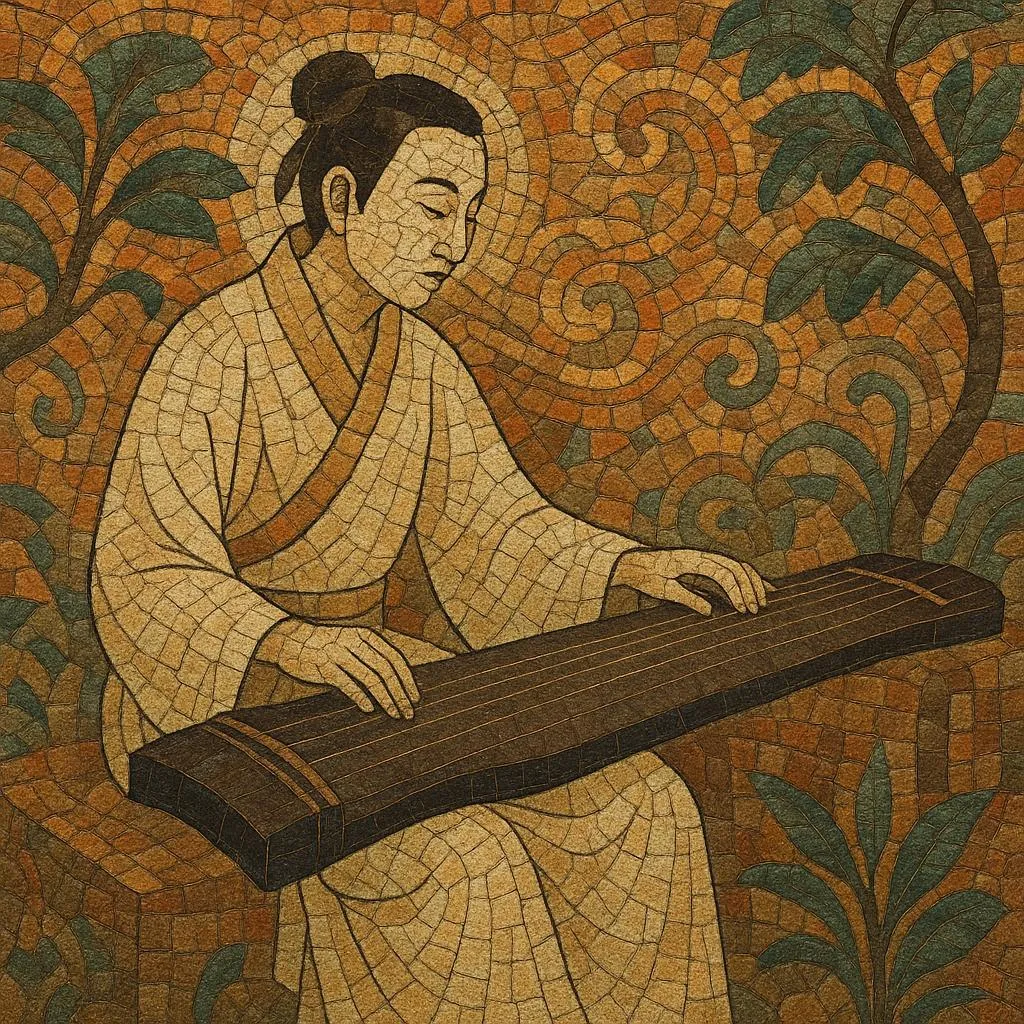
Guqin is the ancient Chinese seven‑string long zither, emblematic of the scholar‑official (literati) tradition and associated with self‑cultivation, poetry, and quiet contemplation. Historically strung with silk (now often nylon‑metal), it is played with a wide palette of right‑hand plucks and left‑hand slides, vibrati, and controlled harmonics on an unfretted wooden board.
Musically it favors pentatonic modes, flexible pulse, and nuanced timbral shading over loudness or overt virtuosity. Three primary sound categories structure its technique: open strings (san yin), stopped tones (an yin), and bell‑like harmonics (fan yin). Repertoire is transmitted through detailed tablature (jianzipu) that encodes fingering, positions, and ornamentation rather than staff notation, inviting interpretive freedom and meditative pacing.
History
References to the qin (later guqin) appear in classical Chinese texts and archaeological finds from the pre‑Qin era, with playable instruments evidenced by the Warring States period. By the Han and Tang dynasties its construction (long, hollow wooden body with seven strings) and aesthetics were largely codified, and its quiet, intimate sound aligned with Confucian, Daoist, and poetic ideals of cultivation and restraint.
From the Tang onward, detailed tablature traditions matured, culminating in jianzipu (abbreviated character tablature) that specifies string, position, right/left‑hand techniques, and ornaments while leaving rhythm and phrasing to the performer. This notation supported the guqin’s role as a literati art practiced alongside calligraphy and poetry, often performed solo or in small gatherings.
Across the Song, Yuan, Ming, and Qing dynasties, stylistic lineages (often named for locales or masters—e.g., Guangling, Yushan, Zhucheng, Mei’an) curated and transmitted signature versions of core pieces. Canonical works such as "Meihua Sannong" (Plum Blossom), "Guangling San," and "Liu Shui" (Flowing Water) circulated in printed pu (tablature collections) and hand‑copied manuscripts, each lineage emphasizing distinct touch, timbre, and phrasing.
The early 20th century saw disruptions to court and literati culture, but master performers and researchers safeguarded the art through societies, recordings, and documentation. After mid‑century challenges, conservatories and guqin associations helped revive pedagogy and instrument making. Notably, a guqin performance of "Flowing Water" was included on NASA’s 1977 Voyager Golden Record, symbolizing the instrument’s global cultural significance.
Since the 1980s a broad revival has brought new performers, research, and instrument craftsmanship. The tradition was proclaimed by UNESCO in 2003 (and later inscribed on the Representative List of the Intangible Cultural Heritage of Humanity), affirming its value. Today the guqin thrives as a solo art, in chamber settings with xiao (end‑blown flute) or voice, and as a refined timbre in contemporary composition and cross‑genre collaborations.