Your digging level

For this genre
0/8
🏆
Sign in, then listen to this genre to level up

Description

Mazandarani folk (also called Tabari music) is the traditional music of Mazandaran, a lush Caspian Sea province in northern Iran. Sung largely in the Mazandarani/Tabari language, it carries call-and-response refrains, narrative ballads, pastoral shepherd songs, and vigorous dance tunes tied to harvests, weddings, and communal feasts.

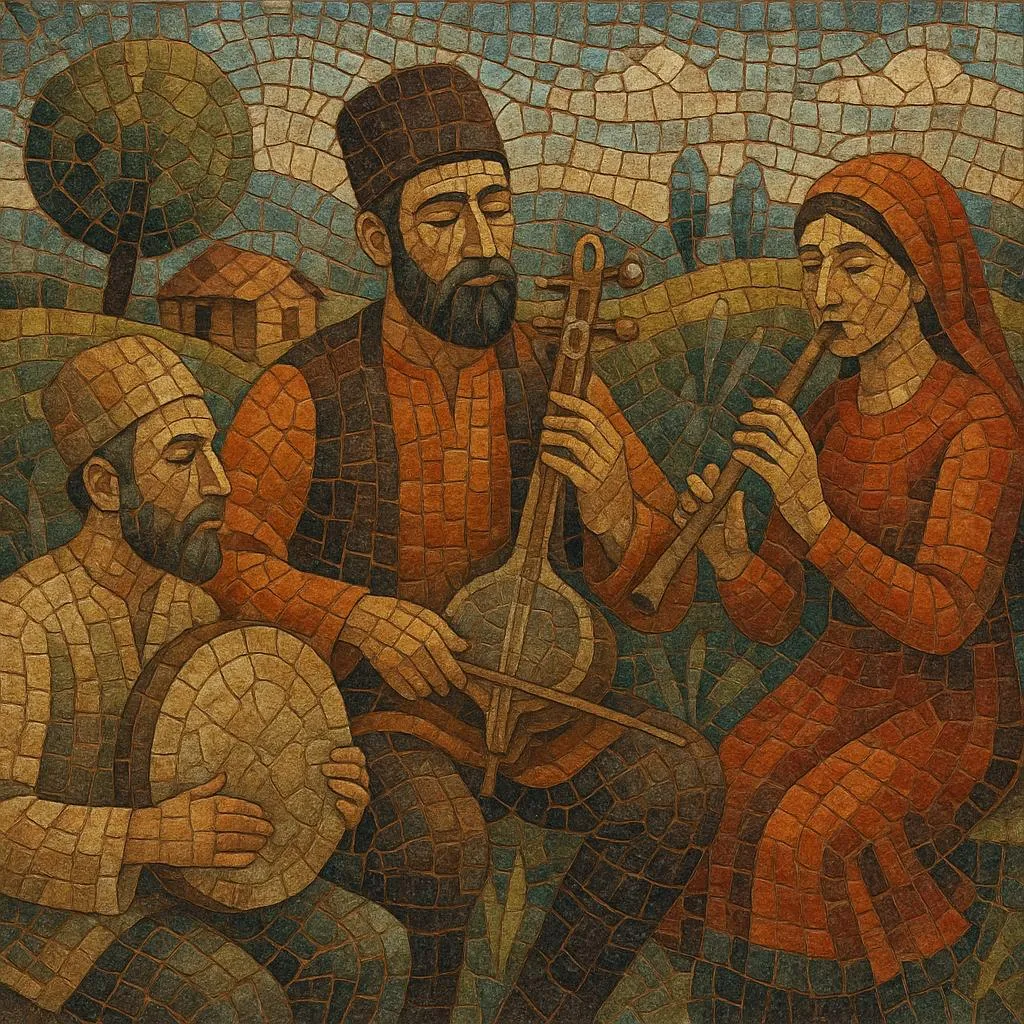
Melodically it blends regional modes with Persian modal thinking, but with distinct local flavors, pentachordal cells, and narrow-ranged, ornamented vocal lines. Common instruments include kamancheh (spike fiddle), ney-labak/laleva (end-blown reed flute), dotar and setar (plucked lutes), dayereh/daff (frame drums), tombak, and outdoor sorna–dohol pairs for ceremonies. Forms such as Amiri (epic/narrative), Katuli (lyrical), Kermāshō (dance song), harvest chants, and lullabies (Lalaei) are characteristic.


Sources: Spotify, Wikipedia, Discogs, RYM, MB, user feedback and other online sources

History

Early roots and oral memory

Mazandarani folk developed as the sung memory of farming and forest communities along the southern Caspian coast. Its verse often references rice paddies, mountain pastures, and sea life. For centuries the style was transmitted orally by village singers, shepherds, and wedding bands, with regional substyles shaped by local dialects and work cycles.

19th–early 20th century documentation

In the 1800s and early 1900s, travelers and later Iranian scholars began documenting the northern folk repertoires. The rise of urban printing and early radio fostered broader awareness of Mazandarani melodies, while local poet-song traditions (e.g., Amiri narratives linked to the poet Amir Pazevari) remained central to identity.

Mid–late 20th century revival

From the mid‑20th century, folklorists and conservatory-trained musicians recorded village singers and arranged Mazandarani songs for stage ensembles, preserving forms like Katuli and Kermāshō. Provincial cultural troupes emerged, and broadcasts helped cement the style within Iran’s mosaic of regional musics.

Contemporary practice and fusion

Today the genre thrives in community celebrations, provincial festivals, and recordings that balance field authenticity with modern arrangements. Younger artists often retain Tabari lyrics and signature instruments (kamancheh, laleva, frame drums) while exploring new harmonizations, chamber settings, or world-fusion contexts.

How to make a track in this genre

Scales, melody, and voice
•   Start with narrow-ranged, stepwise melodies in a Mazandarani/Tabari text setting. Favor modal centers that feel related to Persian dastgāh thinking (e.g., Bayat-ish colors), but keep folk cadences and short, repetitive cells. •   Ornament vocal lines with grace notes, slides, and a lightly nasal timbre; allow call-and-response between a lead singer and chorus.
Rhythm and form
•   Alternate free-rhythm narrative verses (e.g., Amiri) with measured dance sections (e.g., Kermāshō). Use cyclic meters like 6/8 or 2/4 for dances, and freer parlando rubato for storytelling. •   Build strophic forms with refrains; insert vocables and communal shouts for dance energy.
Instrumentation and texture
•   Core palette: kamancheh (melodic lead), laleva/ney-labak (shepherd flute), dotar or setar (drone/ostinato), dayereh/daff and tombak (groove), and sorna–dohol pairs for ceremonial outdoor pieces. •   Arrange heterophonically: multiple instruments elaborating the same tune with individual ornaments.
Lyrics and imagery
•   Write in Mazandarani/Tabari or weave in local lexical color. Themes: love and longing, rice harvests, forests and mountains, sea journeys, communal rites, and humorous social vignettes.
Production tips (modern settings)
•   Keep vocals forward and intimate; minimal reverb suggests village acoustics. •   If fusing, layer subtle strings or drone synths under acoustic kamancheh and frame drums; avoid overpowering the folk pulse.

Top tracks

Locked
Share your favorite track to unlock other users’ top tracks

Upcoming concerts

in this genre
Influenced by
Has influenced
No genres found

Download our mobile app

Get the Melodigging app and start digging for new genres on the go
© 2026 Melodigging
Melodding was created as a tribute to Every Noise at Once, which inspired us to help curious minds keep digging into music's ever-evolving genres.
Buy me a coffee for Melodigging